TL;DR

Get health and wellness essentials delivered free with Prime
- Fast, free delivery on millions of items
- Prime Video, Amazon Music and more included
- Member-only deals all year
A bedroom humidifier adds moisture to indoor air and can ease dryness in your nose, throat, skin, and lips, especially during heating season. Aim for 30–50% relative humidity, choose an ultrasonic or evaporative model based on your water hardness and noise tolerance, and clean the tank regularly — a dirty humidifier can send microbes and mineral dust into the air you breathe all night.
You wake up at 3 a.m. with a throat like sandpaper and lips so dry they crack when you yawn. That’s January in a heated home for you — indoor relative humidity can drop below 20% when the furnace runs full tilt, which is drier than most deserts.
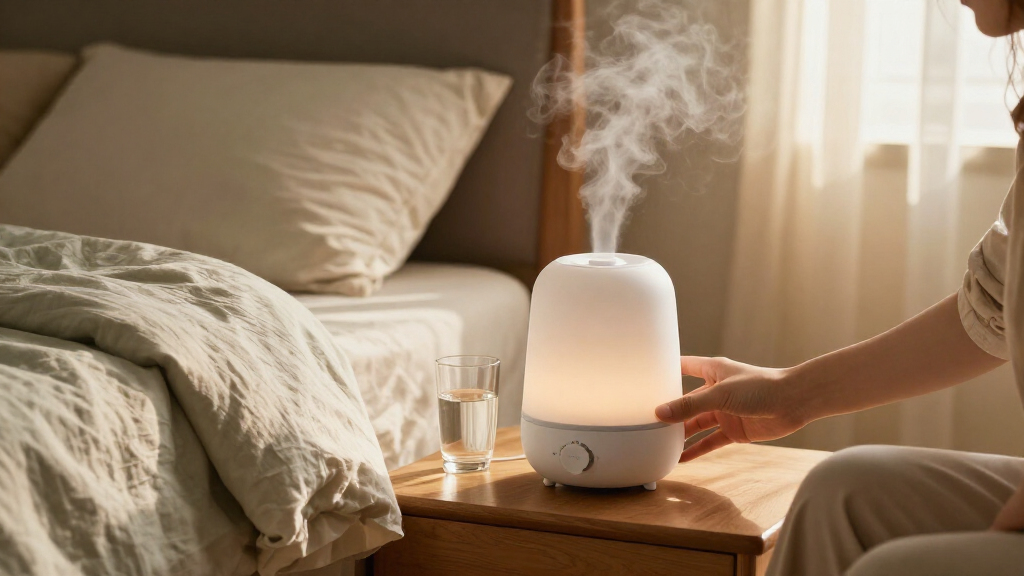
A bedroom humidifier adds moisture to the air and can genuinely take the edge off that dryness. But it’s not a magic health gadget, and a neglected one can make your air worse. People commonly use one when the air feels dry, and for many sleepers it becomes a winter staple next to the bed.
Here’s what you’ll learn: what humidity level to actually target, which type of humidifier fits your bedroom, where to put it, and how to clean it without turning it into a petri dish. Real numbers, real tradeoffs, no fluff.
Target 30–50% relative humidity and verify it with a $10 hygrometer across the room — built-in sensors only read conditions next to the unit.
Pick ultrasonic if you value silence (use distilled water in hard-water areas), or evaporative if you want self-regulating output and no white dust.
Skip warm-mist models in homes with kids or pets — steam and hot water pose burn risks with no added health benefit.
Empty and air-dry the tank daily; deep-clean every 3 days following the manual, or the unit aerosolizes bacteria into your sleeping air.
A humidifier soothes dryness symptoms but does not prevent or cure colds, flu, or allergies — persistent symptoms warrant a doctor’s visit.
The Magic Number: Why 30–50% Humidity Is Your Target
The sweet spot for bedroom humidity is 30–50% relative humidity, and the range exists because both directions carry real costs. Below 30%, the air doesn’t just feel dry — it actively pulls moisture from your skin, lips, and airways, which is why your throat feels raw by morning and your skin itches after a heated night. Dry air also dries out the mucous lining of your nose, and that lining is one of your body’s first defenses against airborne irritants, so you may notice more congestion and nosebleeds in deep winter. Above 50%, you’ve built a luxury condo for mold and dust mites — organisms that don’t just sit there but become permanent residents triggering allergies and asthma — and condensation starts fogging your windows like a teenager’s shower bathroom.
Here’s the catch most people miss: your humidifier’s built-in sensor measures the air right next to the unit, not across the room where your head actually is. Because mist concentration is highest near the outlet, the machine can read “target reached” while the rest of the room is still desert-dry — or, worse, the machine keeps pushing while the far corner quietly climbs into mold territory. The corner by the nightstand might read 45% while the far wall sits at 55%. A separate hygrometer — a $10 humidity gauge — placed across the room gives you an honest reading.
Picture it like a thermostat mounted directly over a heating vent: technically working, practically useless. Trust the remote reading, not the one on the tank.
Simple rule of thumb: if your bedroom windows fog up in the morning or surfaces feel damp, your humidity is too high — turn the output down immediately.
Winter makes this a moving target, and that’s the part that trips people up. Heating season strips moisture from indoor air — every time the furnace warms cold outdoor air, its relative humidity plummets — so a setting that works in October may over-humidify by February, or the reverse if your heating habits change. Humidity isn’t a set-and-forget number; it’s a weekly check-and-adjust routine. The practical implication: budget five minutes a week for the hygrometer check, and treat any reading outside 30–50% as a dial adjustment, not a crisis.
Products Worth Considering

Levoit Vital 100S-P Air Purifier with Washable Pre-Filter

Oral-B iO5 Rechargeable Electric Toothbrush with 5 Cleaning Modes and Travel Case, White

Oral-B iO Series 3 Rechargeable Electric Toothbrush for Adults, Black, 3 Modes, 2 Brush Heads and Travel Case
As an affiliate, we earn on qualifying purchases.
Ultrasonic vs. Evaporative vs. Warm Mist: Which Type Fits Your Bedroom
Humidifiers for bedrooms come in four main types, and the differences matter more than the marketing suggests. That’s because each type solves a different bottleneck — noise, minerals, or overshoot — and the wrong match doesn’t just underperform, it creates a new problem you didn’t have before. The right pick depends on your water hardness, noise tolerance, and whether small kids or pets share the room.
Ultrasonic models vibrate water at high frequency to make mist. They’re whisper-quiet — often under 30 decibels, quieter than a soft whisper — which is why they dominate the bedroom category. The tradeoff is mechanical, not fixable by brand: ultrasonic units don’t filter anything, so with hard tap water they spray fine mineral particles into the air, leaving “white dust” on furniture and, potentially, in your lungs. If your water is hard, the real cost of an ultrasonic unit is either distilled water purchases or living with the dust — factor that in before buying on silence alone.
Evaporative models blow air through a wet wick filter. Their killer feature is physics-based self-regulation: as room humidity rises, the air absorbs less water from the wick, so output naturally drops. That makes overshooting toward 60% genuinely difficult — a real advantage if you’re worried about mold but won’t monitor a hygrometer. The costs are a fan that makes noise (a dealbreaker for light sleepers) and a wick that needs replacing every month or two, which adds $10–20 per season and stops the unit dead if you forget — a clogged wick means zero output, not reduced output.
| Type | Noise | Main Drawback | Best For |
|---|---|---|---|
| Ultrasonic | Very quiet | White dust with hard water | Light sleepers, soft-water areas |
| Evaporative | Fan noise | Filter replacement costs | Self-regulating safety |
| Warm mist | Quiet | Burn risk from hot water and steam | Households without kids or pets |
| Impeller | Quiet | Mineral dispersal, like ultrasonic | Budget buyers in soft-water areas |
Warm-mist humidifiers boil water into steam. The boiling does kill microbes in the tank, which sounds appealing until you weigh it against the rest: they consume significantly more electricity than cool-mist types, they have no general health advantage over cool mist, and the EPA and CPSC both flag burn risks — a tipped-over unit full of just-boiled water is a real hazard near a curious toddler or a cat that walks counters. In practice, the microbe-killing benefit is marginal if you clean any humidifier properly, which makes warm mist a niche choice: reasonable for a child-free, pet-free household that values quiet and doesn’t mind the power draw.
Where to Put It: Placement Mistakes That Ruin Both Your Humidifier and Your Furniture
Place a bedroom humidifier on a stable, water-resistant surface with at least a foot of clearance on all sides, and aim the mist away from beds, walls, curtains, and electronics. That’s the short version. Here’s why each part matters — because placement isn’t about tidiness, it’s about whether the moisture actually reaches the air instead of soaking something expensive.
The core principle: mist needs room to evaporate into air. When it hits a surface before evaporating, you get condensation — and condensation is just humidity delivered to the wrong place. Direct the mist toward your bed and you’ll wake up to a damp pillow and a cold, clammy patch of sheets; prolonged moisture on fabric invites mold within days, and a moldy mattress is a replacement, not a cleanup. Aim it at the wall and you may find peeling paint or a water stain a few weeks later, because paint and drywall absorb what the air was supposed to take. Mist near a TV or laptop, and you’re gambling with condensation inside expensive circuitry — a risk that’s invisible until the device fails months later, which is why it’s one of the costliest placement mistakes.
Height matters too, for the same reason. A unit on the floor blows mist into carpet and furniture before it can disperse — the moisture gets absorbed by the rug instead of reaching the air you breathe. A nightstand or a dresser at roughly 2–3 feet off the floor lets the mist travel through open air and mix properly. Just put a waterproof tray or mat underneath — even new units weep condensation, and a warped nightstand is a preventable loss.
- Choose a flat, water-resistant surface at least 2 feet off the floor.
- Keep 12 inches of clearance around the mist outlet.
- Aim mist into open air, away from beds, walls, and electronics.
- Run a hygrometer across the room to verify the real humidity level.
Sizing follows placement, and it’s a tradeoff rather than a rule. A humidifier rated for 300 square feet will struggle in a 500-square-foot master bedroom: it runs constantly, empties its tank nightly, and may never hit your target — you pay the maintenance burden of a humidifier without getting the benefit. But an oversized unit in a tiny nursery carries the opposite risk: it can push humidity past 60% fast, and a small room gives you less margin for error before you’re in mold territory. Slightly undersized is safer than oversized, because you can always run it longer — you can’t easily undo over-humidification.
The Cleaning Schedule That Separates Helpful Humidifiers From Health Hazards
A dirty humidifier is worse than no humidifier at all, and it’s worth understanding why rather than just accepting the rule. A humidifier works by turning tank water into airborne droplets — whatever is in the tank goes into the air. Standing water in a warm tank grows bacteria and mold within days, and the unit then aerosolizes that cocktail straight into the air you breathe, concentrated, for eight hours a night in a closed bedroom. Unlike a dirty countertop you can avoid touching, a dirty humidifier actively delivers its contamination to your lungs. That’s not fear-mongering — it’s basic microbiology plus physics.
Public-health guidance, including EPA recommendations, advises emptying and drying portable humidifiers daily and giving them a real cleaning every few days. The logic behind the daily empty: most microbes need standing water to multiply, so drying the tank each morning resets the clock every 24 hours. “Real cleaning” means following your manual — usually a vinegar soak to dissolve mineral scale (scale isn’t just ugly; it shelters microbes and forces the unit to work harder), plus disinfecting with a diluted bleach solution when the manufacturer allows it, followed by thorough rinsing, because residual bleach in a tank becomes airborne mist too.
Be honest with yourself about maintenance before buying — this is the single biggest predictor of whether a humidifier helps or harms you, bigger than brand or price. An ultrasonic unit with a top-fill tank and a wide opening is a five-minute job you’ll actually do at 11 p.m. A narrow-necked tank you can’t fit your hand into becomes a chore people abandon by February, and that’s exactly how units turn into biofilm factories. Pay a little more for the easy-to-clean design; it’s effectively buying your future self’s compliance.
- Daily: Empty the tank, rinse, and let it air-dry.
- Every 3 days: Clean following the manual — vinegar for scale, disinfectant if approved.
- Ongoing: Use distilled or demineralized water in ultrasonic units to cut white dust.
- Weekly: Check the hygrometer and your windows for condensation.
One note on trends: newer models advertise UV lights and antimicrobial coatings. These are conveniences, not substitutes, and it’s worth knowing why — UV light only sterilizes water it directly reaches, and antimicrobial coatings slow growth in one spot rather than eliminating it. Their effectiveness varies by design, and no feature replaces elbow grease. If a feature tempts you, ask whether it reduces your cleaning frequency or just your guilt.
What a Humidifier Can (and Can’t) Actually Do for Your Health
A bedroom humidifier can relieve symptoms of dryness — scratchy throat, dry nose, tight skin, cracked lips. It cannot prevent or cure colds, flu, COVID, or allergies, and anyone claiming otherwise is selling something. The distinction matters because it changes what you should expect: a humidifier is comfort care, not medicine. It addresses the environment that makes symptoms worse, not the infection or condition causing them. The evidence simply doesn’t support humidifiers as infection-fighters, despite the persistent folk wisdom that “moist air kills germs.”
Think of it like lip balm for your airways: soothing the chapping, not treating why you’re chapped. That analogy is useful for timing, too — if the dryness tracks with heating season and improves when humidity rises, a humidifier is a reasonable tool. If you wake up congested every morning in July when humidity is fine, the problem isn’t the air, and adding moisture won’t touch it — talk to a doctor about what’s actually going on, whether that’s allergies, reflux, or something structural.
For people with asthma or allergies, humidity is a double-edged sword, and the tradeoff is worth spelling out. Moderate moisture can ease irritated airways, but excess humidity feeds dust mites and mold, two of the most common indoor triggers — meaning the same machine that soothes you at 40% can set off an attack at 60%. If you’re asthmatic and considering a humidifier, monitoring humidity isn’t optional — it’s the whole game. The unit plus a hygrometer is a package deal; one without the other is a gamble with your airways.
A humidifier manages comfort, not illness. If symptoms persist or worsen, see a qualified healthcare professional rather than turning the dial higher.
Can you run one all night? Generally yes — if the unit is clean, used as directed, and your hygrometer shows the room staying under 50%. This is why the cleaning schedule earlier matters so much: overnight is exactly when the risk profile is worst, a closed bedroom, eight hours of continuous aerosolization, and no one awake to notice a musty smell. The risk isn’t the hours; it’s the tank you haven’t cleaned since Thanksgiving.
5 Features Worth Paying For (and 2 You Can Skip)
Humidifier features split cleanly into “makes daily life better” and “shiny but skippable.” The test that separates them is simple: does the feature reduce friction in the daily fill-and-clean loop, or does it just add novelty? Features that touch the loop pay for themselves; features that don’t, expire. After you’ve picked the right type, these are the upgrades that earn their price.
The winners:
- Top-fill design — you pour water in the top instead of flipping a heavy, dripping tank upside down over the sink every night. This matters more than it sounds: nightly refilling is the highest-frequency task, and every second of annoyance per fill compounds across an entire winter.
- Built-in humidistat with auto-shutoff — the unit stops itself at your target humidity instead of soaking the room. It’s a safety net, not a substitute for a remote hygrometer, but it caps the worst-case scenario of overnight over-humidification while you sleep.
- Wide tank opening — if your hand fits inside, cleaning takes minutes instead of becoming a dealbreaker. This single design detail is arguably the strongest predictor of long-term hygiene, because a tank you can actually scrub is a tank that gets scrubbed.
- Low noise rating — look for under 35 decibels if you’re a light sleeper; some ultrasonic units run near-silent. The implication: even “quiet” fans and gurgle from water movement vary between models, so check independent measurements, not box claims.
- Dimmable or hidden display — a bright LED readout at eye level can wreck your sleep almost as fast as dry air, which defeats the entire purpose of a bedroom unit. Sleep quality is the product here; don’t let the accessory undermine it.
The skips: app and voice control are genuinely fun for a week, then you use the physical button like everyone else — the unit is three feet from your head, so remote control solves a problem you don’t have. And essential-oil diffuser trays sound nice but carry a hidden cost: oils gum up the mechanism, can degrade plastic components, and often void warranties. The tradeoff math is bad — aromatherapy you could get from a $20 separate diffuser, risked against a $60+ humidifier. Use a dedicated diffuser if you want lavender mist.
Real example: a $60 top-fill ultrasonic model with a humidistat, used with distilled water and cleaned twice a week, will outperform a $180 smart unit that gets descaled once a season. The reason is structural, not lucky: humidifier performance is mostly a function of water quality and cleanliness, neither of which any price tier can automate away. Maintenance beats features, every time.
Frequently Asked Questions
What humidity level should a bedroom be at?
Aim for 30–50% relative humidity. Below 30%, air feels dry and irritates skin and airways; above 50%, you risk mold, dust mites, and window condensation. If windows fog up in the morning, lower the humidifier’s output immediately.
Can I leave a bedroom humidifier on all night?
Usually yes, provided the unit is clean, used per its manual, and the room stays within 30–50% humidity. A humidistat with auto-shutoff makes this safer. The overnight risk isn’t runtime — it’s a dirty tank aerosolizing microbes for eight hours.
Is tap water okay to use in a humidifier?
It depends on your model and local water hardness. In ultrasonic units, hard tap water creates white dust — airborne mineral residue. Distilled or demineralized water greatly reduces this buildup and also slows scale inside the tank.
How often should I clean my humidifier?
Public-health guidance recommends emptying and air-drying portable units daily and deep-cleaning every few days, following the manual. Vinegar dissolves mineral scale; a diluted bleach solution disinfects where the manufacturer allows it. Always rinse thoroughly before refilling.
Will a humidifier help with a stuffy nose or dry throat at night?
It can ease dryness-related irritation in the nose, throat, and lips, especially during heating season. It does not treat the underlying cause of congestion or illness. If symptoms persist or you have asthma or allergies, consult a healthcare professional — excess humidity can actually worsen triggers like mold and dust mites.
Conclusion
Buy the humidifier you’ll actually maintain. A modest ultrasonic or evaporative unit, filled with distilled water if your tap is hard, cleaned a couple of times a week, and watched with a cheap hygrometer, will outperform any feature-stuffed model you neglect by mid-January. That’s the whole strategy: right type, right placement, 30–50% humidity, honest cleaning.
Tonight, when the furnace kicks on and your lips start to crack, you’ll know exactly what to do — and just as important, what not to overdo. Sweet dreams start with balanced air, not a swamp.