For an NDIR CO2 monitor for an apartment, I’d start with the Aranet4 as the best overall pick for buyers who want a focused, portable CO2 monitor, while the GoveeLife H5140 stands out for a display, alarm, and connected features, and the INKBIRDPLUS Indoor NDIR Monitor offers a simpler CO2, temperature, and humidity approach. The main tradeoff is whether you want a clear reading in one room, extra air-quality measurements, or app-based tracking. A larger screen and more sensors can add convenience, but they can also make a monitor less portable and its readings harder to interpret at a glance. I compare all 14 options by sensor approach, usability, apartment fit, and feature tradeoffs below. Continue reading for the full breakdown and help matching a monitor to your rooms and routine.

Get health and wellness essentials delivered free with Prime
- Fast, free delivery on millions of items
- Prime Video, Amazon Music and more included
- Member-only deals all year
Key Takeaways
- Dedicated CO2 readings make the clearest comparison. Models such as the Aranet4 and the NDIR-focused INKBIRDPLUS and YOWEXA monitors keep the main decision centered on CO2 rather than a long list of air-quality readings.
- More measurements do not automatically mean a better apartment monitor. The Lecoolife 16-in-1 and Lwyinp 10-in-1 appeal to buyers seeking a broad display, but buyers should check which measurements are directly sensed and which are calculated.
- Display and alert choices shape everyday usability. The GoveeLife H5140 emphasizes an alarm and connected functions, while simpler monitors are better suited to checking a room without setting up an app.
- Portable models fit changing room needs. The Temtop portable monitor and INKBIRDPLUS PTH-10C can suit buyers who want to move a device between spaces, unlike a monitor chosen mainly for a fixed display setup.
- The lineup spans simple readings to more involved tracking. The YOWEXA 24-hour-history model and SwitchBot Meter Pro offer different ways to review conditions, while the BREATHE Airmonitor Plus Gen 2 and Aranet4 sit among options for buyers who prioritize broader or more connected monitoring.
| INKBIRDPLUS Indoor NDIR CO₂ Air Quality Monitor with Temperature and Humidity |  | Best Portable CO₂-First Pick | Model: PTH-9C | Measurements: CO₂, temperature, and humidity | Sensor: NDIR CO₂ sensor | VIEW ON AMAZON | See Our Full Breakdown |
| YOWEXA CO2 Monitor with NDIR Sensor and 24-Hour History | 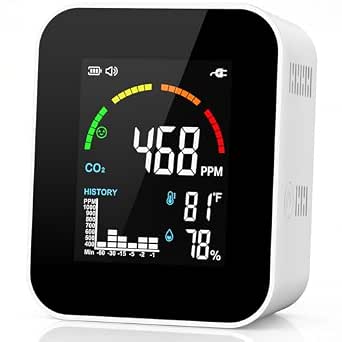 | Best for Short-Term CO₂ Trends | Measurements: CO₂, temperature, and humidity | Sensor: NDIR with automatic and manual calibration | CO₂ measurement interval: 4 seconds when connected to USB | VIEW ON AMAZON | See Our Full Breakdown |
| Lecoolife 16-in-1 Indoor Air Quality Monitor with 7-Inch Display |  | Best Large-Screen Multi-Pollutant Monitor | Model: AK22B | Measurements: CO₂, PM1.0, PM2.5, PM10, HCHO, TVOC, temperature, humidity, and AQI | Display: 7-inch screen with adjustable brightness | VIEW ON AMAZON | See Our Full Breakdown |
| GoveeLife H5140 Smart Air Quality Monitor with CO₂ Detector, Display, and Alarm |  | Best for Connected Long-Term Tracking | Model: H5140 | Sensor: SCD4x photoacoustic NDIR CO₂ sensor | CO₂ accuracy: ±(40 ppm + 5%) | VIEW ON AMAZON | See Our Full Breakdown |
| INKBIRDPLUS 6-in-1 NDIR Indoor Air Quality Monitor |  | Best Battery-Powered Air-Quality Bundle | Model: NDIR Air Quality Monitor | Measurements: CO₂, PM2.5, PM10, AQI, temperature, and humidity | Power: Battery powered | VIEW ON AMAZON | See Our Full Breakdown |
| SwitchBot Meter Pro CO2 Indoor Air Quality Monitor |  | Best Overall for Apartment Readability | Sensor: Swiss-made NDIR | CO2 measuring range: 400–9,000 ppm | CO2 accuracy: ±(50 ppm + 5% of reading) | VIEW ON AMAZON | See Our Full Breakdown |
| BREATHE Airmonitor Plus Gen 2 Indoor Air Quality Monitor |  | Best for Broader Air-Quality Tracking | Measurements: CO2, PM1, PM2.5, PM10, TVOC, formaldehyde (HCHO), temperature, and humidity | CO2 sensor: NDIR | Particle sensor: Laser | VIEW ON AMAZON | See Our Full Breakdown |
| Temtop Portable Indoor CO₂ Monitor with Temperature and Humidity |  | Best for Simple, Portable Room Checks | Model: C1 | Sensor type: Photoacoustic | CO2 measurement range: 400–5,000 ppm | VIEW ON AMAZON | See Our Full Breakdown |
| INKBIRD IAM-O2 Indoor Air Quality Monitor |  | Best for Long Intervals Between Charges | Model: IAM-O2 | Measurements: CO2, temperature, and humidity | CO2 measurement range: 0–9,999 ppm | VIEW ON AMAZON | See Our Full Breakdown |
| YOWEXA CO2 Monitor with NDIR Sensor |  | Best for a Clear CO2 Alarm on USB Power | Model: YEM-42-LF | Sensor: NDIR | CO2 measurement range: 400–10,000 ppm | VIEW ON AMAZON | See Our Full Breakdown |
| Lwyinp 10-in-1 Indoor Air Quality Monitor |  | Best for Broad Air-Quality Checks | Model: MT13S | Measurements: CO2, HCHO, TVOC, AQI, PM2.5, PM1.0, PM10, temperature, humidity, and time | Connectivity: Bluetooth | VIEW ON AMAZON | See Our Full Breakdown |
| INKBIRDPLUS Portable CO2 Detector with NDIR Sensor and Color LCD (PTH-10C) |  | Best for Portable CO2 Alerts | Model: PTH-10C | Sensor type: NDIR | CO2 measurement range: 400–5000 ppm | VIEW ON AMAZON | See Our Full Breakdown |
| INKBIRD IAM-T2 Indoor Air Quality Monitor with CO₂, Temperature, and Humidity |  | Best for App-Based Room Tracking | Model: IAM-T2 | Measurements: Carbon dioxide, temperature, and humidity | Display: Backlit LCD | VIEW ON AMAZON | See Our Full Breakdown |
| Aranet4 Indoor Air Quality Monitor with Wireless CO₂ Detector | 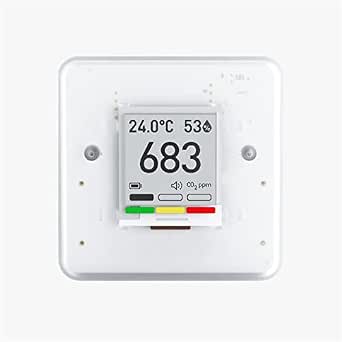 | Best for Low-Maintenance Monitoring | Model: TDSPC003.001 | Measurements: CO2, temperature, relative humidity, and atmospheric pressure | Sensor technology: NDIR | VIEW ON AMAZON | See Our Full Breakdown |
| ndir co2 monitor for apartment | Model | Measurements | Display |
|---|---|---|---|
| INKBIRDPLUS Indoor NDIR CO₂ Ai | PTH-9C | CO₂, temperature, and humidity | LED screen |
| YOWEXA CO2 Monitor with NDIR S | — | CO₂, temperature, and humidity | 3-inch LCD; 1-second refresh; three adjustable backlight levels |
| Lecoolife 16-in-1 Indoor Air Q | AK22B | CO₂, PM1.0, PM2.5, PM10, HCHO, TVOC, temperature, humidity, and AQI | 7-inch screen with adjustable brightness |
| GoveeLife H5140 Smart Air Qual | H5140 | CO₂, temperature, and humidity | — |
| INKBIRDPLUS 6-in-1 NDIR Indoor | NDIR Air Quality Monitor | CO₂, PM2.5, PM10, AQI, temperature, and humidity | Backlit color LED with date and time |
| SwitchBot Meter Pro CO2 Indoor | — | — | — |
| BREATHE Airmonitor Plus Gen 2 | — | CO2, PM1, PM2.5, PM10, TVOC, formaldehyde (HCHO), temperature, and humidity | Color display |
| Temtop Portable Indoor CO₂ Mon | C1 | — | — |
| INKBIRD IAM-O2 Indoor Air Qual | IAM-O2 | CO2, temperature, and humidity | — |
| YOWEXA CO2 Monitor with NDIR S | YEM-42-LF | — | — |
| Lwyinp 10-in-1 Indoor Air Qual | MT13S | CO2, HCHO, TVOC, AQI, PM2.5, PM1.0, PM10, temperature, humidity, and time | Color screen |
| INKBIRDPLUS Portable CO2 Detec | PTH-10C | — | Full-color LCD |
| INKBIRD IAM-T2 Indoor Air Qual | IAM-T2 | Carbon dioxide, temperature, and humidity | Backlit LCD |
| Aranet4 Indoor Air Quality Mon | TDSPC003.001 | CO2, temperature, relative humidity, and atmospheric pressure | E-ink |
More Details on Our Top Picks
INKBIRDPLUS Indoor NDIR CO₂ Air Quality Monitor with Temperature and Humidity
For an apartment buyer who mainly wants to check CO₂, this battery-powered NDIR monitor keeps the focus on the basics: CO₂, temperature, and humidity on an LED screen. Its customizable alarm can flag a stuffy room without requiring an app, and USB recharging makes it easier to move between a bedroom and living area than the AC-dependent GoveeLife H5140. Calibration support also gives owners a way to reset the sensor, though the process calls for 200 seconds in an open environment. The tradeoff is a narrower view of indoor air than the INKBIRDPLUS 6-in-1, which adds particulate readings and AQI. Its listed warning bands also meet at 700 and 1500 ppm, so the thresholds are not perfectly clear at those boundaries. Choose this for straightforward CO₂ checks, not broader pollution tracking.
Pros:- NDIR sensor measures CO₂ alongside temperature and humidity
- Customizable CO₂ alarm can draw attention to rising levels
- Battery power and USB input support moving it between rooms
- Calibration support and a hanging hole add setup flexibility
Cons:- Calibration requires 200 seconds in an open environment
- Listed CO₂ stages overlap at 700 and 1500 ppm
- Does not measure particulates or provide app-based history
Best for: Apartment residents who want a portable, app-free way to monitor CO₂, temperature, and humidity in more than one room.
Not ideal for: Buyers who want particulate or AQI readings, long-term app charts, or clearly separated alarm bands.
- Model:PTH-9C
- Measurements:CO₂, temperature, and humidity
- Sensor:NDIR CO₂ sensor
- CO₂ stages:Normal: 400–700 ppm; warning: 700–1500 ppm; dangerous: 1500–5000 ppm
- Power:Battery powered; USB input: 5 V, 1 A
- Display:LED screen
- Color:Black
Our verdict“Choose this portable monitor if CO₂ is your main concern and you do not need the broader readings or app history offered by other picks.”
YOWEXA CO2 Monitor with NDIR Sensor and 24-Hour History
The 24-hour CO₂ bar graph gives this YOWEXA a useful role for apartment dwellers trying to connect ventilation habits with changing readings. It measures CO₂, temperature, and humidity, refreshes its LCD every second, and takes CO₂ readings every four seconds while connected to USB. That trend view is more informative than the basic LED display on the INKBIRDPLUS PTH-9C, while automatic and manual calibration offer some flexibility. The compromise is its power setup: continuous monitoring needs USB power, and the backup battery is intended for power-saving emergency use, not daily operation. Its history is erased on restart, so it is not a lasting record like the GoveeLife H5140’s app history. This is a better fit for people who want a visible daily pattern than for anyone seeking unattended long-term logging.
Pros:- NDIR sensing with automatic and manual calibration
- 24-hour bar graph helps reveal daily CO₂ patterns
- Three backlight levels and visual indicators aid quick reading
- Alarm can be muted with the power button
Cons:- Continuous monitoring requires USB power
- History is erased when the device restarts
- Backup battery mode is not intended for everyday monitoring
Best for: Apartment renters who can keep the monitor plugged in and want to see how CO₂ changes over a day.
Not ideal for: People who need routine battery-powered monitoring or want historical records to survive a restart.
- Measurements:CO₂, temperature, and humidity
- Sensor:NDIR with automatic and manual calibration
- CO₂ measurement interval:4 seconds when connected to USB
- Display:3-inch LCD; 1-second refresh; three adjustable backlight levels
- History:24-hour CO₂ bar graph; data is lost when the device restarts
- Alarm threshold:1000 ppm
- Power:USB Type-C; backup battery supports up to 24 hours in power-saving mode
- Size:3 × 1.6 × 3.5 inches
- Temperature accuracy:±2 °F
Our verdict“Pick the YOWEXA if a clear one-day CO₂ trend matters more than portable daily use or persistent long-term history.”
Lecoolife 16-in-1 Indoor Air Quality Monitor with 7-Inch Display
If CO₂ is only one part of your apartment air-checking routine, the Lecoolife offers a much wider dashboard than the CO₂-focused INKBIRDPLUS PTH-9C. It tracks CO₂, particulate matter, HCHO, TVOC, temperature, humidity, and AQI, with a 7-inch screen that makes several readings easier to scan from across a room. Adjustable brightness and configurable audible alerts help tailor it to a living space, and the buzzer can be muted. That breadth comes with tradeoffs: perfumes and strong odors may affect sensor accuracy, and the supplied product details do not specify its power source or battery life. Compared with the GoveeLife H5140, it emphasizes on-device display and more pollutant categories rather than app charts, smart-home links, and long-term CO₂ history. It suits buyers who value a large local readout over connectivity.
Pros:- Tracks CO₂, particulate matter, HCHO, TVOC, temperature, humidity, and AQI
- Large 7-inch display presents readings together
- Adjustable brightness supports different room lighting
- Calibration support and a mute function offer useful control
Cons:- Perfumes and strong odors may affect sensor accuracy
- Power source and battery life are not specified in the provided details
- Larger screen and 1.5-pound weight take more space than compact monitors
Best for: Apartment households that want a large, easy-to-read screen covering CO₂ and several other indoor air indicators.
Not ideal for: Buyers seeking a compact CO₂-only monitor, documented battery operation, or long-term connected data tracking.
- Model:AK22B
- Measurements:CO₂, PM1.0, PM2.5, PM10, HCHO, TVOC, temperature, humidity, and AQI
- Display:7-inch screen with adjustable brightness
- Alerts:Audible buzzer with mute function
- Calibration:Calibration support
- Temperature units:°F or °C
- Time format:12-hour or 24-hour
- Item weight:1.5 pounds
Our verdict“Choose the Lecoolife if you want a large local dashboard for multiple air indicators and can accept limited power details and odor-sensitive readings.”
GoveeLife H5140 Smart Air Quality Monitor with CO₂ Detector, Display, and Alarm
Among these five, the GoveeLife H5140 makes the strongest case for apartment owners who want to follow CO₂ patterns over time rather than check a single display. It measures CO₂, temperature, and humidity, refreshes every five seconds, and pairs up to two years of history with CSV export. Customizable buzzer, app, and email alerts provide more ways to notice a threshold change than the YOWEXA’s device alarm, while Alexa and Google Assistant add smart-home access. Its listed SCD4x photoacoustic NDIR sensor has a stated CO₂ accuracy of ±(40 ppm + 5%). The main compromise is power and setup: continuous AC operation is required, and the clock and some settings depend on the app. Compared with the battery-powered INKBIRDPLUS PTH-9C, this is less portable but much better suited to ongoing connected monitoring.
Pros:- Stores up to two years of history and supports CSV export
- Buzzer, app, and email alerts have customizable thresholds
- Works with Alexa and Google Assistant
- Measures CO₂, temperature, and humidity with a five-second refresh rate
Cons:- Requires continuous AC power
- Clock and some settings require the connected app
- App and connectivity features may be unnecessary for buyers wanting a simple local display
Best for: Apartment residents who want app alerts, exportable CO₂ history, and smart-speaker compatibility from a monitor kept near an outlet.
Not ideal for: People who need a battery-powered monitor, want to move it between rooms often, or prefer device-only setup.
- Model:H5140
- Sensor:SCD4x photoacoustic NDIR CO₂ sensor
- CO₂ accuracy:±(40 ppm + 5%)
- Refresh rate:5 seconds
- Measurements:CO₂, temperature, and humidity
- Alerts:Built-in buzzer, app notifications, and email reports
- Data history:Up to 2 years
- Connectivity:App, Alexa, and Google Assistant
- Power:AC power
Our verdict“Choose the H5140 if persistent connected records and remote alerts matter more than battery operation or a fully app-free setup.”
INKBIRDPLUS 6-in-1 NDIR Indoor Air Quality Monitor
The INKBIRDPLUS 6-in-1 is the broader alternative for apartment buyers who want CO₂ readings alongside PM2.5, PM10, and AQI. Its backlit color display also shows the date and time, and the unit can sit on a desk or hang on a wall—more placement flexibility than the larger Lecoolife 7-inch monitor. Unlike that model, this INKBIRDPLUS is described as battery powered, though the supplied details do not state battery life. Its audible alert is tied to AQI exceeding 100, not a customizable CO₂ threshold, so it is less direct for someone focused specifically on ventilation. Calibration also takes a 200-second process in a ventilated area. Compared with the PTH-9C, it covers more air-quality indicators, but sacrifices the simpler CO₂-focused alarm setup. Choose it for a mixed air-quality snapshot, not precise CO₂ alert tailoring.
Pros:- Measures six indicators, including CO₂, PM2.5, PM10, and AQI
- Backlit color screen includes date and time
- Battery-powered design can be placed on a desk or wall-hung
- Audible alert activates when AQI exceeds 100
Cons:- Alarm is tied to AQI rather than a stated customizable CO₂ threshold
- Calibration requires a 200-second process in a ventilated area
- Battery life is not specified in the provided details
Best for: Apartment residents who want portable readings for CO₂, particulates, AQI, temperature, and humidity on one screen.
Not ideal for: Buyers who prioritize a customizable CO₂ alarm, documented battery runtime, or long-term app-based history.
- Model:NDIR Air Quality Monitor
- Measurements:CO₂, PM2.5, PM10, AQI, temperature, and humidity
- Power:Battery powered
- Display:Backlit color LED with date and time
- AQI modes:Normal: 0–50; warning: 51–100; hazard: 101–500
- Alarm:Sounds when AQI exceeds 100
- Temperature units:Celsius or Fahrenheit
- Mounting:Desktop or wall-hung
- Item weight:12.8 ounces
Our verdict“Pick this model if portable, multi-indicator air checks matter more than a dedicated CO₂ alarm or documented runtime.”
SwitchBot Meter Pro CO2 Indoor Air Quality Monitor
For an apartment where I want useful readings visible without opening an app, the SwitchBot Meter Pro CO2 is the strongest all-around fit in this group. Its large screen combines CO2, temperature, humidity, time, date, and a comfort indicator, while the Swiss-made NDIR sensor updates every second across a broad 400–9,000 ppm range. That mix is more immediately useful for everyday room checks than the Temtop C1’s simpler set of readings, and the SwitchBot can sit on a table or mount on a wall. The tradeoff is that app alerts require a SwitchBot Hub, so the built-in sound and screen alerts matter more for buyers without one. I also can’t confirm charging or battery-replacement details from the supplied specifications, despite the stated battery life of up to 12 months.
Pros:- Large display shows CO2, temperature, humidity, time, date, and comfort status together.
- Swiss-made NDIR sensor measures CO2 from 400–9,000 ppm with a one-second response time.
- Sound and screen alerts work alongside optional app notifications.
- Adjustable stand and wall-mount holes suit different apartment layouts.
Cons:- App notifications require a SwitchBot Hub.
- Charging or battery-replacement details are not specified.
- The monitor tracks fewer air contaminants than the BREATHE Airmonitor Plus Gen 2.
Best for: Apartment residents who want CO2, temperature, and humidity readable together on a prominent display, with flexible placement and local alerts.
Not ideal for: Buyers who need app notifications without buying a SwitchBot Hub, or who want clearly specified battery charging and replacement details.
- Sensor:Swiss-made NDIR
- CO2 measuring range:400–9,000 ppm
- CO2 accuracy:±(50 ppm + 5% of reading)
- Response time:1 second
- Temperature accuracy:±0.2 °C / 0.36 °F
- Humidity accuracy:±1.8% RH
- Battery life:Up to 12 months
- Dimensions and weight:3.62 × 3.62 × 0.98 inches; 4.8 ounces
- Mounting and alerts:Wall mount or adjustable bracket; sound, screen, and app alerts (app requires a SwitchBot Hub)
Our verdict“I’d choose this for an apartment that needs clear, at-a-glance CO2 and comfort readings, provided its hub-dependent app alerts are acceptable.”
BREATHE Airmonitor Plus Gen 2 Indoor Air Quality Monitor
If CO2 is only one part of the air picture I want to track, the BREATHE Airmonitor Plus Gen 2 offers the broadest coverage among these five picks. It measures eight metrics, including CO2, three particle sizes, TVOC, formaldehyde, temperature, and humidity. That gives it a clear advantage over the SwitchBot Meter Pro CO2 and Temtop C1, both of which focus on a smaller set of readings. The color display provides local information, while its app adds configurable alerts, up to 90 days of history, and data export—useful for spotting patterns across rooms or routines. Its main compromise is portability: the battery lasts up to six hours, so regular apartment monitoring will likely mean keeping it on USB-C power. It also depends on 2.4 GHz Wi-Fi for app connectivity.
Pros:- Tracks eight metrics, including CO2, PM1, PM2.5, PM10, TVOC, and formaldehyde.
- App offers configurable alerts, up to 90 days of history, and data export.
- Color display shows readings directly on the device.
- Can run on battery or USB-C power for continuous use.
Cons:- Portable battery use lasts up to six hours.
- App connectivity requires 2.4 GHz Wi-Fi.
- Broader pollutant coverage may be unnecessary for buyers seeking only a straightforward CO2 monitor, such as the Temtop C1.
Best for: Apartment occupants who want CO2 readings alongside particle, VOC, and formaldehyde monitoring, plus app history for tracking changes over time.
Not ideal for: People who need an all-day portable monitor or whose home network does not support 2.4 GHz Wi-Fi.
- Measurements:CO2, PM1, PM2.5, PM10, TVOC, formaldehyde (HCHO), temperature, and humidity
- CO2 sensor:NDIR
- Particle sensor:Laser
- Battery life:Up to 6 hours
- App history:Up to 90 days
- Connectivity:2.4 GHz Wi-Fi
- Power:Rechargeable battery; USB-C power for continuous use
- Display:Color display
Our verdict“I’d pick this for apartment buyers who want a wider air-quality picture and app-based history, but not for frequent cordless use.”
Temtop Portable Indoor CO₂ Monitor with Temperature and Humidity
The Temtop C1 suits apartment buyers who want a portable read on CO2, temperature, and humidity without stepping up to a multi-pollutant device. Its photoacoustic sensor covers 400–5,000 ppm, and configurable audio and display alerts can be silenced—helpful in a bedroom or shared living space where frequent beeps or bright lights would be distracting. Compared with the SwitchBot Meter Pro CO2, it has a narrower CO2 range and a slower five-second refresh, but its controls offer a straightforward way to quiet alerts. The up-to-70-day figure is standby battery life, not a promise of that much continuous monitoring; Temtop recommends plugging it in for ongoing use. It also measures CO2, not carbon monoxide, so I would not treat it as a substitute for a dedicated CO alarm.
Pros:- Measures CO2, temperature, and humidity in one portable device.
- Configurable audio alerts and display illumination can be disabled.
- Photoacoustic sensor measures CO2 from 400–5,000 ppm with 1 ppm resolution.
- Includes a USB cable and bracket or accessories set for flexible placement.
Cons:- Continuous monitoring is recommended while plugged in.
- Five-second refresh is slower than the SwitchBot Meter Pro CO2’s one-second response time.
- Does not detect carbon monoxide.
Best for: Apartment residents who want a compact, portable CO2, temperature, and humidity monitor with adjustable alerts and occasional battery-powered checks.
Not ideal for: Buyers who need a wide CO2 measuring range, rapid updates, or a dedicated carbon monoxide safety alarm.
- Model:C1
- Sensor type:Photoacoustic
- CO2 measurement range:400–5,000 ppm
- CO2 accuracy:±40 ppm + 5% of reading within 400–2,500 ppm
- CO2 resolution:1 ppm
- Refresh rate:5 seconds
- Temperature and humidity ranges:-10°C to 60°C; 0–99% RH
- Standby battery life:Up to 70 days
- Power:Battery powered; continuous monitoring is recommended while plugged in
Our verdict“I’d choose the Temtop C1 for portable, uncomplicated room checks, but not as a continuously cordless monitor or a CO safety device.”
INKBIRD IAM-O2 Indoor Air Quality Monitor
The INKBIRD IAM-O2 is a practical choice for an apartment where the monitor will usually stay in one place but should remain easy to move between rooms. It covers CO2, temperature, and humidity, with a backlit LCD, color air-quality indicators, and sound alerts. Its stated three-to-six-month battery life per charge is the main point of difference from the YOWEXA YEM-42-LF, whose continuous battery operation is listed at up to three hours. The IAM-O2 also offers tabletop and wall-mounted placement, so it can move from a desk to a living room wall. However, the battery estimate is not a guarantee, and the supplied specifications give a CO2 range but no CO2 accuracy figure. I’d choose it for convenient basic monitoring, not for buyers who need a documented accuracy comparison.
Pros:- Tracks CO2, temperature, and humidity with a backlit LCD.
- Color indicators and sound alerts provide quick air-quality cues.
- Tabletop and wall-mounted placement make it easy to position around an apartment.
- Estimated battery life is three to six months per charge.
Cons:- Battery life is an estimate rather than a guaranteed duration.
- The supplied specifications do not state CO2 accuracy.
- Tracks fewer pollutant types than the BREATHE Airmonitor Plus Gen 2.
Best for: Apartment residents who want a rechargeable CO2, temperature, and humidity monitor that can stay in place for long stretches between charges.
Not ideal for: Buyers who need a stated CO2 accuracy specification or frequent, detailed air-quality history and app features.
- Model:IAM-O2
- Measurements:CO2, temperature, and humidity
- CO2 measurement range:0–9,999 ppm
- Temperature accuracy:±0.2°C (±0.36°F)
- Humidity accuracy:±1.8% RH
- Battery:One included lithium-ion battery
- Battery life:Estimated 3–6 months per charge
- Weight:3.68 ounces
- Mounting:Tabletop or wall-mounted
Our verdict“I’d choose the IAM-O2 for basic room monitoring with infrequent charging, but skip it if published CO2 accuracy is a requirement.”
YOWEXA CO2 Monitor with NDIR Sensor
The YOWEXA YEM-42-LF makes sense when I want a dedicated CO2 display with a defined alarm point rather than broader pollutant tracking. Its NDIR sensor measures from 400–10,000 ppm, and the monitor sounds an alarm at 1,000 ppm or higher; a one-touch mute can help keep that alert from becoming disruptive. The color screen, adjustable backlight, and visual emoticons make readings easy to scan, while manual 400 ppm calibration gives owners a calibration option. Compared with the SwitchBot Meter Pro CO2, YOWEXA lists a wider upper range but has a three-minute response time and only up to three hours of battery life during continuous operation. For a fixed apartment spot, USB power is the sensible setup; this is a weaker match for moving around cordless throughout the day.
Pros:- NDIR sensor measures CO2 from 400–10,000 ppm.
- Sounds an alarm at 1,000 ppm or higher, with a one-touch mute option.
- Color screen has three adjustable backlight settings and visual emoticons.
- Supports manual 400 ppm calibration.
Cons:- Continuous battery operation lasts up to three hours, so USB power is recommended.
- Response time is three minutes, slower than the SwitchBot Meter Pro CO2.
- Does not list temperature or humidity measurements.
Best for: Apartment residents who want a straightforward CO2 alarm with a color display and plan to keep the monitor connected to USB power.
Not ideal for: Buyers who need quick response readings, long cordless operation, or temperature and humidity measurements on the same device.
- Model:YEM-42-LF
- Sensor:NDIR
- CO2 measurement range:400–10,000 ppm
- Accuracy:±5% + 50 ppm
- Measurement interval:4 seconds
- Response time:3 minutes
- Alarm threshold:1,000 ppm
- Battery and charging:Up to 3 hours of battery life; 2.5-hour charging time
- Display and dimensions:Color screen with 3 adjustable backlight settings; 5.12 × 2.36 × 3.54 inches
Our verdict“I’d pick this for a stationary apartment CO2 alarm with USB power, but not for fast-response or all-day portable monitoring.”
Lwyinp 10-in-1 Indoor Air Quality Monitor
The Lwyinp MT13S is the broadest-check option here: alongside CO2, it measures formaldehyde, TVOC, particulate matter, temperature, and humidity. That range can help apartment dwellers investigate more than ventilation alone, while the color screen makes the readings easier to scan at a glance. Unlike the INKBIRDPLUS PTH-10C, which focuses on NDIR CO2 readings and alerts, this model trades a more focused CO2-monitoring setup for a wider set of indicators. It is also portable enough to move between rooms or take in a vehicle. The tradeoff is that the provided product data does not specify an NDIR sensor or CO2 measurement range, so buyers seeking clearly documented CO2 sensing may prefer the PTH-10C or Aranet4. Bluetooth is used for time calibration, adding a phone step for that function.
Pros:- Measures CO2 plus formaldehyde, TVOC, PM1.0, PM2.5, and PM10
- Color screen presents readings directly on the device
- Portable for moving between apartment rooms or indoor locations
- Bluetooth supports automatic time calibration
Cons:- Product data does not identify the CO2 sensor technology or measurement range
- Time calibration requires connecting to a phone through Bluetooth
- Broad measurement coverage may be more than needed for buyers focused only on CO2
Best for: Apartment residents who want one portable screen to track CO2 alongside particles, formaldehyde, TVOC, temperature, and humidity.
Not ideal for: Buyers who want a clearly specified NDIR CO2 sensor and documented measurement range, or who want time setup without connecting a phone.
- Model:MT13S
- Measurements:CO2, HCHO, TVOC, AQI, PM2.5, PM1.0, PM10, temperature, humidity, and time
- Connectivity:Bluetooth
- Display:Color screen
- Temperature units:Adjustable
- Controls:Sound and screen controls
- Included items:Air quality monitor, charging cable, and user manual
Our verdict“Choose the Lwyinp if you want a portable, multi-indicator air-quality overview, but pick a model with specified NDIR sensing if CO2 measurement is your main priority.”
INKBIRDPLUS Portable CO2 Detector with NDIR Sensor and Color LCD (PTH-10C)
For renters who want to carry a focused CO2 monitor from room to room, the INKBIRDPLUS PTH-10C combines an NDIR sensor with a color LCD, three colored level indicators, and an adjustable audible alert. Its stated range of 400–5000 ppm gives buyers a clear sense of what the device is designed to display, unlike the Lwyinp MT13S, whose supplied specifications do not identify its CO2 sensor or range. The lanyard and roughly 72-hour battery life also suit short trips around an apartment or office without keeping it plugged in. Compared with the Aranet4, this model has a shorter stated battery runtime and no supplied app-history feature, but it emphasizes portable alerts and a customizable alarm. It measures CO2 rather than a broader slate of pollutants, and battery life is approximate.
Pros:- NDIR sensor measures CO2 across a stated 400–5000 ppm range
- Color LCD and three color-coded levels make readings quick to interpret
- Audible alert threshold can be customized
- Rechargeable battery is rated for about 72 hours and the unit includes a lanyard
Cons:- Focuses on CO2 rather than measuring humidity, temperature, or other pollutants
- About 72 hours of use per charge requires more frequent charging than the Aranet4’s stated battery life
- Provided specifications do not list app connectivity or historical data
Best for: Apartment residents who want a rechargeable, handheld NDIR CO2 monitor with visible level cues and a customizable sound alert.
Not ideal for: Buyers who need formaldehyde or particle readings, long-term app history, or a monitor intended to stay in one place for years without frequent charging.
- Model:PTH-10C
- Sensor type:NDIR
- CO2 measurement range:400–5000 ppm
- Display:Full-color LCD
- Indicator levels:Green: 400–699 ppm; yellow: 700–1499 ppm; red: 1499–5000 ppm
- Audible alert:Triggers above 1500 ppm; alert value is customizable
- Battery:1000 mAh; about 72 hours per charge
- Charging time:About 3 hours
- Weight:4.96 ounces
Our verdict“Pick the PTH-10C if you want a clearly specified NDIR CO2 monitor you can carry and set to alert, rather than a multi-pollutant or history-focused device.”
INKBIRD IAM-T2 Indoor Air Quality Monitor with CO₂, Temperature, and Humidity
The INKBIRD IAM-T2 suits apartment residents who want CO2 readings paired with temperature and humidity, plus a record they can revisit. Its Bluetooth 5.0 app displays readings and supports data export, while 30 days of offline storage means the monitor can keep a record even when a phone is not connected. That makes it a stronger fit for tracking room patterns than the portable INKBIRDPLUS PTH-10C, which is presented around immediate readings and alerts rather than stored history. The IAM-T2 also offers audible and visual alerts and a rechargeable 3000 mAh battery. Its limits are practical: app access depends on a Bluetooth connection, the stated range is up to 100 meters only without obstructions, and a full charge takes about six hours. Buyers wanting years of battery life may prefer the Aranet4.
Pros:- Tracks CO2, temperature, and humidity in one device
- Stores up to 30 days of readings offline and supports app data export
- Audible and visual alerts provide more than one way to notice changing conditions
- Rechargeable 3000 mAh battery supports portable use
Cons:- App connection depends on Bluetooth range and unobstructed conditions
- A full charge takes about six hours
- Measures fewer air-quality indicators than the Lwyinp MT13S
Best for: Apartment residents who want to compare CO2, temperature, and humidity over time and are comfortable checking readings through a Bluetooth app.
Not ideal for: Buyers who need a long-life, low-maintenance monitor, or who want multi-pollutant readings such as particles and formaldehyde.
- Model:IAM-T2
- Measurements:Carbon dioxide, temperature, and humidity
- Display:Backlit LCD
- Connectivity:Bluetooth 5.0
- Bluetooth range:Up to 100 meters unobstructed
- Battery:3000 mAh lithium battery
- Charging time:About 6 hours
- Offline data storage:30 days
- Item weight:6.4 ounces
Our verdict“Choose the IAM-T2 if room-by-room trends and app access matter more than extra pollutant measurements or long intervals between charges.”
Aranet4 Indoor Air Quality Monitor with Wireless CO₂ Detector
The Aranet4 is the low-maintenance choice in this group: its NDIR sensor tracks CO2 alongside temperature, relative humidity, and atmospheric pressure, while the e-ink display keeps readings visible without the power demands of a continuously lit screen. Its stated battery life of up to four years is a major contrast with the rechargeable INKBIRDPLUS PTH-10C and IAM-T2, both of which need regular charging. Color-coded alerts and an optional buzzer suit quick checks, while the app stores up to 90 days of history—three times the IAM-T2’s stated offline storage period. The tradeoff is that historical data is viewed through a smartphone app, and the Aranet4 runs on two AA batteries rather than a rechargeable pack. It also covers fewer pollutant categories than the Lwyinp MT13S.
Pros:- NDIR sensor measures CO2 alongside temperature, relative humidity, and atmospheric pressure
- E-ink display and stated battery life of up to four years support low-maintenance monitoring
- Color-coded alerts and optional buzzer help make elevated readings noticeable
- Companion app provides up to 90 days of historical data
Cons:- Uses two AA batteries rather than a rechargeable battery
- Historical data is accessed through the smartphone app
- Measures fewer pollutant categories than the Lwyinp MT13S
Best for: Apartment residents who want a compact, always-available NDIR CO2 display with long stated battery life and several months of app history.
Not ideal for: Buyers who prefer rechargeable power, want history visible on the device, or need readings for particles, formaldehyde, or TVOC.
- Model:TDSPC003.001
- Measurements:CO2, temperature, relative humidity, and atmospheric pressure
- Sensor technology:NDIR
- Display:E-ink
- Battery life:Up to 4 years
- Batteries:2 AA batteries, included
- App history:Up to 90 days
- Dimensions:2.76 x 2.76 x 0.94 inches
- Weight:3.67 ounces
Our verdict“Choose the Aranet4 if you want a compact NDIR monitor with long battery life and extended app history, and do not need a rechargeable or multi-pollutant device.”

How We Picked
I ranked these monitors around the needs of apartment residents: clear CO2 readings, practical placement across compact rooms, readable displays, useful alerts or history, and a feature set that does not make routine checks unnecessarily complicated. I also considered whether the listed product is explicitly described as using an NDIR sensor, whether it combines CO2 with temperature and humidity, and whether its format appears suited to a fixed spot or portable use. A longer sensor list was not treated as a substitute for a clear CO2 reading.
The order favors options that make apartment CO2 monitoring straightforward and useful across common living spaces, then distinguishes models for connectivity, history, portability, and broader air-quality data. Products with more specialized features can be a better fit for particular buyers, but they rank below simpler picks when the added functions may not matter to someone whose main goal is monitoring CO2. Product names and feature descriptions here are based on the supplied product lineup; buyers should check the current listing for exact specifications and compatibility.
Factors to Consider When Choosing Ndir Co2 Monitor For Apartment
Apartment buyers often have to balance room coverage, display convenience, and how much information they actually want. These checks help separate a monitor that will be easy to use every day from one whose extra features go unused.
Choose a sensor type that matches your goal
If your main question is how CO2 changes as people gather in a room, prioritize a monitor explicitly described as using an NDIR sensor. Do not assume that every device labeled an air-quality monitor measures CO2 directly; some readings in multi-function products may be estimates or use different sensing methods. Check the product specifications for the sensor type and the specific gases or conditions measured. A dedicated CO2 monitor can be easier to interpret than a display crowded with unrelated readings. If you also want temperature and humidity, look for those as named measurements rather than assuming they are included.
Match the display to where you will check readings
A monitor placed across a room needs a display you can read at a glance, while a device checked on a phone can prioritize app access instead. Large displays, such as the Lecoolife’s 7-inch screen, take up more counter or shelf space but may be easier to read from a distance. Compact units can fit tighter apartments yet require you to be closer to see the number. Before buying, decide whether the monitor will live in a bedroom, living area, or shared space and check that its screen and controls suit that location. Avoid choosing a screen based on size alone if the layout makes it hard to place near the area you want to monitor.
Decide whether alerts and history will change your routine
An alarm can draw attention to rising CO2 without requiring frequent checks, while history can help you spot patterns across the day. Those functions are useful only if you can set thresholds and review the data in a way that fits your habits. A 24-hour history feature, like the one named for the YOWEXA model, may answer short-term questions but may not replace longer-term logging if you want to compare weeks. App-based features can add remote access, but they may require setup and compatible connectivity. If you mainly want a quick room check, a clear live reading may matter more than alerts or stored charts.
Plan for placement and movement between rooms
In a small apartment, one monitor may be moved between a bedroom and living area rather than assigned to every room. A portable design is a better fit for that routine, but moving it often can make it harder to compare readings consistently in one location. A fixed monitor offers a stable reference point, especially if you want to observe a room over time. Place any monitor where air can circulate around it, away from an open window, direct airflow, or a spot where people breathe directly onto it. Think through whether you need one dependable location or a device you can carry before choosing a compact format.
Separate useful measurements from feature overload
Multi-in-one monitors can combine CO2 with other readings, which may be helpful if you want a wider view of indoor conditions. Yet a long list of measurements can make it less clear which number should guide a ventilation decision. Check whether the product identifies each measurement plainly and whether its screen lets you see CO2 without cycling through menus. Do not pay extra attention to a headline count of sensors unless those readings match questions you actually have. For a CO2-first buyer, straightforward sensor information and readable results are stronger priorities than the largest feature list.
Check power, connectivity, and ongoing use
Before choosing a monitor, confirm how it is powered and whether the product’s app or connected functions suit your home setup. A device that needs to stay plugged in may work well on a desk but be less convenient to move around. Battery-powered operation can help with placement, though battery life and charging needs can affect routine use. For connected models, check phone compatibility and whether the features you want depend on an account or network connection. The best fit is the one you can keep powered, placed, and readable without turning routine monitoring into another household task.
Frequently Asked Questions
Do I need an NDIR model if I only want to check CO2 in one room?
An NDIR model is a sensible place to start when CO2 is your main concern because the sensor type is explicitly identified in the product description. For one room, you may not need a large display, extensive history, or a long list of additional measurements. Focus on a clear live reading, practical placement, and whether you prefer an alarm or a simple visual check. Compare the stated sensor details rather than relying on a general “air quality” label. If the listing does not clearly say how CO2 is measured, verify that information before choosing.
Should I buy one monitor for the whole apartment or separate units for each room?
One unit can be enough if you are comfortable moving it and checking rooms at different times. That approach costs less space and avoids duplicating features, but it cannot show simultaneous conditions in multiple rooms. Separate monitors make more sense if you want ongoing readings in a bedroom and living area without relocating a device. Room size, door habits, and how many people use each space can affect which rooms you want to track. Start by identifying where you spend time and whether comparing rooms at the same moment matters to you.
Is a monitor with many air-quality measurements better than a CO2-only model?
Not automatically. Additional readings can be useful if you have a specific reason to track them, but they do not make the CO2 measurement more useful by themselves. Multi-function models may also display estimated values alongside directly sensed ones, so check the product’s measurement descriptions. If your priority is ventilation awareness, a readable CO2 number and suitable alerts may be easier to act on than a crowded screen. Choose broader monitoring when you know which extra readings you want and how you will use them.
Are app alerts worth choosing over a monitor with a local display?
App alerts can help if the monitor is in another room or you want notifications without looking at its screen. A local display is more direct for quick checks and does not make phone access part of the routine. Connected features may require setup, compatible devices, or a reliable network, so review those requirements before buying. Some buyers will prefer both a display and alerts, while others will find either one sufficient. Base the choice on where you spend time and whether you are likely to respond to notifications.
Can I use a portable CO2 monitor to compare rooms fairly?
You can move a portable monitor between rooms, but readings are most useful when you give the device time to settle in its new location according to its instructions. Moving it frequently can make comparisons less consistent, especially if room conditions change while you carry it. Keep placement similar across rooms and avoid setting it beside a window, vent, or a person’s face. If you want simultaneous comparisons or ongoing records for several rooms, fixed units are a better match. Portability is most valuable when you want occasional checks rather than continuous coverage everywhere.
Conclusion
For most apartment buyers who want a focused, portable CO2 monitor, I’d choose the Aranet4 as the best overall; its place in this roundup reflects its dedicated wireless CO2-monitoring role. The best value direction is a straightforward NDIR model such as the INKBIRDPLUS Indoor NDIR Monitor when CO2, temperature, and humidity are enough. For a best premium-style feature set, consider the BREATHE Airmonitor Plus Gen 2 or SwitchBot Meter Pro if their broader or connected features match your needs. Beginners may prefer the GoveeLife H5140 for its display and alarm, while buyers who want a portable device to move between rooms should compare the Temtop and INKBIRDPLUS PTH-10C. If a large screen or many readings matter most, the Lecoolife or Lwyinp may suit your setup; if they do not, a simpler CO2-first monitor is likely the clearer choice.