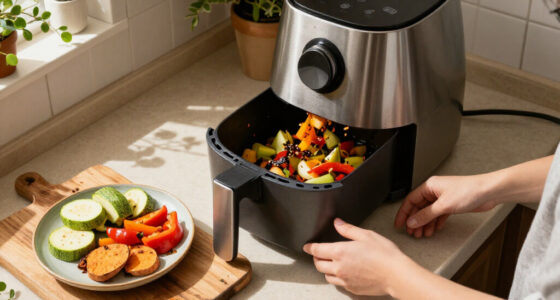
When choosing an air fryer for healthy cooking, the key question is not which shape makes food healthy by itself. Both basket-style and oven-style models circulate hot air, and either can cook many foods with little or no added oil. The real decision is whether you want a compact appliance that handles modest portions with minimal fuss or a larger countertop oven that can cook more food at once and take on other jobs.

Get health and wellness essentials delivered free with Prime
- Fast, free delivery on millions of items
- Prime Video, Amazon Music and more included
- Member-only deals all year

Cosori TurboBlaze Air Fryer, 9-in-1, 6 Qt, PFAS-Free Ceramic Coating
- ✔ Capacity: 6 quarts
- ✔ Coating: PFAS-free ceramic on basket and crisper tray
- ✔ Temperature range: 90°F–450°F

bella Fits-anywhere™ Slim 4qt Air Fryer, Non-Toxic Ceramic Coating, Oatmilk
- ✔ Capacity: 4 quarts; up to 3.3 pounds of food
- ✔ Coating: EverGood ceramic nonstick; stated free of PFAS, PFOA, PTFE, lead, and cadmium
- ✔ Temperature range: 90°F–400°F

Dash Compact Air Fryer, 2 Quart, Cool Grey
- ✔ Capacity: 2 quarts (1.2 liters)
- ✔ Interior: PTFE nonstick
- ✔ Temperature control: Adjustable; listed range 85°C–200°C
A basket-style air fryer is often the better fit for one or two people who want quick weeknight portions of vegetables, fish, chicken, or potatoes. An oven-style air fryer makes more sense for households that cook larger batches, want multiple racks or extra functions, and have room for another countertop appliance. The differences in cooking capacity and convenience can shape what you eat day to day; neither model guarantees a healthier diet, and the quality of the ingredients and cooking method still matter.
At a Glance
| Criteria | Basket-style air fryer | Oven-style air fryer | Winner |
|---|---|---|---|
| Oil use and food choices | Can crisp many foods with little or no added oil; results depend on the recipe and ingredients. | Can cook with little or no added oil too; extra capacity does not change the nutritional value of ingredients. | Tie |
| Small-portion convenience | Usually quick to heat and straightforward for one or two portions. | May be less efficient for a single small serving because of its larger interior. | A |
| Batch capacity | Best suited to smaller batches; crowded food may cook unevenly. | Often offers more usable room, racks, or trays for family portions. | B |
| Cooking consistency | A compact chamber and shakeable basket can produce even results when food is arranged in a single layer. | Racks can create hot and cool spots; trays may need rotating for even browning. | A |
| Cooking versatility | Strong for air frying, reheating, and roasting smaller portions; features vary by model. | Often adds oven-style functions such as baking or toasting; check the individual model. | B |
| Cleanup | Typically one removable basket and crisper plate to clean. | More trays and racks can mean more parts to wash. | A |
| Counter space | Usually the smaller, easier-to-store choice. | Takes more counter space and may be awkward to store. | A |
| Value | Often a lower-cost way to get convenient air frying. | Higher price can pay off for households that use its capacity and extra functions. | Depends |
Cosori TurboBlaze Air Fryer, 9-in-1, 6 Qt, PFAS-Free Ceramic Coating
For a household that wants one air fryer to handle more than frozen snacks, Cosori TurboBlaze is the strongest fit in this lineup. Its 6-quart square basket offers more room than bella’s 4-quart basket and far more than Dash’s 2-quart compartment, making it easier to cook a useful family batch in one go. The stated PFAS-free ceramic coating on both basket and crisper tray will also appeal to buyers who put cooking-surface materials high on their list.Its range of settings is relevant to healthy cooking because the appliance can support different ingredients and routines: the listed modes include air fry, roast, broil, bake, dry, and proof, while five fan speeds and a 90°F to 450°F range give more control than bella’s six presets and 400°F ceiling. Cosori also includes a customizable preheat function and dishwasher-safe parts. The manufacturer says its airflow can cook with up to 95% less oil than traditional deep frying; that comparison is a product claim, not a promise that every recipe will use less oil or be nutritionally balanced.The tradeoff is size and complexity. At 13.2 pounds and roughly 14.4 by 11.8 by 11.9 inches, it needs a dedicated counter spot, while bella is narrower and Dash is much lighter. Its many functions may be unnecessary for someone who mainly reheats a snack. We rank it first because its capacity, ceramic-coated parts, and control range make the most convincing everyday combination, provided your kitchen has room for it.
Pros:
- 6-quart square basket offers the most capacity in this comparison.
- PFAS-free ceramic coating is specified for the basket and crisper tray.
- Five fan speeds and a 90°F–450°F range provide flexible control.
- Basket and crisper plate are listed as dishwasher-safe.
Cons:
- Its dimensions and 13.2-pound weight make it less convenient to store than Dash or the slim bella.
- The number of modes and settings may feel excessive for occasional snack cooking.
- The stated lower-oil comparison is not a guarantee of the nutrition of a finished meal.
Best for: Households that cook several portions at once and want a ceramic-coated basket with multiple cooking modes.
Not ideal for: People with very little counter space, cooks who want the simplest possible controls, or buyers who mainly prepare single servings.
Bottom line: Choose the Cosori TurboBlaze when we want the broadest cooking range and a roomy ceramic-coated basket for regular household meals.
“Choose the Cosori TurboBlaze when we want the broadest cooking range and a roomy ceramic-coated basket for regular household meals.”
bella Fits-anywhere™ Slim 4qt Air Fryer, Non-Toxic Ceramic Coating, Oatmilk
The bella Fits-anywhere Slim makes a clear case for buyers who want more than a personal-size air fryer without giving up as much counter width. Its 4-quart basket is rated for up to 3.3 pounds of food, a substantial step up from Dash’s 2-quart capacity. The tall, narrow design measures 8.22 inches wide, so it may fit more easily in a crowded kitchen than the wider Cosori, although its depth is still about 14.56 inches.For shoppers focused on cooking surfaces, bella lists its EverGood ceramic nonstick coating as free from PFAS, PFOA, PTFE, lead, and cadmium. That materials information distinguishes it from Dash’s PTFE interior. Six presets cover air fry, bake, roast, broil, reheat, and dehydrate, and the basket and crisping tray are dishwasher-safe. Those features make bella a practical choice for everyday meals when a full range of manual settings is less important than straightforward controls and cleanup.Compared with Cosori, bella has less capacity, a lower maximum temperature of 400°F, and no listed fan-speed control. It also lacks Cosori’s 6-quart room for larger batches. Compared with Dash, however, it is much better suited to cooking a family-sized portion. The 1,300-watt appliance and vertical shape offer a useful compromise, but buyers should check that its depth and height work on their counter. We rank it second because it pairs a documented ceramic coating with genuinely useful capacity in a slim body, while giving up some of Cosori’s versatility.
Pros:
- Ceramic coating is described as free of PFAS, PFOA, PTFE, lead, and cadmium.
- 4-quart capacity and stated 3.3-pound food capacity suit more than individual snacks.
- Narrow 8.22-inch width may help on crowded counters.
- Six presets and dishwasher-safe basket and crisping tray simplify routine use.
Cons:
- The 400°F maximum is lower than Cosori’s 450°F ceiling.
- It has less capacity and fewer listed controls than Cosori.
- Its tall, deep profile still requires checking available counter and storage space.
Best for: Cooks who want a ceramic-coated basket and family-use capacity but need a narrower appliance than the Cosori.
Not ideal for: Those who need the largest batch capacity, want temperatures above 400°F, or prefer extensive manual airflow control.
Bottom line: Pick bella when we want ceramic-coated family cooking in a narrow footprint and can accept fewer controls than Cosori.
“Pick bella when we want ceramic-coated family cooking in a narrow footprint and can accept fewer controls than Cosori.”
Dash Compact Air Fryer, 2 Quart, Cool Grey
When kitchen space is the main constraint, Dash keeps the appliance itself modest: it weighs 5.8 pounds and measures 10.2 by 8.1 by 11.4 inches. Its 2-quart size is the smallest in this comparison, which can make it easier to tuck away in a dorm, small apartment, or RV. The removable basket, adjustable temperature control, timer, and cool-touch handle support simple snack and small-meal preparation.Dash is best understood as a portion-size choice, not a smaller substitute for Cosori or bella. Its 1.2-liter capacity is much less than bella’s 4 quarts and Cosori’s 6, so regular family meals may require multiple rounds. That can make batch cooking slower and less convenient. It also lists a PTFE nonstick interior, unlike the ceramic-coated surfaces specified by the other two options; buyers who specifically want ceramic should look to bella or Cosori instead.The manufacturer describes AirCrisp as producing crisp food with up to 75% less added fat, but that stated comparison does not tell us the nutrition of any particular meal. The appliance is also listed as hand-wash only, whereas both larger picks have dishwasher-safe cooking parts. Still, its straightforward controls and small footprint can support home-prepared portions when space matters more than capacity or coating preference. We place it third because its compactness is valuable, but its size and care requirements narrow its usefulness for a broad healthy-cooking routine.
Pros:
- Smallest listed capacity and lightest weight in this group.
- Adjustable temperature control and timer provide basic flexibility.
- Cool-touch handle and auto shut-off add practical safety features.
- Removable basket makes it easier to transfer a small serving.
Cons:
- 2-quart capacity is restrictive for family meals or batch cooking.
- The listed interior is PTFE nonstick rather than ceramic-coated.
- Hand-wash care takes more effort than the dishwasher-safe parts on the other picks.
Best for: One-person households, dorm residents, or anyone who mostly cooks snacks and small portions in a tight kitchen.
Not ideal for: Families, batch cooks, buyers seeking a ceramic-coated basket, or anyone who wants dishwasher-safe cooking parts.
Bottom line: Choose Dash when a small footprint matters most and we mainly prepare snacks or single portions.
“Choose Dash when a small footprint matters most and we mainly prepare snacks or single portions.”
As an Amazon Associate we earn from qualifying purchases.
Key Differences
The most meaningful difference for healthy everyday meals is how each appliance fits the portions you actually cook. A basket model is well suited to preparing a side of vegetables or a serving of salmon without heating a full-size oven. Its smaller cooking area can make quick meals feel manageable, though it limits how much you can cook at once. Filling the basket too heavily can trap steam and leave food less crisp, so larger meals may require cooking in batches.
An oven-style model offers more room and often a wider range of cooking functions. That can help a household cook several servings together or prepare different components on separate racks. More room is useful only when you use it: the appliance occupies more counter space, and racks may need attention during cooking to brown food evenly. For either style, air frying is a cooking method, not a health rating. A lightly oiled batch of vegetables and a heavily breaded, salty snack remain different choices regardless of the appliance.
Cost follows the same practical tradeoff. Basket models usually deliver the core air-frying job for less money and with fewer parts to clean. Paying more for an oven-style appliance can be worthwhile if its capacity and other functions replace cooking steps you would otherwise do elsewhere. If you mainly make one or two portions, the extra purchase price and space are unlikely to improve your meals enough to justify the upgrade.
Detailed Comparison
Oil use and food choices (moderate difference)
Winner: Tie; the appliance style does not determine whether a meal is healthy. Both types circulate hot air and can brown foods with a light coating of oil or none, depending on the recipe. This is a moderate consideration because an air fryer can reduce the need for deep frying, but it cannot remove salt, change a food’s ingredients, or make every packaged snack nutritious. Choose the model that makes it easier for you to prepare the vegetables, lean proteins, or other foods you want to eat. Use a measured amount of oil when a recipe benefits from it, and avoid treating crispness as a sign of nutritional quality.
Small-portion convenience (Basket-style air fryer wins — moderate)
Winner: A; the advantage is moderate for solo cooks and couples. A basket-style model usually has a smaller chamber to heat and a simple pull-out cooking area. That layout suits a quick portion of vegetables or protein without setting up trays or using a larger oven-style appliance. The practical benefit is convenience, which can make home cooking easier on busy evenings. An oven-style unit still works for small servings, but its larger interior and footprint may feel excessive for that job. If you mostly cook for a larger household, this advantage matters less.
Batch capacity (Oven-style air fryer wins — major)
Winner: B; the gap is major for family meals. Oven-style models commonly provide trays or racks and more room for several servings, although exact capacity varies by product. That can let you cook more food in one session instead of repeating small basket loads. Basket models can still feed a household, but overfilling one can compromise airflow and browning; cooking in batches adds time and may make everyone wait. Compare the actual interior measurements and usable tray area before buying. A large advertised capacity is less useful if you cannot spread the foods you cook in the space provided.
Cooking consistency (Basket-style air fryer wins — moderate)
Winner: A for many single-layer portions; the gap is moderate. Basket-style units make it easy to shake or turn food, and keeping food in one layer supports even exposure to hot air. Oven-style units provide more room, but multiple racks can leave some areas browner than others, making rotation or tray swapping useful. This is a practical difference in attention: a basket may ask you to shake food, while an oven-style model may ask you to rotate trays. Neither shape makes even cooking automatic. Results depend on the appliance design, the amount and size of food, and how it is arranged.
Cooking versatility (Oven-style air fryer wins — moderate)
Winner: B; the gap is moderate, depending on the model. Many oven-style appliances include functions such as baking or toasting alongside air frying, while basket models tend to focus on air frying, roasting, and reheating. Those extras may consolidate cooking jobs if you would otherwise use separate appliances. However, product features differ: check the controls and cooking modes rather than assuming every oven-style unit has the same capabilities. A basket model may be the more useful tool if those extra functions would sit unused. The deciding factor is whether you have regular tasks for the added modes.
Cleanup (Basket-style air fryer wins — minor)
Winner: A; the gap is minor to moderate. Basket models often have fewer removable pieces, usually a basket and crisper plate, so there may be less to wash after a meal. Oven-style designs can add racks, mesh trays, or drip trays, and more surfaces can mean more cleanup. Model details matter: dishwasher-safe parts can change the effort, and stuck-on food can require extra care in either design. If frequent cleanup is the reason you skip cooking, a simpler setup may suit you better. Review the care instructions before buying, especially for parts that touch greasy or sugary food.
Counter space (Basket-style air fryer wins — moderate)
Winner: A; the gap is moderate in smaller kitchens. Basket-style appliances are generally more compact and easier to fit into a cupboard or onto a crowded counter. Oven-style models take up more room, and their shape may make them harder to store between uses. The consequence is not just visual: an appliance that cannot stay accessible may be used less often. Measure the available surface and check the unit’s clearance requirements before deciding. If you have a dedicated appliance area, the larger oven-style footprint may be a minor tradeoff for more capacity.
Value (major difference)
Winner: Depends on how you cook; the gap can be major if features go unused. A basket-style model is usually a lower-cost route to air frying and may provide better value for people making small portions. An oven-style model costs more, but its room and additional functions can justify the price if they replace several appliances or reduce repeated cooking batches. Paying more makes sense when you will regularly use those advantages, not simply because the unit is larger or has a longer feature list. Compare capacity, cleaning needs, and functions against your normal meals. For occasional use, either can be poor value if it stays on the shelf.
Basket-style air fryer: Pros and Cons
Pros:
- Compact footprint suits smaller kitchens.
- Convenient for quick meals and modest portions.
- Simple basket layout is easy to shake or turn.
- Often costs less and has fewer removable parts to clean.
Cons:
- Smaller cooking area can require multiple batches for a family.
- Overcrowding can reduce browning and crispness.
- Usually offers fewer oven-style functions than a multi-purpose model.
Oven-style air fryer: Pros and Cons
Pros:
- More room can help with family portions and batch cooking.
- Multiple racks or trays can let you prepare more food at once.
- Often includes baking, toasting, or other oven-style functions.
Cons:
- Larger footprint can be difficult in a small kitchen.
- Multiple trays and racks may take more effort to clean.
- Food on different levels may need rotating for even browning.
- Higher cost is hard to justify if you do not use the extra room or functions.
Who Should Choose What
Choose Basket-style air fryer if:
- You cook for one or two people and want quick portions of vegetables, fish, or chicken.
- Your counter or cupboard space is limited.
- You prefer a simple appliance with fewer trays and a lower purchase price.
- You tend to cook one food at a time and do not need several racks.
Choose Oven-style air fryer if:
- You regularly prepare meals for a family or cook several servings together.
- You want racks or trays to handle larger batches.
- You will use its baking, toasting, or other listed cooking functions.
- You have the counter space and are willing to clean additional parts.
Skip both if: Skip both if you already have an appliance that handles your usual meals well, rarely cook at home, or lack a safe, accessible place to use and store another countertop appliance.
Value for Money
A basket-style air fryer is generally the stronger value for people who want the core benefit: convenient hot-air cooking for small or moderate portions. It costs less in many product ranges, occupies less space, and often leaves fewer parts to wash. Those advantages matter most when you cook regularly but do not need family-size batches. For that buyer, paying extra for racks or a larger interior may add expense without changing the meals they make.
The higher price of an oven-style model can be worthwhile when its capacity solves a recurring problem. If you routinely cook several servings, want multiple racks, or will replace a toaster or small countertop oven with one appliance, the extra cost may buy useful flexibility. Compare the specific model’s usable capacity and functions with appliances you already own. Do not pay more for modes you are unlikely to use, and do not assume that extra room makes food more nutritious.
For healthy cooking, the better value is the appliance you will use to prepare meals that fit your preferences and routine. A small basket that gets used several times a week can be a better purchase than a larger oven-style unit that is inconvenient to store or clean. Conversely, if a small basket forces repeated batches and discourages cooking for your household, investing in more capacity may make sense.
Final Verdict
For most people who want an air fryer mainly for healthier everyday cooking, the basket-style model is the better starting choice. It handles common portions, takes less space, and usually costs less, while offering the same basic opportunity to cook with little or no added oil. Choose it if you usually prepare food for one or two people and value quick cleanup.
Choose an oven-style air fryer if you regularly feed a family, want to cook larger batches, or will use its extra cooking functions often. Its higher price is justified when the capacity and versatility solve real problems in your kitchen. The biggest deciding factor is how much food you cook at once: small portions favor the basket, while regular family-size meals favor the oven. If neither appliance fits your space or routine, skip both and use the cooking equipment you already have.
Frequently Asked Questions
Which air fryer is healthier, basket-style or oven-style?
Neither style is automatically healthier. Both circulate hot air and can cook many foods with little or no added oil. Ingredients, portion size, salt, and the recipe matter more to a meal’s nutritional profile than whether the appliance has a basket or racks.
Does an air fryer use less oil than deep frying?
Air frying can cook many foods without submerging them in oil, so a recipe may call for less oil than deep frying. The amount varies by food and preparation. Breaded or packaged foods may still be high in salt or fat even when cooked in an air fryer.
Is an oven-style air fryer worth paying more for?
It can be worth the added cost if you regularly cook larger batches or use its other functions, such as baking or toasting. If you mainly cook one or two portions, a basket model usually provides the core air-frying function with less space and often less expense.
Can a basket air fryer cook enough for a family?
That depends on the basket’s usable capacity and the meal. Some can handle several servings, but crowding food can limit airflow and even browning. Check the manufacturer’s capacity and consider whether you are comfortable cooking in batches.
Do oven-style air fryers cook more evenly?
Not automatically. Their larger interiors and multiple rack levels can make it useful to rotate trays or move food during cooking. Basket models are often easier to shake or turn for a single layer. Evenness depends on the model, load, and arrangement of food.