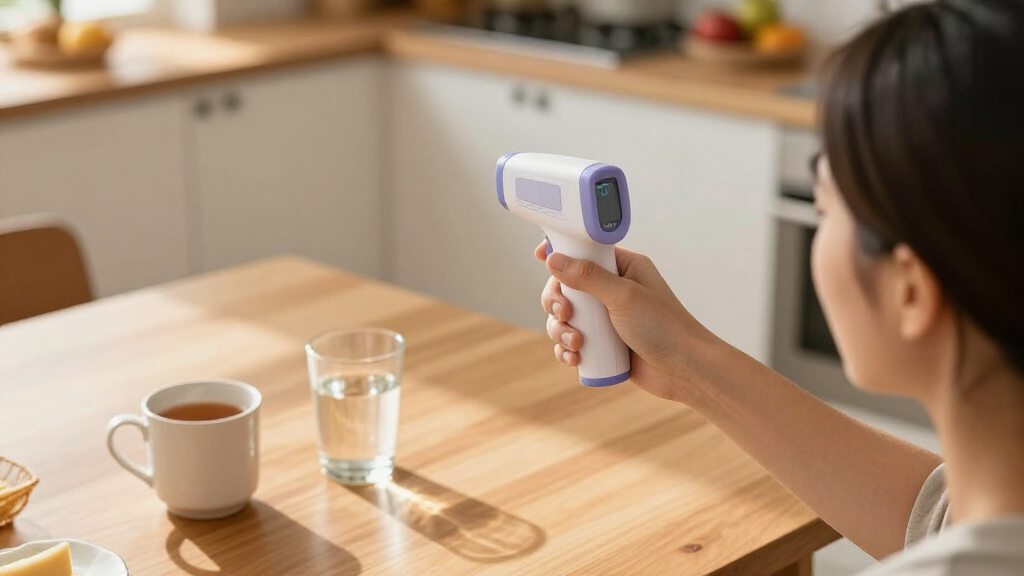

When most people shop for an infrared thermometer for adults, they are not choosing between brands first — they are choosing between two technologies: the non-contact forehead (temporal) thermometer you point at the skin, and the ear (tympanic) thermometer whose probe goes inside the ear canal. Both promise a reading in seconds, both sit in roughly the same price band (typically $20 to $60), and both are marketed with the same claim of clinical accuracy. That overlap is exactly why the decision feels confusing.

Get health and wellness essentials delivered free with Prime
- Fast, free delivery on millions of items
- Prime Video, Amazon Music and more included
- Member-only deals all year

ANMEATE Non-Contact Forehead Thermometer for Adults and Kids
- ✔ Brand: ANMEATE
- ✔ Type: Digital infrared non-contact forehead thermometer
- ✔ Response Time: 1 second

Goodbaby No-Touch Forehead Thermometer for Adults and Kids
- ✔ Brand: Goodbaby
- ✔ Type: No-touch infrared forehead thermometer
- ✔ Measurement Modes: Forehead, room, object

GoodBaby Non-Contact Forehead Thermometer for Adults and Kids
- ✔ Display: Digital LCD, backlit, 3-color fever alarm
- ✔ Response Time: 1 second
- ✔ Temperature Range: 89.6°F – 100.3°F
The honest difference is this: ear thermometers measure closer to the body’s core temperature and tend to be more repeatable when used correctly, but they depend on technique and a clear ear canal. Forehead thermometers are easier to use on sleeping adults, safer from a hygiene standpoint in multi-person households, and nearly impossible to use wrong — but they are more easily skewed by sweat, ambient temperature, cosmetics, and distance from the skin. Neither is a toy; both are legitimate clinical tools. The question is which failure mode you would rather live with.
This guide compares them side by side across the criteria that actually change your experience: accuracy and consistency, speed, ease of correct use, comfort and hygiene, suitability for specific users, features, and long-term cost. If you want the short version: most households are better served by a forehead thermometer as their default, with an ear thermometer as the better pick if precision and repeatability matter most to you or someone in the home has ongoing health monitoring needs.
At a Glance
| Criteria | Forehead (temporal) infrared thermometers | Ear (tympanic) infrared thermometers | Winner |
|---|---|---|---|
| Accuracy when used correctly | Good, but sensitive to ambient conditions and sweat | Very good — measures near core temperature | B |
| Consistency across repeated readings | Moderate — readings can vary by several tenths | Good when positioned correctly in the same ear | B |
| Ease of correct technique | Very easy — point, hold distance, press | Moderate — requires straightening the ear canal and correct angle | A |
| Speed | 1–3 seconds | 1–3 seconds | Tie |
| Comfort for sleeping users | Excellent — fully non-contact | Poor — probe insertion usually wakes the user | A |
| Hygiene in multi-person households | Excellent — no probe contact, no disposable covers needed | Moderate — requires cleaning or disposable probe covers | A |
| Tolerance of ear conditions (wax, infection) | Unaffected by ear canal conditions | Poor — earwax or ear infections skew readings | A |
| Ongoing cost | None beyond batteries | Ongoing cost of disposable probe covers | A |
ANMEATE Non-Contact Forehead Thermometer for Adults and Kids
The ANMEATE Non-Contact Forehead Thermometer earns our top spot because it gets the fundamentals right without asking you to navigate extra modes. Readings land in about one second, and the three-color backlight (green, yellow, red) gives you an instant visual verdict before you have even processed the number — a genuinely useful feature when you are checking your own temperature half-asleep at 2 a.m. The 35-reading memory recall lets you track how a fever is trending across a day or two, which matters more for adults managing illness than a single snapshot reading.Compared with the Goodbaby No-Touch model, the ANMEATE is more focused: it does body temperature only, with no room or object mode. We consider that a fair trade for most buyers, since fewer modes means fewer chances to accidentally take a surface reading when you meant to check a forehead. The one-touch mute mode is another thoughtful touch that the GoodBaby B08MT3D361 also offers, but ANMEATE pairs it with the clearest fever-alarm implementation of the three. The honest caveat: like every non-contact forehead thermometer here, it is a screening tool. If you need clinical-grade certainty, an oral thermometer remains the gold standard, and the indoor-only usage recommendation limits its flexibility.
Pros:
- 1-second readings with a color-coded green/yellow/red backlight for instant interpretation
- 35-set memory recall makes it easy to track fever trends over time
- One-touch mute mode for nighttime checks without waking anyone
- Switchable Fahrenheit/Celsius display with included AAA batteries
- Clinically tested accuracy for a consumer forehead device
Cons:
- Forehead readings are less accurate than oral or rectal methods
- No room or object temperature modes — indoor body readings only
Best for: Adults and families who want a fast, single-purpose forehead thermometer with clear fever feedback and temperature history tracking.
Not ideal for: Anyone who wants one device for room or surface measurements, or who needs clinical-grade accuracy for medical decisions.
Bottom line: The most balanced pick of the three: fast, clear, and focused on doing one job exceptionally well.
“The most balanced pick of the three: fast, clear, and focused on doing one job exceptionally well.”
Goodbaby No-Touch Forehead Thermometer for Adults and Kids
Where the ANMEATE keeps things simple, the Goodbaby No-Touch Forehead Thermometer leans into versatility. Its standout differentiator is the three measurement modes: forehead, room, and object temperature. That extra capability is more practical than it sounds — being able to verify a nursery’s ambient temperature or check whether a coffee cup is scalding gives this model a second life beyond sick days. Operation is a genuine one-button affair, and the recommended 1.5-inch measurement distance is forgiving for self-checks.The tradeoff for that flexibility is sensitivity to conditions. This is the only model in our lineup whose manufacturer explicitly notes that unstable room temperatures can skew readings, and you are advised to wait ten minutes after cleaning skin and ten seconds between measurements. Every infrared thermometer has these constraints — the Goodbaby simply makes them more visible. Its 12-month replacement warranty and round-the-clock support are a stronger assurance package than the other two offer, which offsets some of the fussiness. If you are choosing between this and the GoodBaby B08MT3D361, the decision comes down to whether you value the extra modes here or the broader certifications and no-clean design there. For multi-purpose households, this option makes more sense.
Pros:
- Clinically tested accuracy with pediatrician recommendation
- Three modes: forehead, room, and object temperature
- Simple one-button no-touch operation safe for all ages
- 12-month replacement warranty with 24/7 customer support
Cons:
- Readings can drift in unstable room temperatures
- Requires a 10-minute wait after cleaning skin and 10 seconds between measurements
Best for: Buyers who want one device for body, room, and surface temperatures, and who appreciate a solid warranty.
Not ideal for: Anyone who wants the fastest possible check with minimal waiting between readings or strict conditions.
Bottom line: The most flexible of the three, best suited to households that want a thermometer plus a room and surface checker in one.
“The most flexible of the three, best suited to households that want a thermometer plus a room and surface checker in one.”
GoodBaby Non-Contact Forehead Thermometer for Adults and Kids
The second GoodBaby entry in our lineup, the B08MT3D361, takes a different approach from its sibling: instead of adding modes, it doubles down on hygiene and trust signals. Because it never touches the skin, there is no cleaning required between uses — a real advantage in a household where multiple people are sick at once. Its certification stack (FDA, CE, ISO) is the strongest of the three, and it is FSA/HSA eligible, which may matter if you are paying with health spending funds. The large backlit LCD with a three-color fever alarm is easy to read day or night, and the 1-second response time matches the ANMEATE.Its two weaknesses are worth taking seriously, though. The stated temperature range tops out at 100.3°F — noticeably lower than the ANMEATE’s 109.2°F ceiling — which means high fevers may fall outside its accurate measurement window, precisely when you need reliable numbers most. And some units have been reported to fail due to incorrect battery installation or electronic faults, so check the battery orientation before assuming the device is defective. Compared with the ANMEATE, this model is better suited to hygiene-conscious, multi-person households; compared with the Goodbaby No-Touch, it offers stronger credentials but none of the room-and-surface versatility. It is a solid pick, just not the safest bet for tracking a serious fever.
Pros:
- No cleaning required between uses thanks to the fully touchless design
- Strong certification stack: FDA, CE, ISO — plus FSA/HSA eligibility
- Large backlit LCD with 3-color fever alarm for day and night use
- 35-reading memory recall for tracking temperature history
Cons:
- Upper temperature range limited to 100.3°F, below typical high-fever thresholds
- Reported failures from incorrect battery installation or electronic malfunction
Best for: Hygiene-focused households and buyers who value FDA/CE/ISO certification and FSA/HSA eligibility.
Not ideal for: Anyone monitoring high fevers, since the measurement range caps at 100.3°F.
Bottom line: A certification-rich, hygiene-first choice — as long as its limited upper temperature range fits your needs.
“A certification-rich, hygiene-first choice — as long as its limited upper temperature range fits your needs.”
As an Amazon Associate we earn from qualifying purchases.
Key Differences
The single biggest practical gap is repeatability. A forehead thermometer can give you 97.9°F on one scan and 98.6°F on the next, even seconds apart, because the reading is affected by sweat, room drafts, hair, skincare products, and how steadily you hold the device at the recommended distance. That does not make it useless — the average of a few readings is usually meaningful, and a true fever almost always shows up clearly — but it can produce anxiety-inducing variation when you are checking a sick adult at 2 a.m. An ear thermometer, when inserted at the right angle in the same ear each time, tends to return nearly identical numbers on consecutive measurements. For people tracking a fever’s course or monitoring a post-operative patient at home, that consistency matters more than any feature list.
The second major difference is what each device demands of the user. A forehead thermometer is nearly technique-proof: point, keep the stated distance, press the button. An ear thermometer requires you to pull the ear slightly up and back to straighten the canal and aim the probe at the eardrum. Do it wrong — or measure through a buildup of earwax, or during an ear infection, or in an ear the person has been lying on — and the reading can be misleadingly low. Ear thermometers reward correct technique and punish sloppy use; forehead thermometers forgive sloppy use but punish environmental conditions.
The third difference is logistics. Forehead thermometers need nothing but batteries: no probe covers, no cleaning between users, no consumables. Ear thermometers either require disposable covers (an ongoing cost and something to keep stocked) or careful alcohol cleaning between people, which matters in a household where more than one person gets sick at once. Neither device is expensive to own, but only one of them has a recurring shopping list attached.
Detailed Comparison
Accuracy and consistency (Ear (tympanic) infrared thermometers wins — moderate)
Ear thermometers win on accuracy in principle: the eardrum shares blood supply with the hypothalamus, the body’s temperature-regulation center, so a correctly aimed tympanic reading sits close to core temperature. Forehead thermometers measure skin surface temperature and use an algorithm to estimate internal temperature, which introduces more environmental noise. In practice, both are accurate enough to detect a fever in an adult, but an ear thermometer used properly will usually give tighter, more trustworthy repeat readings. If you are tracking whether a fever is rising or falling over hours, the ear thermometer’s consistency is a real advantage. The gap is moderate, not absolute — a quality forehead model from a reputable brand will outperform a cheap ear unit — but at equal quality, ear wins.
Ease of correct use (Forehead (temporal) infrared thermometers wins — moderate)
Forehead thermometers are the clear winner. The technique is trivial: hold the device the recommended distance from the center of the forehead, press, read. There is no positioning skill to learn, which is why forehead models became the default in offices, schools, and airports. Ear thermometers demand more: the probe must be inserted gently and angled toward the eardrum, and the ear canal must be straightened by pulling the ear up and back. Adults can do this to themselves or each other with a little practice, but a rushed or awkward measurement will read low. If you want a thermometer any family member can pick up and use correctly on the first try, forehead is the safer bet.
Comfort and usability on a sleeping person (Forehead (temporal) infrared thermometers wins — major)
One of the most underappreciated advantages of non-contact forehead thermometers is that you can take a reading from a sleeping adult without touching them at all. This matters for checking on a sick partner overnight without waking them, and it is the reason many parents keep a forehead model even after buying an ear thermometer for accuracy. Ear thermometers require inserting a probe, which almost always wakes a sleeping person or at least disturbs them. If overnight monitoring is part of your use case, the forehead thermometer wins outright, and the gap is major.
Hygiene and multi-person use (Forehead (temporal) infrared thermometers wins — moderate)
A non-contact forehead thermometer carries essentially zero cross-contamination risk between users — no contact, no cleaning, no covers. Ear thermometers touch the ear canal, so they need either disposable probe covers (recurring cost and storage) or alcohol swabbing between people. Neither approach is difficult, but one is frictionless and the other is a chore you will occasionally skip when you should not. In a household where illness spreads from person to person, or if you plan to use the thermometer on visitors, the forehead model is clearly better. The gap is moderate to major depending on how many people use the device.
Immunity to user-specific conditions (Forehead (temporal) infrared thermometers wins — moderate)
Ear thermometer readings are degraded by earwax buildup, ear infections, and even the residual warmth of lying on one ear — all common in real life. A person with an outer ear infection may register a falsely high reading, and heavy wax can register falsely low. Forehead thermometers have their own sensitivities (sweat, hats, cold rooms, drafts, forehead cosmetics), but these are easier to notice and correct in the moment than an invisible wax plug. For adults with recurring ear problems, the forehead model is the more reliable choice. This is a moderate but often overlooked difference.
Speed and convenience (minor difference)
This is effectively a tie. Both technologies return a reading in roughly one to three seconds. The ear thermometer requires a few extra seconds of positioning; the forehead thermometer requires holding a steady distance. Neither will feel slow to anyone upgrading from an oral mercury-style or digital stick thermometer, where you wait thirty seconds to several minutes. Speed should not drive your decision here.
Features and readings you actually get (minor difference)
At comparable prices, both types typically offer fever indicators (color-coded backlights), memory of the last 10–30 readings, and Celsius/Fahrenheit switching. Forehead models more often add surface/object mode for measuring bath water or room temperature; ear models more often include pre-warmed tips to reduce the low-reading artifact from a cold probe. These differences are marketing more than substance for most buyers — decide on the measurement technology first and treat features as a tiebreaker between specific models, not between types.
Cost of ownership (Forehead (temporal) infrared thermometers wins — minor)
Both types cost roughly the same upfront — solid units from recognized brands run about $25 to $60, and paying more than that buys marginal gains. The difference is recurring: ear thermometers that use disposable probe covers add a small but permanent consumable cost, and running out of covers at the wrong moment is a genuine annoyance. Forehead thermometers cost nothing beyond batteries. The lifetime cost gap is real but small; treat it as a tiebreaker rather than a decider unless you are outfitting a clinic or large family.
Forehead (temporal) infrared thermometers: Pros and Cons
Pros:
- Fully non-contact — safe to use on sleeping adults without waking them
- No technique to learn; any household member can use it correctly
- No probe covers or cleaning between users; no consumables
- Unaffected by earwax or ear infections
- Often includes object/surface mode for room or liquid temperatures
Cons:
- Readings vary with sweat, drafts, hair, cosmetics, and holding distance
- Less consistent across repeated measurements than a well-used ear thermometer
- Accuracy depends on ambient room temperature being stable
- Can show anxiety-inducing variation when you re-check several times
Ear (tympanic) infrared thermometers: Pros and Cons
Pros:
- Measures near core temperature — closer to true internal body heat
- Highly consistent readings when positioned correctly in the same ear
- Excellent for tracking fever progression over hours and days
- Unaffected by sweat, room drafts, or forehead conditions
Cons:
- Requires correct insertion technique; sloppy use reads falsely low
- Earwax and ear infections distort results
- Inserting the probe wakes or disturbs a sleeping person
- Needs disposable covers or alcohol cleaning between users — a recurring cost and chore
Who Should Choose What
Choose Forehead (temporal) infrared thermometers if:
- You want one thermometer the whole household can grab and use correctly without instructions
- You expect to check temperatures on sleeping people overnight without waking them
- Multiple people in the home get sick at the same time and you want zero cleaning between users
- Anyone in the household has frequent earwax buildup or ear infections
- You are buying for general peace of mind rather than precise fever tracking
Choose Ear (tympanic) infrared thermometers if:
- You are monitoring an ongoing condition where tracking small temperature changes matters
- You will take the time to learn correct technique and apply it consistently
- You are checking your own temperature (self-positioning is easier than positioning someone else)
- You are bothered by reading-to-reading variation and want repeatable numbers
- Nobody in the household has chronic ear problems
Skip both if: If accuracy is truly critical — post-surgical care, immunocompromised household members, or situations where a fraction of a degree changes a decision — talk to a clinician about validated clinical thermometers rather than relying on any consumer infrared device as the sole reference.
Value for Money
Both types occupy the same $25–60 price band, and within that band, brand and build quality matter more than the extra $10 or $20 you might spend. Paying more than about $60 for a consumer infrared thermometer buys you very little: mostly marketing, extra memory slots, and sometimes an app connection you will stop using within a month. A well-reviewed $30 unit of either type from an established medical-device brand is the sweet spot.
The real value difference is recurring, not upfront. Ear thermometers that require probe covers add a permanent consumable cost — modest, but real, and frustrating when you run out. Forehead thermometers have effectively zero cost of ownership. Factoring that in, a forehead thermometer is the better value for most casual households, while an ear thermometer justifies its small ongoing cost only for people who genuinely benefit from its tighter repeatability. If you find yourself wanting both, note that many mid-range forehead models cost so little that owning one of each — ear for accuracy, forehead for convenience — is a reasonable and common solution.
Final Verdict
For most buyers, the forehead (temporal) infrared thermometer is the right default. It is easier to use correctly, works on sleeping adults without waking them, needs no cleaning or covers between users, and is immune to the ear conditions that quietly sabotage ear thermometer readings. Its weaknesses — sensitivity to sweat and ambient conditions, and some reading-to-read variation — are manageable habits: let the device and the room sit a few minutes if you have just come inside, wipe a sweaty forehead, and take two or three readings and mentally average them.
Choose the ear thermometer instead if precision and repeatability are your priority: you are tracking a fever’s course closely, monitoring your own temperature, or you are willing to learn correct insertion technique and stock probe covers. Used well, it is the more trustworthy number.
The single biggest deciding factor is how you will use it at 2 a.m. on a sick adult. If the answer is “quickly, quietly, and without waking them,” buy the forehead model. If the answer is “accurately, and I will take my time,” buy the ear model. And if accuracy is genuinely medical-critical, do not rely on any consumer infrared device alone — confirm with a clinician.
Frequently Asked Questions
Which is more accurate for adults, forehead or ear infrared thermometers?
Ear thermometers are generally more accurate when positioned correctly, because the eardrum sits close to the body’s core temperature. Forehead thermometers estimate internal temperature from skin surface heat and are more affected by sweat, drafts, and room temperature. That said, a quality forehead model is accurate enough to detect any clinically meaningful fever in an adult — the difference matters most when you need to track small changes over time.
Why do I get different readings every time I use my forehead thermometer?
Forehead readings vary because the measurement depends on skin surface conditions and how you hold the device. Sweat, a recently removed hat, hair on the forehead, skincare products, drafts, and inconsistent distance all shift the number. Let the person acclimate to the room for a few minutes, wipe the forehead, hold the device at its stated distance, and take two or three readings — the pattern, not any single number, is what matters.
Can earwax affect an ear thermometer reading?
Yes, and this is the ear thermometer’s biggest weakness. A wax buildup blocks the infrared beam from reaching the eardrum and typically produces a falsely low reading. Ear infections and the warmth from lying on one ear can also skew results. If an ear reading seems inconsistent with how the person feels, check the other ear or confirm with a different method.
Are the disposable probe covers really necessary on ear thermometers?
They serve two purposes: hygiene between users and protecting the probe window from earwax, which degrades accuracy. Some models can be used without covers if you clean the probe window with alcohol between uses. Skipping the covers entirely leads to a wax-filmed sensor and unreliable readings, so either budget for covers or commit to regular cleaning.
Is it worth paying more than $60 for an infrared thermometer?
Usually not. Between roughly $25 and $60 you are paying for better sensors, build quality, and support from established medical-device brands. Above that, you are mostly paying for app connectivity, larger memory, and marketing. Accuracy gains past the mid-range are small for home use on adults.
Columbus Day / Indigenous Peoples' Day Picks
long weekend sales
As an affiliate, we earn on qualifying purchases.


![I Made Tinnitus My Friend, Then It Disappeared [Video]](https://breatheatlas.com/wp-content/uploads/2026/08/i-made-tinnitus-my-friend-then-it-disappeared-video-featured-560x300.jpg)