TL;DR

Get health and wellness essentials delivered free with Prime
- Fast, free delivery on millions of items
- Prime Video, Amazon Music and more included
- Member-only deals all year
A Sixty and Me report featuring a Pilates instructor argues that stiffness after 60 is not always an inevitable result of aging: long periods of sitting and repeating a narrow range of movements may contribute. The instructor describes starting with gentle movement before stability and strength work, but the report does not provide clinical research proving the approach or establish that it applies to everyone.
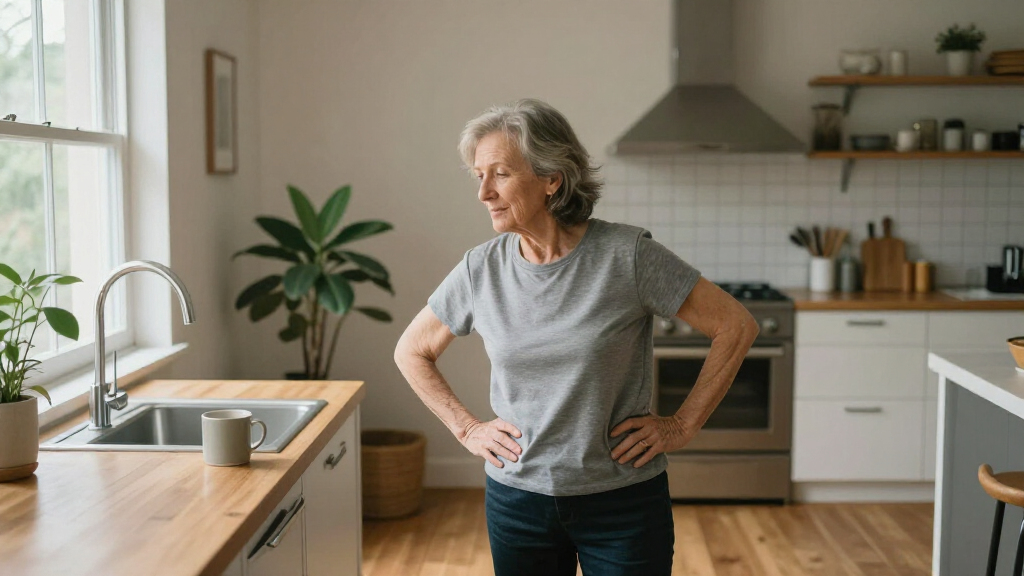
A report from Sixty and Me says stiffness people experience after 60 may be related in part to long periods of sitting and limited movement, not age alone. A Pilates instructor who says she has taught women over 55 for more than 10 years describes seeing stiffness ease for many students after they begin moving, while cautioning readers not to push into pain.
The instructor’s account focuses on everyday routines: sitting to eat, driving, watching television, reading or working at a computer. She says people also tend to repeat a limited set of movements, such as walking forward, reaching for nearby objects and bending over household tasks. In her experience, the women who arrive feeling stiffest are often those who have spent more time sitting, including after a long drive or a weekend of reading or computer work.
The report lists the neck, shoulders, upper back, hips and spine as areas where stiffness may be noticed during ordinary tasks. Examples include turning to check a blind spot, reaching overhead, getting in and out of a car, or bending to tie shoes. These are observations from the instructor’s classes, not findings from a clinical study cited in the article.
In class, she says, sessions begin with slow, easy movement, then work on stability around joints before building strength. She reports that students often say they feel looser after class and notice a difference when they miss a week. The source also suggests a short seated routine: gentle neck turns, shoulder rolls, seated cat-cow movements and alternating knee lifts. It advises moving comfortably, not forcing movement into pain, and checking with a doctor before starting something new if a person has an injury or health condition.
How Daily Movement May Affect Stiffness
The report offers readers a practical alternative to assuming that every episode of stiffness is simply an unavoidable part of aging. If stiffness tends to follow extended sitting, the instructor’s account suggests that adding comfortable movement breaks or using more varied positions may be worth discussing with a qualified health professional. The suggested seated motions are presented as gentle options, not as a treatment or a guaranteed way to relieve symptoms.
The distinction matters because stiffness can have different causes, and an individual account cannot identify what is behind a particular person’s symptoms. The report does not show that movement alone resolves stiffness or explain how often it is caused by inactivity compared with age, injury or health conditions. It is best read as a movement instructor’s experience and guidance, rather than medical evidence or a diagnosis.
seated neck and shoulder stretch exercises
As an affiliate, we earn on qualifying purchases.
As an affiliate, we earn on qualifying purchases.
The Instructor’s Class-Based Observations
The source is a first-person report from Sixty and Me. Its author says she has taught Pilates to women over 55 for more than a decade and describes a pattern she has noticed in class: stiffness is often more apparent after extended sitting and eases for many participants once they move. The article does not give a publication date in the supplied material, identify participants beyond this description, or report a formal study.
The instructor’s explanation is that people become accustomed to the positions and movements they use most, while less-used motions can feel unfamiliar or restricted. She contrasts repetitive daily activity with movements people may do less often, such as reaching overhead or leaning to the side. This is the article’s explanation of her observations; the supplied source does not provide research data to establish how strongly this pattern affects people generally.
The report also points readers to the instructor’s separate article about stiffness after 40 and promotes a free five-day mobility program. Those references are part of the source’s material, but they do not independently establish the effectiveness of its suggestions.
gentle Pilates resistance bands for seniors
As an affiliate, we earn on qualifying purchases.
As an affiliate, we earn on qualifying purchases.
What the Report Does Not Establish
The supplied report does not cite clinical research, quantify how commonly sitting contributes to stiffness, or compare the effects of inactivity with aging or other causes. It also does not establish that the proposed routine is suitable for every reader or that it will improve stiffness. The instructor’s experience is limited to what she says she has observed among her students.
The report does not provide a way to determine whether a reader’s stiffness is related to ordinary inactivity or to an injury or health condition. It advises people with a specific injury or condition to consult a doctor before trying new exercises, but it does not set out broader guidance on when persistent or worsening stiffness should be evaluated. Readers should not treat the article as a diagnosis or substitute for individualized professional advice.
As an affiliate, we earn on qualifying purchases.
Gentle Movement and Individual Guidance
The report encourages readers to notice whether stiffness appears after long periods of sitting and to try a few minutes of slow, comfortable movement, such as the seated motions it describes. It recommends staying within a comfortable range and not pushing into pain. The source gives no follow-up study or planned research that would test the instructor’s observations.
For someone considering a new routine, the article advises checking with a doctor first if an injury or health condition is involved. The instructor also offers a free five-day mobility program, but its availability and effectiveness are not independently assessed in the report. Whether movement helps, and what kind of activity is appropriate, will vary from person to person.
As an affiliate, we earn on qualifying purchases.
Key Questions
Does the report say stiffness after 60 is caused only by age?
No. The Pilates instructor says age may be one factor, while extended sitting and limited movement may also contribute. The report does not establish the cause of any individual’s stiffness.
Which movements does the article suggest?
It describes gentle seated neck turns, shoulder rolls, cat-cow movements and alternating knee lifts. The instructor says to move slowly, stay within a comfortable range and never push into pain.
Does the report provide clinical evidence that these exercises work?
No clinical study or measured outcome is cited in the supplied report. The claims about students feeling looser are the instructor’s observations from her Pilates classes.
Should someone with an injury try the routine?
The report advises people with a specific injury or health condition to check with a doctor before starting something new. It does not assess whether the routine is suitable for a particular person.
Source: rss
Fall Picks
fall essentials
As an affiliate, we earn on qualifying purchases.