
For most homes, I’d start with the LEVOIT Vital 200S-P as the best overall air purifier for PM2.5, while the Dreo 539 stands out for shoppers who want a built-in particle monitor and the ECOSELF HAP602 for large-room coverage with a PM2.5 display. The main tradeoff is that broad stated coverage does not always mean fast particle cleanup in your actual room; airflow, room size, and how often the purifier runs matter too. Monitoring and smart controls can make operation easier, but they add features that not every buyer needs. Filter replacement and fan noise also affect day-to-day use. Read on for the full breakdown of all 15 picks and help matching one to your space.

Get health and wellness essentials delivered free with Prime
- Fast, free delivery on millions of items
- Prime Video, Amazon Music and more included
- Member-only deals all year
Complete the kit


Key Takeaways
- The LEVOIT Vital 200S-P is the roundup’s best overall choice for buyers balancing large-room use with smart controls, while simpler models may suit shoppers who do not need app features.
- The Dreo 539 and ECOSELF HAP602 stand out for built-in PM2.5 monitoring. A live reading can show particle changes, but it does not replace appropriate room coverage or filtration.
- Large coverage claims appear across several models, including FreAire, ECOSELF, and GoveeLife. Compare the room-size claim with your own floor plan and intended fan speed, rather than choosing by the biggest number alone.
- The VEWIOR two-pack offers a different approach from a single large-room purifier: two units can be placed in separate rooms, though each still needs suitable airflow and filter care.
- The lineup spans feature-rich smart units and more straightforward options. Buyers should weigh PM2.5 visibility, control preferences, noise, and ongoing filter needs instead of treating every HEPA-labeled model as equivalent.
| FreAire HAP605 Air Purifier for Large Rooms (Up to 2600 sq. ft.) |  | Best for Pet-Focused Large Spaces | Model: HAP605 | Coverage area: Up to 2,600 sq. ft. | Filter type: HEPA with washable pre-filter | VIEW LATEST PRICE | See Our Full Breakdown |
| ECOSELF HAP602 Air Purifier for Large Rooms with True HEPA Filter and PM2.5 Display |  | Best for Family-Friendly Controls | Model: HAP602 | Coverage area: 2,400 sq. ft. | Filtration: 3-stage True HEPA | VIEW LATEST PRICE | See Our Full Breakdown |
| ECOSELF Air Purifier for Large Rooms up to 2,400 sq. ft. with True HEPA Filter |  | Best for Flexible Features | Coverage area: Up to 2,400 sq. ft. | Air purification frequency: Twice per hour | Filtration efficiency: Captures 99.97% of airborne particles | VIEW LATEST PRICE | See Our Full Breakdown |
| ECOSELF Air Purifier for Large Rooms up to 1,800 sq. ft. |  | Best for Mid-Size Rooms | Coverage area: Up to 1,800 sq. ft. | Air intake: 360° | Filtration: Pre-filter, HEPA filter, and activated carbon layer | VIEW LATEST PRICE | See Our Full Breakdown |
| Akeelia Double-Sided HEPA Air Purifier for Large Rooms, White | 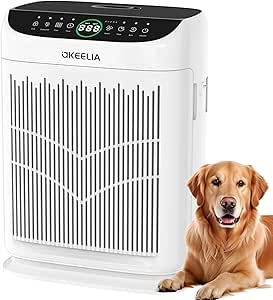 | Best for Broad Air Intake | Coverage area: Up to 3,000 sq. ft. | Air intake: Double-sided, 360° | Fan speeds: 5 | VIEW LATEST PRICE | See Our Full Breakdown |
| AirHub Air Purifier for Home Bedroom and Large Rooms (Up to 1092 ft²) |  | Best for Quiet, Sensor-Led Bedroom Use | Coverage: Up to 1,092 ft² at 1 air change per hour; 209 ft² at 4.8 air changes per hour | Filtration: Two three-stage systems: washable pre-filter, True HEPA, and activated carbon | Particle capture: 99.97% of particles as small as 0.3 microns | VIEW LATEST PRICE | See Our Full Breakdown |
| LEVOIT Vital 200S-P Smart Air Purifier for Large Rooms |  | Best for Large Rooms and Pet Hair | Room coverage: Up to 1,875 ft² | Smoke CADR: 250 CFM | Dust CADR: 254 CFM | VIEW LATEST PRICE | See Our Full Breakdown |
| Levoit Eleva 300X Air Purifier for Home Bedroom |  | Best for Detailed PM Monitoring | Coverage: Up to 1,200 ft² | CADR: 161 CFM | Filtration: Fully sealed HEPA with a dual-filter design and activated carbon | VIEW LATEST PRICE | See Our Full Breakdown |
| KNKA APH4000 Air Purifier for Home, White |  | Best for Pet-Focused Modes | Maximum coverage: 1,695 ft² at 1 air change per hour | Faster-cleaning coverage: 4.8 air changes per hour in rooms up to 350 ft² | Smoke/dust/PM2.5 CADR: 226 CFM (384 m³/h) | VIEW LATEST PRICE | See Our Full Breakdown |
| VEWIOR 2-Pack Air Purifiers with Washable H13 Filter |  | Best Two-Room Set | Package quantity: Two air purifiers | Coverage: Up to 1,200 ft² per unit | Filtration: Three-stage: washable pre-filter, H13 filter, and activated carbon | VIEW LATEST PRICE | See Our Full Breakdown |
| DREO Air Purifier with HEPA Filter, PM2.5 Monitor, Auto and Sleep Modes, and Scent Diffuser |  | Best for Small Rooms | Model: DR-HAP008 (Dreo 338) | CADR: 115 CFM | Recommended room size: 178 sq. ft. at 4.8 ACH | VIEW LATEST PRICE | See Our Full Breakdown |
| MOOKA Air Purifier for Large Rooms, White |  | Best for Quiet Overnight Use | Coverage: Up to 2,200 sq. ft. | Filtration: Three-stage filtration with HEPA filter and washable pre-filter | Air-quality sensor: PM2.5 sensor with digital display | VIEW LATEST PRICE | See Our Full Breakdown |
| GoveeLife Air Purifier for Large Rooms (Up to 1162 ft²) with 360° Intake |  | Best for Smart-Home Control | CADR: 150 CFM | Coverage area: Up to 1,162 sq. ft. | Air intake: 360° | VIEW LATEST PRICE | See Our Full Breakdown |
| Dreo 539 Air Purifier with PM2.5 Monitor, AHAM Verified, 4 Speeds, Auto & Sleep Modes |  | Best for Verified PM2.5 Performance | Model: DR-HAP009 (Dreo 539) | CADR: 158 CFM | Coverage: Up to 1,176 sq. ft. at 1 ACH; 245 sq. ft. at 4.8 ACH | VIEW LATEST PRICE | See Our Full Breakdown |
| GoveeLife Smart Air Purifier for Large Rooms |  | Best for App and Automation | CADR: 135 CFM | Coverage: Up to 1,046 sq. ft. at 1 ACH; 523 sq. ft. at 2 ACH | Filtration: Three-stage filtration | VIEW LATEST PRICE | See Our Full Breakdown |
| air purifiers for PM2.5 | Sleep Mode noise | Filtration |
|---|---|---|
| FreAire HAP605 Air Purifier fo | 20 dB | — |
| ECOSELF HAP602 Air Purifier fo | 20 dB | 3-stage True HEPA |
| ECOSELF Air Purifier for Large | 22 dB | — |
| ECOSELF Air Purifier for Large | 20 dB | Pre-filter, HEPA filter, and activated carbon layer |
| Akeelia Double-Sided HEPA Air | Under 20 dB | — |
| AirHub Air Purifier for Home B | — | Two three-stage systems: washable pre-filter, True HEPA, and activated carbon |
| LEVOIT Vital 200S-P Smart Air | — | — |
| Levoit Eleva 300X Air Purifier | — | Fully sealed HEPA with a dual-filter design and activated carbon |
| KNKA APH4000 Air Purifier for | — | Dual three-stage cartridges with washable pre-filters, high-efficiency filters, and activated carbon |
| VEWIOR 2-Pack Air Purifiers wi | — | Three-stage: washable pre-filter, H13 filter, and activated carbon |
| DREO Air Purifier with HEPA Fi | — | — |
| MOOKA Air Purifier for Large R | As low as 20 dB | Three-stage filtration with HEPA filter and washable pre-filter |
| GoveeLife Air Purifier for Lar | 24 dB | — |
| Dreo 539 Air Purifier with PM2 | — | — |
| GoveeLife Smart Air Purifier f | 24 dB | Three-stage filtration |
More Details on Our Top Picks
FreAire HAP605 Air Purifier for Large Rooms (Up to 2600 sq. ft.)
For large rooms where pet-related particles and changing PM2.5 levels are the main concern, the FreAire HAP605 pairs a real-time sensor and Auto Mode with a dedicated Turbo Pet Mode. Its triple air intake is designed to circulate air across spaces listed up to 2,600 square feet, giving it a larger stated coverage area than the ECOSELF HAP602. That makes the FreAire the more natural fit for a broad, open area, while the HAP602 offers a child lock and touch controls that may suit family bedrooms better. The FreAire also runs at a stated 20 dB in Sleep Mode with its display lights off. The tradeoff is filter upkeep: the main filter is due every 3–6 months, and the manufacturer calls for genuine FreAire replacements to maintain warranty and fit.
Pros:- Triple air intake is designed to circulate air through a large space.
- PM2.5 sensor and Auto Mode adjust fan speed as air quality changes.
- Turbo Pet Mode targets pet hair, dust, and odors.
- Sleep Mode runs at 20 dB with display lights off.
Cons:- Main filter replacement is recommended every 3–6 months.
- Genuine FreAire replacement filters are required for proper fit and warranty support.
Best for: Pet owners with a large open living area who want automatic PM2.5 response and a dedicated pet mode.
Not ideal for: Buyers who want low-maintenance filtration or flexibility to use third-party replacement filters.
- Model:HAP605
- Coverage area:Up to 2,600 sq. ft.
- Filter type:HEPA with washable pre-filter
- Air intake:Triple air intake
- PM2.5 features:Real-time monitoring and Auto Mode
- Sleep Mode noise:20 dB
- Certifications:ETL, FCC, CARB, CA65
- Warranty:1 year
Our verdict“Choose the FreAire HAP605 for a large, pet-heavy space where automatic PM2.5 monitoring matters more than flexible filter sourcing.”
ECOSELF HAP602 Air Purifier for Large Rooms with True HEPA Filter and PM2.5 Display
The ECOSELF HAP602 puts PM2.5 readings and straightforward controls front and center, with a real-time display, color-coded air quality indicators, and Auto Mode. Its stated coverage reaches 2,400 square feet, slightly below the FreAire HAP605, whose triple intake and Turbo Pet Mode are more specifically tailored to larger pet households. The HAP602 instead adds a child lock and an intuitive touch display, which can make it a more comfortable fit for shared family spaces. Its 20 dB Sleep Mode is also suited to bedrooms where fan noise is a concern. The three-stage True HEPA system is described as refreshing the rated area every 30 minutes, but its filters are not washable and need replacement every 3–6 months. It is not intended to remove heavy pet hair from furniture or floors.
Pros:- Real-time PM2.5 display includes color-coded air quality indicators.
- Auto Mode adjusts fan speed based on sensed air quality.
- Child lock and touch controls suit family spaces.
- 20 dB Sleep Mode is designed for quiet bedroom operation.
Cons:- True HEPA filters are not washable and require replacement every 3–6 months.
- Not designed to remove heavy pet hair from floors or fabric surfaces.
- Listed coverage is lower than the FreAire HAP605.
Best for: Families who want visible PM2.5 feedback, a child lock, and automatic operation in a large shared room.
Not ideal for: Pet owners expecting an air purifier to collect heavy hair from floors or fabrics, or buyers seeking a washable main filter.
- Model:HAP602
- Coverage area:2,400 sq. ft.
- Filtration:3-stage True HEPA
- Air refresh claim:Every 30 minutes
- PM2.5 features:Real-time display and Auto Mode
- Sleep Mode noise:20 dB
- Controls:Touch display and child lock
- Filter replacement interval:Every 3–6 months
Our verdict“Pick the HAP602 if clear air-quality feedback and child-friendly controls matter more than pet-specific features or maximum listed coverage.”
ECOSELF Air Purifier for Large Rooms up to 2,400 sq. ft. with True HEPA Filter
This ECOSELF is the flexible-feature pick for buyers who want PM2.5 monitoring alongside customizable operation. Its infrared sensor feeds an automatic fan adjustment, while timer settings, adjustable speeds, lock controls, and an aromatherapy function give it more options than the simpler ECOSELF HAP602. Both list coverage up to 2,400 square feet, but this model specifies air purification twice per hour and a 22 dB Sleep Mode; the HAP602 lists a quieter 20 dB sleep setting and adds a child lock with a color-coded PM2.5 display. The advertised 99.97% particle capture gives buyers a stated filtration benchmark, though the supplied description does not identify a replacement interval. That makes long-term filter planning less clear than with the HAP602, and the product recommends ECOSELF replacement filters.
Pros:- PM2.5 display and infrared sensor support automatic fan adjustment.
- Rated to purify a space up to 2,400 square feet twice per hour.
- Timer, adjustable fan speeds, and lock controls offer flexible operation.
- Aromatherapy function and filter indicator add useful everyday controls.
Cons:- Sleep Mode is rated at 22 dB, compared with 20 dB for the ECOSELF HAP602.
- The product description does not specify a filter replacement interval.
- The manufacturer recommends ECOSELF replacement filters.
Best for: Buyers who want PM2.5-based automatic operation plus timer, fan-speed, and aromatherapy options in a large room.
Not ideal for: People who prioritize the quietest stated sleep setting or want a clearly specified filter replacement schedule.
- Coverage area:Up to 2,400 sq. ft.
- Air purification frequency:Twice per hour
- Filtration efficiency:Captures 99.97% of airborne particles
- PM2.5 monitoring:Display and infrared sensor
- Sleep Mode noise:22 dB
- Features:Auto Mode, timer, adjustable fan speed, lock controls, aromatherapy, filter indicator
- Certifications:ETL, FCC, EPA, CARB, DOE
- Warranty and support:1 year+ warranty and lifetime technical support
Our verdict“Choose this ECOSELF when adjustable controls and aromatherapy matter more than a quieter stated sleep mode and a clear filter schedule.”
ECOSELF Air Purifier for Large Rooms up to 1,800 sq. ft.
The 1,800-square-foot ECOSELF is a more room-specific choice than the larger HAP602 or FreAire HAP605: its 360° intake and three-stage pre-filter, HEPA, and activated-carbon setup target airborne particles as well as everyday odors. For PM2.5, the sensor supports automatic fan adjustment, so the unit can respond to changing readings without relying on manual speed changes. Compared with the 2,400-square-foot HAP602, this model trades stated coverage for useful household controls, including a 1–24 hour timer, light control, and a child/pet lock. Its 20 dB Sleep Mode also switches off the display and indicator lights. The main compromises are the 3–6 month filter replacement cycle and the recommendation to use a genuine ECOSELF filter; its smaller coverage rating is a mismatch for very large open-plan spaces.
Pros:- PM2.5 sensor supports automatic fan adjustment.
- Three-stage filtration includes a pre-filter, HEPA filter, and activated carbon layer.
- 360° air intake draws air from around the unit.
- 20 dB Sleep Mode turns off the display and indicator lights.
Cons:- Coverage is lower than the HAP602 and FreAire HAP605.
- Filter replacement is recommended every 3–6 months.
- The product recommends a genuine ECOSELF replacement filter.
Best for: Households with a medium-to-large room up to 1,800 square feet that want PM2.5 auto control, odor filtration, and lockable controls.
Not ideal for: Buyers needing the larger stated coverage of the ECOSELF HAP602 or FreAire HAP605, or those wanting flexible filter sourcing.
- Coverage area:Up to 1,800 sq. ft.
- Air intake:360°
- Filtration:Pre-filter, HEPA filter, and activated carbon layer
- Air quality sensor:PM2.5
- Sleep Mode noise:20 dB
- Fan speeds:3
- Timer:1–24 hours
- Filter replacement interval:Every 3–6 months
Our verdict“Choose this model for a room within its 1,800-square-foot rating when odor filtration and quiet, lockable controls take priority over maximum coverage.”
Akeelia Double-Sided HEPA Air Purifier for Large Rooms, White
The Akeelia stands out for double-sided intake and the highest stated coverage in this group, with a rating of up to 3,000 square feet. Its PM2.5 sensor and Auto Mode can adjust operation as the indicator changes, while five fan speeds give more manual control than the three-speed ECOSELF model rated for 1,800 square feet. A washable pre-filter can be vacuumed or rinsed, which helps manage larger debris before it reaches the HEPA filter. The tradeoff is that the HEPA filter still needs replacement every 4–8 months, and faster fan speeds are noisier. Sleep Mode is listed under 20 dB, but buyers should not assume that quiet level applies at higher speeds. The aromatherapy tray is an extra, not a substitute for PM2.5 filtration.
Pros:- Double-sided intake is designed to draw air from both sides.
- PM2.5 sensor and Auto Mode adjust operation based on indicated air quality.
- Removable pre-filter can be vacuumed or rinsed.
- Five fan speeds offer more manual adjustment than the three-speed ECOSELF 1,800-square-foot model.
Cons:- HEPA filter replacement is recommended every 4–8 months.
- Higher fan speeds produce more noise.
- The stated Sleep Mode noise level does not describe noise at stronger speeds.
Best for: Owners of large rooms who want broad intake, several fan-speed choices, and a washable pre-filter for routine upkeep.
Not ideal for: Buyers who need quiet operation at higher speeds or want to avoid replacing the HEPA filter.
- Coverage area:Up to 3,000 sq. ft.
- Air intake:Double-sided, 360°
- Fan speeds:5
- PM2.5 features:Sensor, Auto Mode, and indicator light
- Pre-filter:Removable and washable
- HEPA filter replacement interval:Every 4–8 months
- Sleep Mode noise:Under 20 dB
- Timer:4, 8, or 12 hours
- Certifications:ETL, FCC, EPA, CARB
Our verdict“Pick the Akeelia for a large space where wide intake and a washable pre-filter matter more than quiet high-speed operation.”
AirHub Air Purifier for Home Bedroom and Large Rooms (Up to 1092 ft²)
The AirHub pairs a real-time PM2.5 sensor with Auto Mode, so fan speed can respond to changing particle levels rather than relying on a fixed setting. Its dual-sided intake and two complete filter systems give it a different approach from the single-unit Levoit Eleva 300X, while the included spare filter set lets buyers start with replacements on hand. Sleep Mode reaches 20 dB with the display lights off, a useful fit for light sleepers.
The large-room figure needs context: 1,092 square feet is rated at just one air change per hour, while the faster 4.8-change rate applies to 209 square feet. For frequent smoke or other heavy PM2.5, I would size it around the smaller figure, not the headline coverage. The tradeoffs are manual filter ordering and a diffuser slot rather than a built-in oil reservoir.
Pros:- PM2.5 sensor and Auto Mode adjust fan speed as readings change.
- Dual-sided intake and two complete three-stage filtration systems.
- Includes a second set of pre-filters and HEPA/carbon filters.
- Sleep Mode runs at 20 dB with display lights off.
Cons:- The maximum coverage figure represents only one air change per hour.
- Replacement filters must be sourced and changed manually.
- Aroma feature is a diffuser slot, not an integrated oil tank.
Best for: Light sleepers who want automatic PM2.5 response and plan to use the purifier in a bedroom or other smaller room.
Not ideal for: People seeking fast particle turnover across a large room, since its 1,092-square-foot rating is based on only one air change per hour.
- Coverage:Up to 1,092 ft² at 1 air change per hour; 209 ft² at 4.8 air changes per hour
- Filtration:Two three-stage systems: washable pre-filter, True HEPA, and activated carbon
- Particle capture:99.97% of particles as small as 0.3 microns
- PM2.5 monitoring:High-precision sensor with Auto Mode
- Sleep noise:As low as 20 dB
- Power:24 W
- Included filters:Two pre-filters and two HEPA/carbon filters
- Other features:Child lock, timer, filter-life indicator, and aroma diffuser slot
Our verdict“Choose the AirHub for quiet, sensor-guided bedroom filtration, but not as a high-turnover solution for a large, heavily polluted space.”
LEVOIT Vital 200S-P Smart Air Purifier for Large Rooms
The LEVOIT Vital 200S-P is the capacity-focused choice here: its stated coverage reaches 1,875 square feet, and its listed smoke CADR is 250 CFM. Those figures make it a stronger candidate for broad room coverage than the Levoit Eleva 300X, whose CADR is 161 CFM. For PM2.5, smoke CADR is particularly useful when comparing how quickly a purifier can process smoke-laden air, though room size and operating speed still affect real-world turnover.
Its traditional and U-shaped inlets are designed to draw in pet hair as well as airborne particles, a practical distinction for homes with shedding animals. Smart controls, an air-quality monitor, and sleep mode add convenience. The limitation is sparse filter detail: the supplied information does not spell out capture efficiency or replacement intervals, so buyers wanting those specifics may prefer the more fully described AirHub or VEWIOR systems.
Pros:- Large stated coverage of up to 1,875 square feet.
- Smoke CADR of 250 CFM, with separate dust and pollen CADR figures.
- Traditional and U-shaped inlets are designed to handle pet hair.
- Includes an air-quality monitor, smart controls, and sleep mode.
Cons:- Provided details do not specify filter capture efficiency or replacement intervals.
- Replacement-filter choices are mentioned, but filter details are not provided.
- Listed 27 dB noise level is higher than the AirHub’s 20 dB Sleep Mode figure.
Best for: Households with pets that need a high-capacity purifier for an open-plan living area and want smart controls.
Not ideal for: Buyers who require clearly specified HEPA capture performance and filter replacement guidance before choosing a PM2.5 purifier.
- Room coverage:Up to 1,875 ft²
- Smoke CADR:250 CFM
- Dust CADR:254 CFM
- Pollen CADR:289 CFM
- Noise level:27 dB
- Air inlets:Traditional and U-shaped
- Controls and monitoring:Smart controls and air-quality monitor
- Additional mode:Sleep mode
Our verdict“Pick the Vital 200S-P for large, pet-friendly spaces where stated airflow capacity matters more than detailed filter-life information.”
Levoit Eleva 300X Air Purifier for Home Bedroom
The Levoit Eleva 300X is the most granular monitor in this group: its sensor tracks PM1.0, PM2.5, and PM10, giving app users a wider view of particle levels than the single PM2.5 sensor in the AirHub. A fully sealed HEPA system is intended to keep air from bypassing the filter, and the stated capture rate is 99.97% of allergens down to 0.3 microns. That makes the filtration claim clearer than the information supplied for the LEVOIT Vital 200S-P.
Its 161 CFM CADR and 1,200-square-foot coverage suggest a different priority from the Vital 200S-P’s higher listed smoke CADR: the Eleva leans toward connected monitoring and tailored filtration, not the strongest stated smoke throughput. The main filter can last up to two years, but carbon filters are separate and the full smart experience depends on Wi-Fi and the VeSync app.
Pros:- Tracks PM1.0, PM2.5, and PM10 rather than PM2.5 alone.
- Fully sealed HEPA filtration with a stated 99.97% capture rate down to 0.3 µm.
- Main filter life is listed as up to two years.
- Supports VeSync app, Wi-Fi, Alexa, and Google Assistant.
Cons:- Full smart insights and app controls require Wi-Fi and app use.
- HEPA and carbon filters are separate components with separate replacement needs.
- Its 161 CFM CADR is lower than the Vital 200S-P’s listed 250 CFM smoke CADR.
Best for: App-oriented bedroom users who want PM1.0, PM2.5, and PM10 readings alongside sealed HEPA filtration.
Not ideal for: Buyers who prefer controls and air-quality feedback without Wi-Fi, or who prioritize higher listed smoke CADR over detailed monitoring.
- Coverage:Up to 1,200 ft²
- CADR:161 CFM
- Filtration:Fully sealed HEPA with a dual-filter design and activated carbon
- Particle capture:99.97% of allergens down to 0.3 µm
- Sensor:Monitors PM1.0, PM2.5, and PM10
- Main filter life:Up to 2 years
- Connectivity:Wi-Fi, VeSync app, Alexa, and Google Assistant
- Certifications:AHAM Verified and ECARF Recognized
Our verdict“Choose the Eleva 300X if detailed particle tracking and sealed filtration matter more to you than the highest smoke CADR in this group.”
KNKA APH4000 Air Purifier for Home, White
The KNKA APH4000 makes its case through flexible operating modes rather than app-based detail. PET, ECO, Sleep, and Auto modes let buyers choose between extra airflow for pet-related pollutants, lower-energy operation, or automatic adjustment. Its dual three-stage cartridges combine washable pre-filters, high-efficiency filters, and activated carbon; the real-time, color-coded AQI display also gives a quick visual cue without requiring the app setup offered by the Levoit Eleva 300X.
For PM2.5, the most useful numbers are its 226 CFM smoke/dust/PM2.5 CADR and its rating of 4.8 air changes per hour in rooms up to 350 square feet. The 1,695-square-foot maximum is only one air change per hour, so it is not the right basis for sizing a room with persistent smoke. Compared with the AirHub, it offers a higher stated PM2.5 CADR, but filters need replacement every three to six months.
Pros:- PM2.5, smoke, and dust CADR is listed at 226 CFM.
- Delivers 4.8 air changes per hour in rooms up to 350 square feet.
- PET, ECO, Auto, and Sleep modes support different household needs.
- Dual three-stage cartridges include washable pre-filters and activated carbon.
Cons:- Maximum 1,695-square-foot coverage is rated at only one air change per hour.
- Filters require replacement every three to six months.
- Sleep noise is listed at 22–24 dB, above the AirHub’s 20 dB figure.
Best for: Pet owners who want a dedicated high-airflow mode, visible AQI feedback, and frequent air turnover in a moderate-sized room.
Not ideal for: People expecting fast PM2.5 cleaning throughout a 1,695-square-foot space or seeking long filter intervals.
- Maximum coverage:1,695 ft² at 1 air change per hour
- Faster-cleaning coverage:4.8 air changes per hour in rooms up to 350 ft²
- Smoke/dust/PM2.5 CADR:226 CFM (384 m³/h)
- Pollen CADR:244 CFM (415 m³/h)
- Filtration:Dual three-stage cartridges with washable pre-filters, high-efficiency filters, and activated carbon
- Sleep noise:22–24 dB
- Filter replacement:Every 3–6 months
- Modes and display:PET, ECO, Sleep, and Auto modes; real-time color-coded AQI display
Our verdict“The APH4000 suits pet households wanting strong stated PM2.5 airflow in a moderate room, but its headline coverage is not a rapid-cleaning rating.”
VEWIOR 2-Pack Air Purifiers with Washable H13 Filter
The VEWIOR two-pack is the practical choice for buyers who want separate filtration in two rooms rather than one central unit. Each purifier has a washable pre-filter, H13 filter, activated carbon, and real-time PM2.5 monitoring with Auto Mode. That room-by-room setup differs from the single KNKA APH4000: two units can sit where particles are generated or where people sleep, though they also take up more floor space.
Each unit is rated for up to 1,200 square feet and five air changes per hour, but the supplied details do not name a room size for that five-change rate, so I would not treat it as a guaranteed turnover rate for every room. Sleep Mode is listed as low as 15 dB, quieter on paper than the AirHub’s 20 dB. The washable pre-filter helps limit maintenance, but the main H13 filter still needs replacement every three to six months.
Pros:- Two separate purifiers support room-by-room placement.
- Each unit includes PM2.5 monitoring and Auto Mode.
- Washable or vacuumable pre-filter reduces maintenance on that stage.
- Sleep Mode is listed as low as 15 dB.
Cons:- Two units use more floor space than a single purifier such as the KNKA APH4000.
- The H13 main filter still requires replacement every three to six months.
- The stated five air changes per hour does not include a corresponding room size in the provided details.
Best for: Households that want dedicated PM2.5 monitoring and filtration in two separate bedrooms or living spaces.
Not ideal for: Buyers with limited floor space or anyone expecting washable filters to eliminate ongoing replacement needs.
- Package quantity:Two air purifiers
- Coverage:Up to 1,200 ft² per unit
- Filtration:Three-stage: washable pre-filter, H13 filter, and activated carbon
- Air changes:Up to five per hour; room size for this rate is not specified
- PM2.5 monitoring:Real-time display with Auto Mode
- Sleep noise:As low as 15 dB
- Filter maintenance:Pre-filter is washable or vacuumable; replace main filter every 3–6 months
- Additional features:Child lock, aromatherapy pad, and 2-, 4-, or 8-hour timer
Our verdict“Choose the VEWIOR set to cover two rooms with separate PM2.5-responsive units, provided you have space and accept periodic main-filter replacements.”
DREO Air Purifier with HEPA Filter, PM2.5 Monitor, Auto and Sleep Modes, and Scent Diffuser
The DREO DR-HAP008 is the most clearly sized pick here for a bedroom or home office where PM2.5 levels matter more than broad coverage claims. Its 115 CFM AHAM-verified CADR supports 4.8 air changes per hour in rooms up to 178 sq. ft., a useful benchmark for frequent particle reduction. The live PM2.5 display and automatic fan adjustment also make it easier to see when the purifier is responding to changing air quality. Compared with the larger-room Dreo 539, this model has lower output and a smaller effective room size, but it suits compact spaces without leaning on a one-air-change-per-hour coverage figure. The tradeoff is straightforward: it is not a whole-room solution for larger living areas, and the scent diffuser is an extra rather than a PM2.5 benefit.
Pros:- AHAM-verified 115 CFM CADR with a stated 4.8-ACH area of 178 sq. ft.
- PM2.5 sensor displays readings from 1–999 and signals air quality with color
- Auto mode adjusts fan speed in response to detected air quality
- Sleep mode turns off display lights
Cons:- The 856 sq. ft. figure is based on only one air change per hour
- Lower CADR and smaller effective room size than the Dreo 539
- Scent diffuser adds no particle-removal benefit
Best for: People who want visible PM2.5 readings and automatic particle response in a bedroom or office up to 178 sq. ft.
Not ideal for: Buyers trying to clean a large open-plan room at a frequent air-change rate; its rated 4.8-ACH area is limited to 178 sq. ft.
- Model:DR-HAP008 (Dreo 338)
- CADR:115 CFM
- Recommended room size:178 sq. ft. at 4.8 ACH
- Coverage at 1 ACH:856 sq. ft.
- Filter:Three-layer pre-filter, high-efficiency filter, and activated carbon
- Air quality monitoring:PM2.5 sensor with AQI display from 1–999
- Modes and speeds:Auto, Turbo, Sleep, and Normal; 4 fan speeds
- Certification and energy use:AHAM Verified; ENERGY STAR certified; approximately 125 kWh annually
Our verdict“Choose the DREO DR-HAP008 for sensor-guided PM2.5 cleanup in a compact room, not for rapid purification across a large space.”
MOOKA Air Purifier for Large Rooms, White
The MOOKA prioritizes low-disturbance operation and straightforward upkeep: its sleep mode is rated as low as 20 dB, and a washable pre-filter can catch larger debris before it reaches the HEPA filter. That combination is appealing for bedrooms where a purifier may run for long stretches. It also has a PM2.5 display and auto mode, though the supplied data does not give a CADR or a room area tied to a frequent air-change rate. That makes its “up to 2,200 sq. ft.” claim harder to compare directly with the DREO DR-HAP008, which specifies its area at 4.8 ACH. The MOOKA offers more convenience features, including a child lock and timers, but buyers focused on verifiable PM2.5 throughput should favor models with published CADR figures.
Pros:- Sleep mode noise is listed as low as 20 dB
- Washable pre-filter can reduce the debris reaching the main filter
- PM2.5 sensor, display, and auto mode provide air-quality feedback
- Child lock and selectable 2-, 4-, 6-, or 8-hour timers add household convenience
Cons:- No CADR figure or coverage rating at a specified air-change rate is supplied
- Filter reminder calls for cleaning or replacement after 2,000 hours, which may not reflect actual filter condition
- The protective plastic bag around the filter must be removed before operation
Best for: Light sleepers and families who want a quiet purifier with a PM2.5 display, washable pre-filter, and child lock.
Not ideal for: Buyers who need to compare particle-cleaning speed using a published CADR or a room rating at a frequent air-change rate.
- Coverage:Up to 2,200 sq. ft.
- Filtration:Three-stage filtration with HEPA filter and washable pre-filter
- Air-quality sensor:PM2.5 sensor with digital display
- Fan speeds:4
- Timer:2, 4, 6, or 8 hours
- Sleep mode noise:As low as 20 dB
- Energy consumption:0.63 kWh per 24 hours at maximum speed
- Certifications:CARB, ETL, and DOE
Our verdict“Pick the MOOKA for quiet bedroom operation and practical controls, but choose a model with published CADR data if PM2.5 cleaning speed is your main criterion.”
GoveeLife Air Purifier for Large Rooms (Up to 1162 ft²) with 360° Intake
For shoppers who want voice control alongside meaningful PM2.5 capacity, the GoveeLife 360° Intake pairs a 150 CFM CADR with Alexa and Google Assistant support. Its 360-degree intake and detachable pre-filter suit a central spot in a larger room, while the stated 99.97% particle-capture efficiency describes fine-particle filtration rather than how quickly the unit cleans a particular room. The listed maximum area of 1,162 sq. ft. is not paired with an air-change rate, so I would compare that figure cautiously against the Dreo 539, which publishes both a CADR and a smaller area for 4.8 ACH. GoveeLife’s 24 dB sleep mode and smart-home links are compelling for connected homes; the tradeoffs are 2.4GHz-only Wi-Fi and the need to clean its detachable pre-filter by hand.
Pros:- 150 CFM CADR and 360-degree intake
- Alexa and Google Assistant integration over 2.4GHz Wi-Fi
- Sleep mode noise is listed at 24 dB
- Detachable pre-filter provides a separate surface for routine cleaning
Cons:- The 1,162 sq. ft. coverage figure is not tied to a stated air-change rate
- Does not support 5GHz Wi-Fi
- Detachable pre-filter needs regular manual cleaning
Best for: Smart-home users who want Alexa or Google Assistant control and a 150 CFM purifier for a shared living space.
Not ideal for: Buyers with only 5GHz Wi-Fi or shoppers who need a clearly stated room size at a frequent air-change rate.
- CADR:150 CFM
- Coverage area:Up to 1,162 sq. ft.
- Air intake:360°
- Filtration efficiency:99.97% particle capture
- Sleep mode noise:24 dB
- Connectivity:2.4GHz Wi-Fi, Alexa, and Google Assistant
- Certifications:ENERGY STAR, ETL, FCC, and CA65
- Pre-filter:Detachable
Our verdict“Choose this GoveeLife for connected controls and quiet operation, while favoring the Dreo 539 if you want a stated 4.8-ACH room rating.”
Dreo 539 Air Purifier with PM2.5 Monitor, AHAM Verified, 4 Speeds, Auto & Sleep Modes
The Dreo 539 is the strongest fit in this group for buyers who want PM2.5 monitoring paired with a clearly stated, independently verified airflow figure. Its 158 CFM AHAM-verified CADR is higher than the smaller DREO DR-HAP008’s 115 CFM, and the 539 is rated for 245 sq. ft. at 4.8 air changes per hour. That is a more useful basis for frequent particle reduction than its headline 1,176 sq. ft. figure, which assumes only one air change per hour. The live sensor, color-coded display, and Auto mode help connect air-quality readings to fan operation; a transparent filter window also makes filter checks easier. The tradeoff is that its fast-cleaning area remains modest for a large open-plan room, and its annual energy use is higher than the smaller DREO’s listed figure.
Pros:- Highest listed CADR among these five products at 158 CFM
- AHAM Verified and ENERGY STAR certified
- PM2.5 sensor with LED display and four-color indicator
- 245 sq. ft. rating at 4.8 ACH provides a useful frequent-cleaning benchmark
Cons:- The 1,176 sq. ft. headline coverage is based on only 1 ACH
- Its 4.8-ACH area is still limited for large open-plan spaces
- Listed annual energy use is approximately 162 kWh, above the smaller DREO DR-HAP008
Best for: Buyers who want an AHAM-verified CADR, live PM2.5 readings, and a stated 4.8-ACH room size for a bedroom or medium-sized room.
Not ideal for: People seeking frequent air changes across a large open-plan area; the 4.8-ACH rating is limited to 245 sq. ft.
- Model:DR-HAP009 (Dreo 539)
- CADR:158 CFM
- Coverage:Up to 1,176 sq. ft. at 1 ACH; 245 sq. ft. at 4.8 ACH
- Filter:3-in-1 pre-filter, high-efficiency filter, and activated carbon
- Sensor and display:PM2.5 sensor; LED screen with 4-color RGB indicator
- Modes and speeds:Auto, Turbo, Sleep, and Normal; 4 speeds
- Certification:AHAM Verified and ENERGY STAR
- Annual energy use:Approximately 162 kWh
Our verdict“Choose the Dreo 539 when verified airflow and frequent PM2.5 reduction in a medium room matter more than broad low-rate coverage.”
GoveeLife Smart Air Purifier for Large Rooms
The GoveeLife Smart Air Purifier is a connected alternative for buyers who want app control and automation without needing an on-unit PM2.5 number. Its particle sensor can adjust purification speed in Auto mode, while Alexa and IFTTT support let it fit into routines or voice-controlled homes. The washable pre-filter and three-stage system address particles, odors, and VOCs, and sleep mode is rated at 24 dB. Its 135 CFM CADR is below the 150 CFM GoveeLife 360° Intake and the 158 CFM Dreo 539, so those models have the stronger listed airflow. This unit’s coverage figures also need context: 1,046 sq. ft. is at one air change per hour, falling to 523 sq. ft. at two. It lacks a specific PM2.5 readout, and Turbo mode is louder.
Pros:- App, Alexa, and IFTTT control support connected routines
- Auto mode adjusts purification speed based on detected particles
- Washable pre-filter and three-stage filtration address particles, odors, and VOCs
- Sleep mode noise is listed at 24 dB
Cons:- No specific PM2.5 value is displayed, so a separate monitor is needed for that reading
- 135 CFM CADR is lower than the other GoveeLife model and the Dreo 539
- Does not support 5GHz Wi-Fi, and Turbo mode is louder
Best for: Smart-home users who want app, Alexa, or IFTTT control and automatic fan adjustment in a room where an on-unit PM2.5 reading is not required.
Not ideal for: People who want a visible PM2.5 value or the highest listed CADR; the Dreo 539 and GoveeLife 360° Intake have higher CADRs.
- CADR:135 CFM
- Coverage:Up to 1,046 sq. ft. at 1 ACH; 523 sq. ft. at 2 ACH
- Filtration:Three-stage filtration
- Particle filtration efficiency:99.97% for particles 0.1–0.3 microns
- Smart control:App, Alexa, and IFTTT
- Wi-Fi compatibility:2.4GHz; 5GHz not supported
- Sleep mode noise:24 dB
- Pre-filter and certification:Washable pre-filter; ETL
Our verdict“Choose this model for app-based automation and voice control, but pick the Dreo 539 if visible PM2.5 readings and higher listed airflow are priorities.”

How We Picked
I compared these 15 models through the factors that most affect PM2.5 cleanup at home: stated room coverage, particle filtration claims, airflow and intake design, PM2.5 monitoring, control options, and practical upkeep. I also looked at whether a model’s features serve a clear buyer need—for example, a display for checking particle changes, smart controls for scheduled operation, or a two-unit pack for separate rooms. A purifier’s coverage figure is useful for narrowing choices, but it is not a guarantee of equal performance in every room or at every fan setting.
The ranking favors products with a strong balance of relevant filtration, usable coverage, and features that help buyers run the purifier consistently. Models with PM2.5 displays receive credit for providing useful feedback, but monitoring alone does not make a unit a stronger cleaner. I distinguish smart, monitored, large-room, compact-bedroom, and multi-room options so the order reflects practical fit rather than feature count. Since filter availability, replacement intervals, noise, and exact performance can vary, buyers should confirm those details for the specific model before purchase.
Factors to Consider When Choosing Best Air Purifiers For PM2.5
Choosing an air purifier for PM2.5 is not just a matter of picking the largest coverage figure or a model with a sensor. I’d first match airflow to the room where the purifier will run, then consider whether monitoring and smart controls will change how you use it. These broader checks can help you avoid paying for features that do not solve your main problem.
Match Room Coverage to the Way You’ll Run It
Coverage figures can be reported under different assumptions, so compare the underlying air-cleaning rate when the manufacturer provides it. A large maximum-room claim may reflect slower air changes than you want during smoky or dusty periods. If you want faster particle reduction, choose a unit rated for a room smaller than its maximum and run it at a practical setting. Open layouts complicate the calculation because air must move across connected spaces, not just the room where the purifier sits. A bedroom unit may be a better fit for focused overnight use than one oversized unit placed far from where you spend time. Avoid treating square footage alone as proof that two purifiers will perform equally.
Understand What the PM2.5 Monitor Can—and Can’t—Tell You
A built-in PM2.5 display can show whether a sensor detects changes in fine particles near the purifier, which is useful when cooking, cleaning, or outdoor smoke affects indoor air. It does not measure every pollutant, and readings can differ from a separate monitor because of sensor placement and calibration. Auto mode uses the purifier’s sensor to adjust fan speed, but a low reading may not mean the whole home is clean. A purifier without a display can still filter particles effectively if its filtration and airflow suit the room. If you want to compare readings over time, keep the unit and any separate monitor in consistent locations. Pay for monitoring when the feedback will shape your habits, not just because a screen is present.
Check the Filter Claim and Replacement Path
Look for clear information on particle filtration, filter model numbers, and replacement availability before buying. “HEPA-type” and “True HEPA” are not interchangeable claims, so check the exact wording and supporting specifications for the model. A washable pre-filter can catch larger debris and reduce loading on the main filter, but it does not mean the particle-filtering stage never needs replacement. Ask how filters are changed, how often the maker recommends replacement, and whether the unit will alert you based on time or actual filter condition. A less expensive purifier can become inconvenient if replacement filters are hard to source. For PM2.5, consistent use with a maintained filter matters more than a feature label by itself.
Balance Fan Noise Against the Speed You Need
Purifiers often clean more air at higher fan speeds, while quieter settings move less air. A model that is comfortable on low may not offer the same particle-removal pace as its maximum setting. Check noise information at multiple speeds rather than relying only on a sleep-mode label. For a bedroom, controls that dim lights and allow scheduled operation can make regular use easier. For a living area affected by cooking or smoke, short periods at a stronger setting may matter more than near-silent operation. If possible, choose enough capacity that you can run the unit at a tolerable setting without depending on maximum speed all day.
Choose One Powerful Unit or Several Smaller Ones
A single large-room purifier is straightforward when most of your time is spent in one space, but it cannot clean closed bedrooms at the same time. Multiple smaller units can provide coverage closer to where particles are produced or where people sleep. The tradeoff is managing more filters, power cords, and controls. A two-pack such as the VEWIOR setup may suit separate rooms, but check each unit’s individual coverage rather than adding the two figures together. Doors, hallways, and room boundaries limit how much one purifier can help neighboring spaces. Plan placement around real airflow, with clear space around the intake and outlet.
Decide Whether Smart Features Will Change Your Routine
App control, schedules, and voice-assistant compatibility can make it easier to run a purifier regularly, especially when household routines vary. These features matter less if you prefer a simple manual control panel and leave the unit on a steady setting. Check whether core operation remains available without an internet connection or account, and whether the app provides useful information beyond remote switching. Auto mode is only as helpful as the sensor and its location, so do not assume it will respond perfectly to particles across a whole home. Extra connectivity can add setup steps and another device to manage. Choose smart features for convenience you expect to use, not as a substitute for checking filtration and coverage.
Frequently Asked Questions
Is a PM2.5 display a reason to choose one purifier over another?
A display is useful if you want feedback on particle changes or plan to use auto mode, but it should not be your main measure of cleaning ability. Compare the purifier’s filtration claims and airflow for your room first. Sensor readings describe conditions near the unit and may not match air in another room or corner. If you already own a reliable particle monitor, a purifier without a built-in display may still meet your needs. Choose a display when the information will help you adjust operation or understand indoor changes.
Will one large-room purifier clean PM2.5 throughout my whole home?
Usually, one unit works best in the room where it is placed, especially when doors are closed or the home has separate floors. Air can move between connected areas, but that movement does not guarantee the same particle reduction in each space. For bedrooms and frequently used rooms, separate purifiers can provide more direct coverage. If you choose one central unit, keep it in an open location and check whether its airflow suits the combined space. Avoid adding room-size claims together or assuming a hallway will distribute cleaned air evenly.
Should I buy the purifier with the largest stated coverage?
Not automatically. Coverage depends on the air-cleaning rate and the conditions behind the manufacturer’s figure, including how often air passes through the filter. A unit with more capacity can give you room to run it at a quieter speed, but its size, noise, and filter costs may not suit a smaller space. Compare coverage with the room where you will use it and look for airflow information when available. If you need rapid cleanup during particle spikes, reserve extra capacity rather than relying on a maximum-area claim alone.
Can a washable filter replace the main filter for PM2.5?
A washable pre-filter generally catches larger particles such as lint and hair; it does not automatically replace the main fine-particle filter. Check the product’s filter design and identify which stage is responsible for capturing PM2.5. Follow the cleaning instructions and let washable components dry fully before reinstalling them. The main filter may still need periodic replacement, and a clogged filter can reduce airflow. Before buying, confirm replacement parts are available for the exact model.
Is a two-pack better than one larger purifier for a multi-room home?
Two units can be a better fit when you want direct filtration in two separate rooms, such as a bedroom and a living area. One larger unit may be simpler and more suitable if most activity happens in one open space. Compare each purifier’s individual room coverage, because the combined stated area does not mean the units can clean one large room as a single system. Two units also mean more filter maintenance and more space to place them. Pick the arrangement that matches where people spend time and where PM2.5 sources occur.
Conclusion
For the broadest mix of room capability and useful controls, I’d choose the LEVOIT Vital 200S-P as best overall. The best value depends on your room and filter needs, but shoppers seeking simpler coverage should compare the large-room ECOSELF and FreAire options against replacement-filter availability before deciding. For a premium, feature-focused pick, look at smart models such as the GoveeLife Smart Air Purifier; for beginners, a straightforward unit with clear controls may be easier to live with than an app-heavy model. If particle readings are your priority, choose the Dreo 539 or ECOSELF HAP602; if you need separate-room coverage, consider the VEWIOR two-pack. Match your final choice to the space you want to clean, the fan speed you can tolerate, and the filter upkeep you are willing to handle.