The Airthings View Plus is my best overall pick for readers who want broad indoor monitoring that includes radon, while the AirGradient ONE stands out for detailed readings and Home Assistant support. For a simpler starting point, the Amazon Smart Air Quality Monitor focuses on a smaller set of common indoor readings and smart-home alerts. The main tradeoff is between pollutant coverage, measurement detail, and ease of use: a long sensor list does not automatically mean better data or a clearer next step. I also compare portable models, screen-first monitors, and devices built around specific concerns such as CO₂ or particulate matter. Read on for the full breakdown and help choosing among the 15 options.

Get health and wellness essentials delivered free with Prime
- Fast, free delivery on millions of items
- Prime Video, Amazon Music and more included
- Member-only deals all year
Key Takeaways
- Sensor breadth and useful measurement are not the same thing: several models advertise 16-in-1 monitoring, but buyers should check exactly which pollutants are measured and how clearly readings are presented.
- The Airthings View Plus has a distinctive role: radon monitoring separates it from general-purpose options such as the GoveeLife and Amazon monitors.
- The AirGradient ONE is the specialist choice for connected, detailed monitoring: its Home Assistant support suits users who want more control than a basic display or app offers.
- Portable monitors trade household convenience for flexibility: the 10-in-1 portable models can move between rooms, while larger screen-based units are better suited to a fixed monitoring spot.
- Simple smart-home alerts can matter more than a long sensor list: the Amazon and GoveeLife options are easier to approach for focused monitoring, but they cover a narrower set of needs than broader monitors.
| 16-in-1 Indoor Air Quality Monitor with 7-Inch Display |  | Best for a Large, At-a-Glance Display | Measurements: CO2, PM2.5, PM1.0, PM10, HCHO, TVOC, temperature, humidity, AQI, and time | Display: 7-inch LED display | Display brightness: 3 settings | VIEW LATEST PRICE | See Our Full Breakdown |
| Lecoolife 16-in-1 Indoor Air Quality Monitor with 7-Inch Display |  | Best for Calibration Controls | Measurements: CO2, PM1.0, PM2.5, PM10, HCHO, TVOC, temperature, humidity, AQI, and more | Display: 7-inch screen with adjustable brightness | Alerts: Audible buzzer with mute function | VIEW LATEST PRICE | See Our Full Breakdown |
| 10-in-1 Portable Air Quality Monitor with CO₂, Formaldehyde, TVOC, and Particulate Detection |  | Best for Portable Monitoring | Measurements: CO2, HCHO, TVOC, benzene, AQI, PM1.0, PM2.5, PM10, temperature, and humidity | Measurement error margin: Less than ±5%, as stated | Display: HD color screen | VIEW LATEST PRICE | See Our Full Breakdown |
| YNAK 16-in-1 Indoor Air Quality Monitor with 5.5-Inch HD Display | 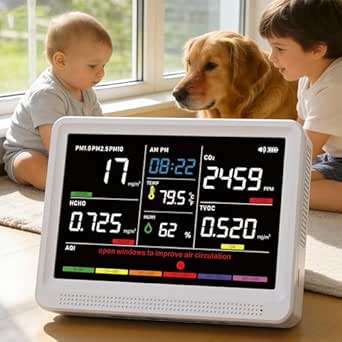 | Best Compact Display Pick | Measurements: CO2, PM2.5, PM1.0, PM10, HCHO, TVOC, temperature, humidity, and AQI | Display: 5.5-inch HD LED | Display brightness: 3 levels | VIEW LATEST PRICE | See Our Full Breakdown |
| Airthings View Plus Battery-Powered Radon and Indoor Air Quality Monitor |  | Best for Radon and Long-Term Trends | Measurements: Radon, PM2.5, CO2, VOCs, humidity, temperature, and air pressure | Power: Battery-powered | Connectivity: WiFi | VIEW LATEST PRICE | See Our Full Breakdown |
| GoveeLife Smart Air Quality Monitor with PM2.5 Sensor and LED Display |  | Best for Smart-Home Automation | Model: H5106 | Measurements: PM2.5, temperature, humidity | PM2.5 accuracy: ±15 µg/m³ from 0 to 100 µg/m³; ±15% from 100 to 1,000 µg/m³ | VIEW LATEST PRICE | See Our Full Breakdown |
| AQItech 16-in-1 Indoor Air Quality Monitor with AQI Alerts |  | Best for Broad Coverage and Audible Alerts | Model: 9AQI+7 AQI Alert Buzzers+Time | Measurements: PM1.0, PM2.5, PM10, CO2, TVOC, HCHO, temperature, humidity | Update interval: Every 3 seconds | VIEW LATEST PRICE | See Our Full Breakdown |
| 10-in-1 Air Quality Monitor with AQI Grading and Data Logging |  | Best for Portable Trend Logging | Model: AK33 | Measurements: CO2, HCHO, TVOC, PM1.0, PM2.5, PM10, temperature, humidity | AQI grading: Automatic, 5 levels | VIEW LATEST PRICE | See Our Full Breakdown |
| AirGradient ONE Indoor Air Quality Monitor (I-9PSL-DE) with Home Assistant Support | 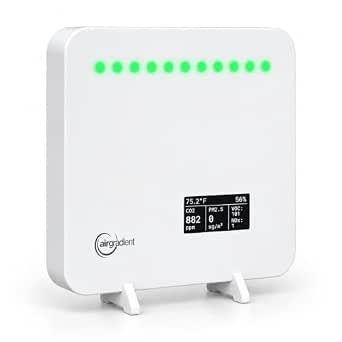 | Best for Home Assistant and Open Data | Model: I-9PSL-DE | Measurements: PM2.5, CO2, TVOC, NOx, temperature, relative humidity | Sensors: SenseAir NDIR CO2; Plantower PMS5003 particle sensor; Sensirion SGP41 TVOC/NOx; Sensirion SHT40 temperature and humidity | VIEW LATEST PRICE | See Our Full Breakdown |
| 16-in-1 Indoor Air Quality Monitor with Real-Time Color Display |  | Best for Fast Portable Readings | Model: AK16C | Measurements: PM1.0, PM2.5, PM10, TVOC, HCHO, temperature, humidity | Sampling interval: 1.5 seconds | VIEW LATEST PRICE | See Our Full Breakdown |
| Aranet4 Wireless Indoor Air Quality Monitor with CO2 Detector |  | Best for CO2-Focused Monitoring | Measurements: CO2, temperature, relative humidity, atmospheric pressure | CO2 sensor: NDIR | Display: E-ink | VIEW LATEST PRICE | See Our Full Breakdown |
| Amazon Smart Air Quality Monitor |  | Best for Alexa Households | Sensors: PM2.5, VOCs, carbon monoxide, humidity, temperature | Connectivity: 2.4 GHz Wi-Fi and Bluetooth Low Energy 4.2 | Status indicator: Multicolor LED | VIEW LATEST PRICE | See Our Full Breakdown |
| BREATHE Airmonitor Plus Gen 2 8-in-1 Indoor Air Quality Monitor |  | Best for Detailed App Tracking | Measurements: CO2, PM1, PM2.5, PM10, TVOC, formaldehyde, temperature, humidity | CO2 sensor: NDIR | Connectivity: 2.4 GHz Wi-Fi | VIEW LATEST PRICE | See Our Full Breakdown |
| 16-in-1 Indoor Air Quality Monitor with HD Color Screen |  | Best for Fast On-Device Readings | Measured indicators: PM1.0, PM2.5, PM10, TVOC, HCHO, temperature, humidity | Sampling interval: 1.5 seconds | Display: HD color screen with color-coded readings | VIEW LATEST PRICE | See Our Full Breakdown |
| Portable 10-in-1 Indoor Air Quality Monitor | 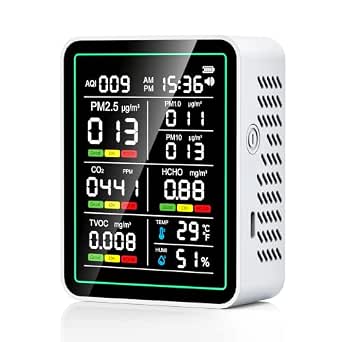 | Best for Longer Cordless Use | Measurements: CO2, HCHO, TVOC, benzene, PM1.0, PM2.5, PM10, temperature, AQI | Measurement error: Less than ±5% | Display: HD color LED screen | VIEW LATEST PRICE | See Our Full Breakdown |
| air quality monitor | Measurements | Display | Model |
|---|---|---|---|
| 16-in-1 Indoor Air Quality Mon | CO2, PM2.5, PM1.0, PM10, HCHO, TVOC, temperature, humidity, AQI, and time | 7-inch LED display | — |
| Lecoolife 16-in-1 Indoor Air Q | CO2, PM1.0, PM2.5, PM10, HCHO, TVOC, temperature, humidity, AQI, and more | 7-inch screen with adjustable brightness | AK22B |
| 10-in-1 Portable Air Quality M | CO2, HCHO, TVOC, benzene, AQI, PM1.0, PM2.5, PM10, temperature, and humidity | HD color screen | — |
| YNAK 16-in-1 Indoor Air Qualit | CO2, PM2.5, PM1.0, PM10, HCHO, TVOC, temperature, humidity, and AQI | 5.5-inch HD LED | WBA03 |
| Airthings View Plus Battery-Po | Radon, PM2.5, CO2, VOCs, humidity, temperature, and air pressure | Customizable eInk screen | 2960 |
| GoveeLife Smart Air Quality Mo | PM2.5, temperature, humidity | LED display with clock and four air-quality indicator levels | H5106 |
| AQItech 16-in-1 Indoor Air Qua | PM1.0, PM2.5, PM10, CO2, TVOC, HCHO, temperature, humidity | — | 9AQI+7 AQI Alert Buzzers+Time |
| 10-in-1 Air Quality Monitor wi | CO2, HCHO, TVOC, PM1.0, PM2.5, PM10, temperature, humidity | 3-color digital display | AK33 |
| AirGradient ONE Indoor Air Qua | PM2.5, CO2, TVOC, NOx, temperature, relative humidity | 1.3-inch OLED and 11-LED color bar | I-9PSL-DE |
| 16-in-1 Indoor Air Quality Mon | PM1.0, PM2.5, PM10, TVOC, HCHO, temperature, humidity | HD color screen with color-coded air-level readings | AK16C |
| Aranet4 Wireless Indoor Air Qu | CO2, temperature, relative humidity, atmospheric pressure | E-ink | — |
| Amazon Smart Air Quality Monit | — | — | — |
| BREATHE Airmonitor Plus Gen 2 | CO2, PM1, PM2.5, PM10, TVOC, formaldehyde, temperature, humidity | — | — |
| 16-in-1 Indoor Air Quality Mon | — | HD color screen with color-coded readings | — |
| Portable 10-in-1 Indoor Air Qu | CO2, HCHO, TVOC, benzene, PM1.0, PM2.5, PM10, temperature, AQI | HD color LED screen | — |
More Details on Our Top Picks
16-in-1 Indoor Air Quality Monitor with 7-Inch Display
For a fixed spot where several people need to read the numbers, this monitor’s 7-inch display is its clearest advantage. It tracks CO2, particulate sizes, HCHO, TVOC, temperature, humidity, and AQI, with alerts for changes that might otherwise go unnoticed. Compared with the YNAK 16-in-1, it offers a larger screen, while YNAK specifies a slightly longer battery runtime. This model’s up to 8 hours of cordless use is useful for moving it between rooms, but it is not a set-and-forget portable monitor for extended trips. The listed “16-in-1” count also includes alert functions, rather than 16 separately identified measurements. Strong odors and perfumes can affect its sensors, so it suits routine room monitoring better than testing air during fragrance-heavy activities.
Pros:- Tracks CO2, PM1.0, PM2.5, PM10, HCHO, TVOC, temperature, humidity, and AQI.
- Large 7-inch display has three brightness settings.
- Real-time alerts include a mute option.
- USB-C charging and up to 8 hours of battery runtime allow some cordless placement.
Cons:- The stated 16-in-1 count includes alert functions, not just detectable parameters.
- Perfumes and strong odors may affect sensor readings.
- Up to 8 hours of runtime is limited for extended portable monitoring.
Best for: Households that want large, easy-to-read readings and alerts in a shared room, with occasional cordless placement.
Not ideal for: Buyers who need a clearly documented set of 16 distinct measurements, long battery monitoring, or readings around perfumes and strong odors.
- Measurements:CO2, PM2.5, PM1.0, PM10, HCHO, TVOC, temperature, humidity, AQI, and time
- Display:7-inch LED display
- Display brightness:3 settings
- Alerts:7 AQI alert functions; mute button
- Battery runtime:Up to 8 hours
- Charging:USB-C; AC adapter included
- Temperature units:Fahrenheit and Celsius
Our verdict“Choose this model if a large display matters more than longer battery life or a clearly itemized 16-measurement count.”
Lecoolife 16-in-1 Indoor Air Quality Monitor with 7-Inch Display
The Lecoolife is a good fit for buyers who want a large screen but also value built-in calibration support, a control the first 7-inch monitor does not list. Its readings cover CO2, particle sizes, HCHO, TVOC, temperature, humidity, and AQI, with an audible buzzer that can be muted. You can also choose 12- or 24-hour time and Fahrenheit or Celsius, small conveniences for a monitor that stays visible in a room. Compared with the 10-in-1 portable monitor, Lecoolife gives up voice alerts and a specified 20-hour battery for a larger display and calibration support. The tradeoff is that its “16-in-1” description does not identify every additional measurement, and no battery runtime is provided. Strong odors can affect the sensors, so calibration is not a substitute for careful placement.
Pros:- Measures CO2, PM1.0, PM2.5, PM10, HCHO, TVOC, temperature, humidity, and AQI.
- 7-inch screen has adjustable brightness for different rooms.
- Built-in calibration support and a mute option for the audible buzzer.
- Offers 12- or 24-hour time and Fahrenheit or Celsius settings.
Cons:- The product description does not identify all measurements included in its 16-in-1 count.
- Battery runtime and charging details are not specified.
- Sensors should not be touched or exposed to perfumes and strong odors.
Best for: Homeowners who want a large, always-visible monitor with calibration support and configurable sound and display settings.
Not ideal for: People seeking a clearly specified full sensor list, long cordless runtime, or voice alerts for readings from across the room.
- Measurements:CO2, PM1.0, PM2.5, PM10, HCHO, TVOC, temperature, humidity, AQI, and more
- Display:7-inch screen with adjustable brightness
- Alerts:Audible buzzer with mute function
- Calibration:Built-in calibration support
- Time format:12-hour or 24-hour
- Temperature units:Fahrenheit or Celsius
- Model:AK22B
Our verdict“Pick Lecoolife over the other 7-inch model if calibration controls matter more to you than specified battery runtime.”
10-in-1 Portable Air Quality Monitor with CO₂, Formaldehyde, TVOC, and Particulate Detection
This is the strongest choice in this group for moving a monitor from room to room without frequent recharging: its 2000 mAh battery is rated for up to 20 hours. The measurement list also names benzene alongside CO2, HCHO, TVOC, particulate sizes, temperature, humidity, and AQI, making it more specific about its gas coverage than the Lecoolife’s “and more” description. A color-changing screen and voice alerts make changing readings easier to catch, while one-touch auto-calibration keeps setup simple. Against the YNAK 16-in-1, this model offers longer stated runtime and a named benzene reading, but YNAK has a larger 5.5-inch display. Voice alerts may not suit quiet rooms, and outdoor suitability is not specified. Treat the stated error margin as a manufacturer claim, not a guarantee for every condition.
Pros:- Lists CO2, HCHO, TVOC, benzene, AQI, PM1.0, PM2.5, PM10, temperature, and humidity.
- Rechargeable 2000 mAh battery supports up to 20 hours per charge.
- Color display and voice alerts make readings and threshold changes easier to notice.
- One-touch auto-calibration simplifies operation.
Cons:- Outdoor suitability is not specified.
- Voice alerts may be disruptive in quiet spaces.
- The display size is not provided, making at-a-glance readability harder to compare.
Best for: People who want to carry an air monitor between rooms and prioritize long battery life, voice alerts, and named gas measurements.
Not ideal for: Buyers who need a large, room-readable display, quiet alerts, or a monitor specified for outdoor use.
- Measurements:CO2, HCHO, TVOC, benzene, AQI, PM1.0, PM2.5, PM10, temperature, and humidity
- Measurement error margin:Less than ±5%, as stated
- Display:HD color screen
- Alerts:Voice alerts and color-changing screen indicators
- Calibration:One-touch auto-calibration
- Battery capacity:2000 mAh
- Battery life:Up to 20 hours per charge
Our verdict“Choose this portable model over the YNAK if longer cordless runtime and a specifically listed benzene reading matter more than a larger screen.”
YNAK 16-in-1 Indoor Air Quality Monitor with 5.5-Inch HD Display
The YNAK keeps the broad measurement mix of the other 16-in-1 monitors while trimming the display to 5.5 inches, a practical fit for a desk or shelf where a 7-inch screen would take up more space. It tracks CO2, PM1.0, PM2.5, PM10, HCHO, TVOC, temperature, humidity, and AQI, with three brightness levels and a mute button for its alerts. Its up to 10-hour runtime also exceeds the 8 hours listed for the first 7-inch model, though it falls short of the portable 10-in-1’s 20-hour claim. The compromise is a smaller screen and no listed calibration support. The product cautions that perfumes and strong odors can affect its sensors, so this is better for steady household monitoring than checking air during fragrance use.
Pros:- Measures CO2, PM1.0, PM2.5, PM10, HCHO, TVOC, temperature, humidity, and AQI.
- 5.5-inch HD display has three brightness levels.
- Up to 10 hours of runtime is longer than the first 7-inch monitor’s stated runtime.
- USB-C charging and a mute button support flexible placement and quieter use.
Cons:- The 5.5-inch screen is smaller than the 7-inch displays on the Lecoolife and first monitor.
- Up to 10 hours of runtime is shorter than the portable 10-in-1’s stated 20 hours.
- Sensors may be affected by perfumes and strong odors.
Best for: Buyers who want a portable, broad-coverage monitor that takes up less display space than a 7-inch model.
Not ideal for: People who need the largest possible screen, a long multi-day battery, or stated calibration support.
- Measurements:CO2, PM2.5, PM1.0, PM10, HCHO, TVOC, temperature, humidity, and AQI
- Display:5.5-inch HD LED
- Display brightness:3 levels
- Alerts:7 AQI alert functions; mute button
- Runtime:Up to 10 hours
- Charging:USB-C
- Model:WBA03
Our verdict“Choose the YNAK if you want a smaller-screen alternative to the 7-inch monitors with more stated runtime than the first model.”
Airthings View Plus Battery-Powered Radon and Indoor Air Quality Monitor
The Airthings View Plus is the clear choice here for buyers who want to track radon, which none of the other four listings names. It also monitors PM2.5, CO2, VOCs, humidity, temperature, and air pressure, with WiFi-connected app notifications and historical trends. Unlike the large-screen 16-in-1 models, its customizable eInk display and battery-powered design favor quieter, cable-free placement over a bright dashboard of many readings. It can also connect with other Airthings monitors for multi-room coverage. That connected approach brings a meaningful dependency: the app requires an account and internet access, and data tracking and analysis rely on cloud storage. Choose it over the portable 10-in-1 when radon and ongoing trends matter more than a stated 20-hour rechargeable runtime or voice alerts.
Pros:- Measures radon as well as PM2.5, CO2, VOCs, humidity, temperature, and air pressure.
- Battery-powered design allows cable-free placement.
- App notifications and historical trends support ongoing monitoring.
- Can connect with other Airthings monitors for multi-room coverage.
Cons:- App use requires an account and internet access.
- Tracking and analysis rely on cloud-based data storage.
- The eInk screen is not the same kind of large, multi-reading dashboard offered by the 7-inch models.
Best for: Homeowners who want ongoing radon monitoring, app-based alerts and trends, and the option to link multiple Airthings monitors.
Not ideal for: Buyers who want a standalone monitor without an account or internet, or who prefer a large, immediate reading display and voice alerts.
- Measurements:Radon, PM2.5, CO2, VOCs, humidity, temperature, and air pressure
- Power:Battery-powered
- Connectivity:WiFi
- Display:Customizable eInk screen
- Operating temperature:4 to 40°C (39 to 104°F)
- App requirements:Airthings app, account, and internet access
- Model:2960
Our verdict“Choose the View Plus if radon and long-term app trends are your priority; skip it if you want a fully offline, screen-first monitor.”
GoveeLife Smart Air Quality Monitor with PM2.5 Sensor and LED Display
The GoveeLife H5106 is a focused choice for buyers who mainly want to track fine particles alongside temperature and humidity, then use that information to respond. Its readings refresh every two seconds, and Wi-Fi and Bluetooth monitoring add remote graphs and data export; compatible GoveeLife appliances can also react to changing air quality. Compared with the broader AQItech 16-in-1, it measures fewer categories, but its simpler scope may be easier to act on if PM2.5 is your priority. The tradeoff is that it has no built-in battery, so placement depends on a power outlet. Its PM2.5 accuracy also varies across the stated concentration ranges, and the clock requires 2.4 GHz Wi-Fi. I’d choose it for connected monitoring, not broad pollutant coverage.
Pros:- Refreshes PM2.5, temperature, and humidity readings every two seconds
- Wi-Fi and Bluetooth enable remote monitoring and data export
- Can automate compatible GoveeLife appliances based on air quality
- Compact LED display shows a clock and four air-quality levels
Cons:- Requires continuous wired power and has no built-in battery
- Measures fewer pollutant types than the AQItech 16-in-1
- PM2.5 accuracy varies by concentration range, and clock display requires 2.4 GHz Wi-Fi
Best for: GoveeLife appliance owners who want quick PM2.5, temperature, and humidity updates with remote graphs and automation.
Not ideal for: People who need battery-powered monitoring, a portable room-to-room device, or readings for gases such as CO2 and TVOC.
- Model:H5106
- Measurements:PM2.5, temperature, humidity
- PM2.5 accuracy:±15 µg/m³ from 0 to 100 µg/m³; ±15% from 100 to 1,000 µg/m³
- Temperature and humidity accuracy:±0.54°F; ±3% RH
- Response time:2 seconds
- Connectivity:Bluetooth and 2.4 GHz Wi-Fi
- Display:LED display with clock and four air-quality indicator levels
- Data storage and export:13-day graphs; export data from the past 2 years
- Power and dimensions:Wired Type-C power, no built-in battery; 5.31 x 1.57 x 2.47 inches
Our verdict“Choose the GoveeLife if PM2.5 tracking and GoveeLife appliance automation matter more to you than portability or wide-ranging pollutant measurements.”
AQItech 16-in-1 Indoor Air Quality Monitor with AQI Alerts
For buyers who want a single device to scan a wide range of indoor indicators, the AQItech 16-in-1 offers more breadth than the GoveeLife H5106: it lists PM1.0, PM2.5, PM10, CO2, TVOC, HCHO, temperature, and humidity. Its seven AQI alert buzzers make changing conditions harder to miss, while one-button controls keep basic operation straightforward. That makes it a better fit for checking several rooms or a car than the GoveeLife, which is a more connected, outlet-based PM2.5 monitor. The portability claim has a limit: its battery lasts up to 4–5 hours, so it is not suited to all-day cordless tracking. The supplied details also do not give accuracy figures for the listed sensors, so I would not pick it when documented measurement precision is the main requirement.
Pros:- Lists particulate, gas, temperature, and humidity measurements in one device
- Seven alert buzzers provide audible AQI warnings
- Battery operation allows use away from an outlet
- Simple controls include a way to silence alerts
Cons:- Battery runtime is limited to up to 4–5 hours per charge
- The product information does not specify individual sensor accuracy
- Larger and heavier than the GoveeLife H5106
Best for: People who want a portable monitor covering several particulate and gas indicators, with audible AQI alerts for home, office, or occasional car checks.
Not ideal for: Buyers who need uninterrupted battery operation or published sensor accuracy details for judging readings.
- Model:9AQI+7 AQI Alert Buzzers+Time
- Measurements:PM1.0, PM2.5, PM10, CO2, TVOC, HCHO, temperature, humidity
- Update interval:Every 3 seconds
- AQI alerts:7 alert buzzers
- Battery runtime:Up to 4–5 hours
- Charging:Type-C; adapter and charging cable included
- Weight:12.8 ounces
- Dimensions:7.95 x 5.63 x 2.83 inches
- Warranty:12 months
Our verdict“Pick the AQItech if broad pollutant coverage and audible alerts matter more than long cordless runtime or clearly stated accuracy figures.”
10-in-1 Air Quality Monitor with AQI Grading and Data Logging
The AirWhisper AK33 suits buyers who want more than a momentary reading: it stores up to 9,999 records and offers historical logs plus real-time trend curves. Its list includes CO2, HCHO, TVOC, three particulate sizes, temperature, and humidity, giving it broader coverage than the GoveeLife H5106, which focuses on PM2.5 and room conditions. The color-coded AQI grading and audible cues also make quick checks easier without interpreting every number. Its key limitation is endurance: the stated runtime is 8+ hours, which is useful for a workday check but falls short of continuous, outlet-free monitoring. I’d also be cautious about treating the broad ±0.01% accuracy claim as a clear measure for every sensor; individual ranges and accuracy details are not provided. Choose it for logged trends, not fully specified measurement performance.
Pros:- Stores up to 9,999 readings for later review
- Provides historical logs and real-time trend curves
- Tracks particulate, gas, temperature, and humidity indicators
- Color display and audible cues offer quick AQI feedback
Cons:- Stated battery runtime is 8+ hours, not continuous multi-day operation
- Individual sensor ranges and accuracy details are not specified
- The general ±0.01% accuracy figure does not explain performance for each measurement
Best for: Home and office users who want portable multi-indicator readings with stored history and trend views.
Not ideal for: People who need continuous monitoring without access to charging or sensor-by-sensor accuracy specifications.
- Model:AK33
- Measurements:CO2, HCHO, TVOC, PM1.0, PM2.5, PM10, temperature, humidity
- AQI grading:Automatic, 5 levels
- Display:3-color digital display
- Data logging:Every 5 minutes; up to 9,999 records
- Trend analysis:Historical logs and 50-second real-time fluctuation curves
- Charging and runtime:USB Type-C; 8+ hours per full charge
- Weight and dimensions:9.9 ounces; 2.56 x 0.79 x 5.71 inches
Our verdict“Choose the AirWhisper AK33 if saved readings and trend views are your priority, and accept limited runtime and sparse sensor-specific accuracy information.”
AirGradient ONE Indoor Air Quality Monitor (I-9PSL-DE) with Home Assistant Support
The AirGradient ONE is the strongest fit here for buyers who want an indoor monitor they can connect to a wider smart-home setup. Home Assistant support, open-source firmware, a free API, and a subscription-free dashboard distinguish it from the GoveeLife H5106, whose automation is centered on compatible GoveeLife appliances. AirGradient also lists six measurements and names the sensor families used, including a SenseAir NDIR CO2 sensor and Plantower particle sensor. Its OLED and color bar make local readings visible without opening a dashboard, while the calibrated PM2.5 sensor comes with a digital test report. One limitation: TVOC and NOx are primarily index readings for tracking trends, not absolute concentrations. The supplied US power adapter may also complicate setup outside the US. I’d favor it for integration and data access, not universal plug-and-play convenience.
Pros:- Home Assistant certified with open-source firmware and free API access
- Tracks PM2.5, CO2, TVOC, NOx, temperature, and relative humidity
- Includes a 1.3-inch OLED display and 11-LED color bar
- Individually calibrated for PM2.5 with a digital test report
Cons:- TVOC and NOx are primarily index values rather than absolute concentrations
- Included 5V/2A power adapter is specified for US use
- Smart-home setup and open integrations may be more than casual users need
Best for: Home Assistant users and technically inclined households seeking local display, open integrations, and subscription-free data access.
Not ideal for: Buyers who need absolute TVOC or NOx concentrations, or who need a power adapter suited to a region outside the US.
- Model:I-9PSL-DE
- Measurements:PM2.5, CO2, TVOC, NOx, temperature, relative humidity
- Sensors:SenseAir NDIR CO2; Plantower PMS5003 particle sensor; Sensirion SGP41 TVOC/NOx; Sensirion SHT40 temperature and humidity
- Display:1.3-inch OLED and 11-LED color bar
- Connectivity and integrations:Home Assistant certified, Homey support, free API, community integrations
- Installation:Freestanding or wall-mounted
- Calibration:Individually calibrated for PM2.5; digital test report included
- Included power:6.6 ft (2 m) USB-A to USB-C cable and 5V/2A US power adapter
Our verdict“Choose AirGradient ONE if Home Assistant support and open access to air-quality data matter more than simple setup or absolute TVOC and NOx readings.”
16-in-1 Indoor Air Quality Monitor with Real-Time Color Display
With a stated 1.5-second sampling interval, the AK16C is the quickest-refreshing option in this batch, making it appealing when you want to watch readings change as you move between spaces or respond to a short-lived source. Its color-coded HD screen covers PM1.0, PM2.5, PM10, TVOC, HCHO, temperature, and humidity, while adjustable audio prompts can be switched off. Compared with the AQItech 16-in-1, it updates more frequently, but the AQItech lists CO2 among its measurements and offers seven AQI alert buzzers. The AK16C’s 4–5-hour battery life limits how long it can work away from an outlet, and its product title claims 16-in-1 despite the description naming seven indicators. I’d pick it for quick, portable visual checks, not for extended cordless monitoring or a clearly documented 16-measurement set.
Pros:- Updates readings every 1.5 seconds
- Color-coded HD display makes changing readings easier to scan
- Tracks particulate matter, TVOC, HCHO, temperature, and humidity
- Audio prompts can be turned off for quiet operation
Cons:- Continuous battery runtime is limited to 4–5 hours
- The description lists seven indicators despite the 16-in-1 title
- Does not list CO2 among its stated measurements, unlike the AQItech 16-in-1
Best for: People who want fast-refreshing particulate and gas readings on a color screen for short checks across indoor spaces.
Not ideal for: Buyers who need long battery life, CO2 readings, or a clearly itemized set of 16 measured indicators.
- Model:AK16C
- Measurements:PM1.0, PM2.5, PM10, TVOC, HCHO, temperature, humidity
- Sampling interval:1.5 seconds
- Display:HD color screen with color-coded air-level readings
- Battery life:4–5 hours of continuous sampling
- Charging:USB Type-C; charging cable and AC adapter included
- Weight:14.4 ounces
- Package dimensions:6.7 × 5.3 × 1.6 inches
- Warranty:12 months
Our verdict“Choose the AK16C for quick visual checks and quiet-mode flexibility, but skip it if you need CO2 readings or longer cordless operation.”
Aranet4 Wireless Indoor Air Quality Monitor with CO2 Detector
The Aranet4 earns this role by giving CO2 readings the clearest priority: its NDIR sensor tracks carbon dioxide alongside temperature, humidity, and atmospheric pressure, while the e-ink screen keeps readings visible without a continuously lit display. Color-coded alerts and an optional buzzer can make it easier to react when ventilation is needed. Compared with the BREATHE Airmonitor Plus Gen 2, it measures fewer categories and lacks its CSV export, but it runs on AA batteries for up to four years rather than relying mainly on USB power. Its 90-day app history is useful for reviewing patterns, though historical graphs require a phone. Skip it if you need particulate or formaldehyde readings; this is a focused CO2 monitor, not an all-in-one pollutant analyzer.
Pros:- NDIR sensor measures CO2, with temperature, humidity, and atmospheric pressure also tracked
- E-ink display and color-coded alerts make readings easy to check at a glance
- Up to four years of battery life reduces charging and replacement frequency
- App provides graphs and up to 90 days of historical data
Cons:- Does not measure particulate matter, VOCs, or formaldehyde
- Review of historical data requires the smartphone app
- Uses two AA batteries rather than a rechargeable battery
Best for: People who mainly want dependable indoor CO2 tracking, long battery life, and a glanceable screen for ventilation decisions
Not ideal for: Buyers who need PM, VOC, or formaldehyde measurements, or who want historical graphs directly on the device
- Measurements:CO2, temperature, relative humidity, atmospheric pressure
- CO2 sensor:NDIR
- Display:E-ink
- Battery life:Up to 4 years
- Batteries:2 AA batteries, included
- App history:Up to 90 days
- Dimensions:2.76 x 2.76 x 0.94 inches
- Weight:3.67 ounces
Our verdict“Choose the Aranet4 if long-term, low-maintenance CO2 monitoring matters more to you than measuring a broad range of pollutants.”
Amazon Smart Air Quality Monitor
The Amazon Smart Air Quality Monitor is the easiest fit for buyers who already use Alexa and want air readings to prompt household actions. It tracks PM2.5, VOCs, carbon monoxide, humidity, and temperature, then shares status through a multicolor LED and the Alexa app. Notifications and routines can connect a change in air quality to compatible devices, a practical advantage over the Aranet4, which focuses on CO2 and offers app history rather than Alexa automation. The tradeoff is that this monitor requires power and 2.4 GHz Wi-Fi, and much of its usefulness depends on Alexa-compatible devices or app features. Its listed carbon monoxide measurement is not a substitute for a dedicated CO alarm. Choose it for connected home responses, not as a standalone safety system.
Pros:- Tracks PM2.5, VOCs, carbon monoxide, humidity, and temperature
- Alexa app presents an air quality score and supports phone notifications
- Alexa routines can trigger actions on compatible devices
- Automatic calibration and self-cleaning are listed features
Cons:- Requires a power outlet and 2.4 GHz Wi-Fi
- Alexa features are a poor fit for households outside that ecosystem
- Carbon monoxide monitoring does not replace a dedicated CO alarm
Best for: Alexa users who want indoor air readings, phone notifications, and routines linked to compatible smart-home devices
Not ideal for: People seeking a battery-powered monitor, non-Alexa integration, or a replacement for a dedicated carbon monoxide alarm
- Sensors:PM2.5, VOCs, carbon monoxide, humidity, temperature
- Connectivity:2.4 GHz Wi-Fi and Bluetooth Low Energy 4.2
- Status indicator:Multicolor LED
- Dimensions:65 x 65 x 45 mm
- Weight:120 g without cable or adapter
- Power:AC input, 100–240 V, 50/60 Hz; 5.0 V, 1 A output
- Operating conditions:Indoor use; 0–40 °C and 0–80% humidity
- Warranty:One-year limited manufacturer’s device warranty
Our verdict“Pick this monitor if you want air readings to feed into an Alexa household, and skip it if you need an independent, battery-powered device.”
BREATHE Airmonitor Plus Gen 2 8-in-1 Indoor Air Quality Monitor
For buyers who want more than a live number, the BREATHE Airmonitor Plus Gen 2 pairs a broad sensor set with tools for checking changes over time. It measures CO2 with an NDIR sensor, PM1, PM2.5, PM10, TVOC, formaldehyde, temperature, and humidity; its app adds custom alerts, trend graphs, 90-day history, and CSV export. That makes it more useful for comparing readings or keeping records than the Amazon Smart Air Quality Monitor, whose appeal centers on Alexa notifications and routines. The cost of that extra data access is a greater reliance on the app and 2.4 GHz Wi-Fi. Battery operation lasts only up to six hours, so it suits short moves between rooms, not a full day of untethered monitoring. It also does not detect carbon monoxide, smoke, or gas leaks.
Pros:- Tracks eight listed measurements, including particulate sizes, TVOC, and formaldehyde
- NDIR CO2 sensor measures carbon dioxide directly
- App includes custom alerts, graphs, 90-day history, and CSV export
- USB-C power and a short battery option allow limited placement flexibility
Cons:- Battery runtime is up to six hours, making extended portable use impractical
- Wi-Fi connection is limited to 2.4 GHz networks
- Does not detect carbon monoxide, smoke, or gas leaks
Best for: Homeowners who want several pollutant readings plus app-based alerts, historical trends, and exportable data
Not ideal for: People who need long battery operation, a monitor without Wi-Fi, or coverage for carbon monoxide, smoke, and gas leaks
- Measurements:CO2, PM1, PM2.5, PM10, TVOC, formaldehyde, temperature, humidity
- CO2 sensor:NDIR
- Connectivity:2.4 GHz Wi-Fi
- App history:Up to 90 days
- App features:Remote readings, custom CO2 and PM2.5 alerts, trend graphs, CSV export
- Power:USB-C or battery
- Battery runtime:Up to 6 hours
- Warranty:2 years
Our verdict“Choose the BREATHE if you value detailed app records and broad pollutant coverage more than long cordless runtime or smart-home automation.”
16-in-1 Indoor Air Quality Monitor with HD Color Screen
This monitor is aimed at people who prefer to read changing conditions on the device rather than open an app. Its HD color screen displays particulate matter, TVOC, formaldehyde, temperature, and humidity, with updates listed every 1.5 seconds. One-button controls and a switchable audio prompt keep operation simple, while the included adapter supports plugged-in use. Compared with the BREATHE Airmonitor Plus Gen 2, it emphasizes rapid local display instead of app history, alerts, and CSV export. The title says “16-in-1,” but the supplied data identifies only seven distinct ambient indicators; I would judge it by those listed measurements, not the headline count. Its 4–5-hour battery runtime also limits portable use, and the provided measurement list does not include CO2.
Pros:- HD color display presents readings directly on the device
- Listed sampling interval is 1.5 seconds
- Measures particulate matter, TVOC, formaldehyde, temperature, and humidity
- Includes a Type-C cable and AC adapter
Cons:- Battery runtime is about 4–5 hours per charge
- Product data lists seven ambient indicators despite the 16-in-1 title
- No CO2 measurement is listed
Best for: People who want a screen-first monitor for quick indoor readings and occasional movement between rooms
Not ideal for: Buyers who need CO2 measurement, long cordless operation, or app-based trends and data exports
- Measured indicators:PM1.0, PM2.5, PM10, TVOC, HCHO, temperature, humidity
- Sampling interval:1.5 seconds
- Display:HD color screen with color-coded readings
- Battery runtime:About 4–5 hours
- Charging port:USB Type-C
- Weight:14.4 ounces
- Controls:One-button power and °C/°F switching; double-tap to turn off audio prompt
- Warranty:12 months
Our verdict“Consider this model for quick, screen-based checks of particles and selected gases, but not if CO2 tracking or extended battery use is a priority.”
Portable 10-in-1 Indoor Air Quality Monitor
The zemeollo FAS-SA2 stands out here for its stated up to 20-hour battery life, which gives it a stronger case for moving between rooms or taking readings away from an outlet than the BREATHE Airmonitor Plus Gen 2 or the HD-screen 16-in-1, both of which list much shorter battery runtimes. It covers CO2, HCHO, TVOC, benzene, PM1.0, PM2.5, PM10, temperature, and AQI on a color LED display, with visual alerts when readings pass thresholds. Its appeal is portability and breadth, not documented data analysis: no app, history, or export feature is listed. The stated measurement error is less than ±5%, so I would treat the readings as informative indicators rather than exact lab measurements. Buyers should also note that temperature defaults to Celsius.
Pros:- Up to 20 hours of stated battery life exceeds the portable runtime listed for the BREATHE and HD-screen 16-in-1
- Measures CO2, formaldehyde, TVOC, benzene, PM1.0, PM2.5, PM10, temperature, and AQI
- Color display and visual alerts show readings and threshold changes
- One-button operation and Celsius/Fahrenheit switching keep controls simple
Cons:- Listed measurement error is less than ±5%, so readings may not be exact
- No app, history, or data export feature is listed
- Temperature defaults to Celsius and requires a button press to change
Best for: People who want a portable monitor for moving among rooms, cars, or other listed settings without frequent recharging
Not ideal for: Buyers who need app history, downloadable records, or readings supported by a documented calibration method
- Measurements:CO2, HCHO, TVOC, benzene, PM1.0, PM2.5, PM10, temperature, AQI
- Measurement error:Less than ±5%
- Display:HD color LED screen
- Battery capacity:2000 mAh rechargeable lithium battery
- Battery life:Up to 20 hours
- Charging:USB charging cable included
- Temperature units:Celsius and Fahrenheit
- Recommended uses:Home, cars, plants, pets, schools, hotels
Our verdict“Choose the FAS-SA2 if longer cordless operation and broad on-screen readings matter more than app-based records or detailed data management.”
How We Picked
I ranked these monitors by how well their stated capabilities map to real household decisions: identifying a concern, understanding what a reading means, and deciding whether to ventilate, investigate, or keep monitoring. I gave weight to the pollutants named in each product’s description, how readings are displayed or logged, portability, smart-home support, and whether the device has a useful specialty such as radon detection. A larger advertised sensor count did not automatically earn a higher position; the mix of measurements and the way a buyer can act on them matter more.
The ordering reflects differences in audience and function, not a claim that every monitor measures every pollutant with equal accuracy. Broadly useful coverage and a clear role put the Airthings View Plus and AirGradient ONE ahead of simpler or more narrowly focused choices. Models with large displays and many claimed readings may suit buyers who want at-a-glance information, while dedicated CO₂, PM2.5, portable, and entry-level smart options rank better for specific needs. I also weighed tradeoffs such as limited coverage, reliance on connected features, and the risk of treating a monitor as a substitute for certified alarms or professional testing.
Factors to Consider When Choosing Best Air Quality Monitors
Before choosing, match the monitor to the question you want it to answer. Indoor air devices vary in what they sense, how they explain readings, and whether they help with long-term tracking or only a quick check. These broader points can prevent overbuying a feature list that does not fit your home.
Choose Pollutants Before Counting Sensors
Start with the concern that prompted your search: combustion gases, radon, fine particles, excess humidity, or ventilation. A monitor cannot answer a question about a pollutant it does not measure, even if its packaging lists many other readings. Check whether each item is a direct sensor measurement or a calculated indicator, since an aggregate air-quality score may hide the specific cause of a poor result. Buyers often assume that “more-in-one” means broader protection, but sensor counts can include environmental readings that do not address their main concern. If you have a known exposure risk, choose a device that explicitly names that pollutant and check whether its measurement method suits the intended use. A focused monitor can be a more useful purchase than a crowded feature list.
Match Measurement Detail to the Decision You Need to Make
Ask what you will do when a reading changes. A basic status light may be enough to prompt a window opening, while trend graphs and data logging help identify patterns linked to cooking, occupancy, or time of day. A single number can be hard to interpret without units, thresholds, and historical context. Avoid treating a short-term spike as proof of a persistent hazard; readings can shift with normal activity and room conditions. For ongoing concerns, look for a way to compare readings across days rather than relying on a momentary display. The more consequential the decision, the more valuable clear trends and transparent measurement details become.
Place the Monitor Where It Can Represent the Room
A sensor near a kitchen, window, vent, or purifier may report local conditions rather than the air most people breathe in the room. Choose a stable spot with open airflow and follow the maker’s placement guidance, especially for wall-mounted or battery-powered devices. Portable models make it easier to compare rooms, but moving them frequently can make trends harder to interpret unless you note where each reading came from. One monitor also cannot describe every floor or closed-off area in a large home. If your concern is room-specific, prioritize moving the device or adding a second monitor over expecting one central reading to cover everything. Consistent placement makes comparisons more meaningful.
Treat Connectivity as a Workflow Choice
App access, voice assistant links, smart-home automations, and local integrations are useful only if they fit how you want to respond to readings. An alert on a phone can help when you are away, while a physical screen is easier for household members who do not want another app. Home automation can trigger ventilation or other routines, but only when the monitor, hub, and connected equipment work together as intended. Check whether important readings remain available without an account, internet connection, or compatible ecosystem. A connected device may offer richer history, yet a stand-alone display can be less demanding to maintain. Choose the simplest setup that supports the action you actually plan to take.
Know When a Monitor Is Not a Safety Device
Consumer air monitors can help reveal patterns, but they are not interchangeable with certified smoke, carbon monoxide, or other required safety alarms. Do not rely on an air-quality score to confirm that a home is safe or to diagnose a health problem. For concerns such as radon, use the monitor as one part of a testing plan and follow recognized guidance for confirmation and mitigation. Keep required alarms installed and maintained according to their instructions. If readings remain concerning or symptoms persist, seek appropriate professional advice rather than waiting for a monitor to settle. This distinction matters more than adding extra sensors.
Pay More for a Specific Advantage, Not a Longer List
Higher-complexity monitors make sense when they add a capability you will use, such as radon tracking, detailed history, flexible integration, or broad room-to-room monitoring. A premium device may be poor value if you only need a clear indication of one everyday condition. At the other end, a basic model can create frustration if it omits the pollutant or data history that led you to shop. Think about setup, power, display readability, and ongoing app dependence alongside the sensor list. A useful way to decide is to name one must-have measurement and one must-have interaction, such as a local display or phone alert. If a model does not meet those needs, extra features may not justify choosing it.
Frequently Asked Questions
Can one air quality monitor tell me whether my whole home is safe?
No single room reading represents every space, and a consumer monitor is not a general safety certification. Air can differ between floors, closed rooms, and areas near cooking or ventilation sources. Keep required safety alarms in place and use a monitor to track the pollutants it specifically measures. For concerns that call for formal testing, follow appropriate testing guidance rather than treating a general air-quality score as a final answer. A second device may be more useful than moving one monitor constantly if you need ongoing readings in separate rooms.
Should I choose a monitor with many sensors or one focused on CO₂ or PM2.5?
Choose based on the problem you need to understand, not the sensor count printed in the name. A CO₂-focused device can help you track ventilation patterns, while a PM2.5 monitor addresses fine-particle readings; neither automatically covers radon or every chemical concern. Broad monitors can be convenient, but their readings are only useful if the sensor types and measurement details are clear. Compare the named pollutants, the kind of output provided, and whether you can review trends. If you have one known concern, a focused device may be easier to interpret and act on.
Is a portable air quality monitor better than a screen-based home monitor?
Portability helps if you want to compare rooms or check conditions in more than one location. A fixed monitor with a larger display is often easier for ongoing household use because it stays in a consistent place and makes readings visible at a glance. Moving a portable unit can complicate comparisons unless you allow readings to settle and keep track of its location. Neither format is automatically more accurate; the relevant question is whether you need mobility or a dependable stationary trend. For whole-home tracking, one portable device may still leave gaps in rooms you do not monitor regularly.
Do I need Wi-Fi or a smart-home connection to get useful readings?
No, but connectivity can change how easily you access trends, receive alerts, or connect readings to other devices. A local display may be enough if you check the monitor yourself and do not need remote notifications. Connected features are more useful when you will act on alerts or already use a compatible smart-home system. Before buying, check whether core readings and history remain available when internet access is interrupted, and whether the required app or hub fits your setup. Do not pay for integrations you are unlikely to configure or use.
When should I use professional or dedicated testing instead of a general air monitor?
Use dedicated testing when you need an answer about a specific hazard that the monitor does not measure, or when a result will guide a major health or property decision. Radon is one example where a monitor can support tracking, but buyers should follow recognized testing and mitigation guidance for their situation. A general monitor’s overall score cannot rule out carbon monoxide, mold, or other hazards unless it is explicitly designed to measure the relevant condition—and it may still not replace formal assessment. If readings stay unusual or symptoms continue, contact a qualified professional. Keep certified alarms and required inspections separate from routine air monitoring.
Conclusion
For broad household monitoring with a distinctive radon capability, I recommend the Airthings View Plus as the best overall. The Amazon Smart Air Quality Monitor is my best value for a simpler connected setup, while the AirGradient ONE is my best premium-style choice for detailed monitoring and Home Assistant support. New buyers who want a more approachable smart display can start with the GoveeLife, and readers who need to move a device between rooms should focus on the portable 10-in-1 models. If your priority is one specific pollutant, choose by named sensor coverage rather than the biggest advertised count. The right pick is the one that measures the concern you have and presents the result in a form you will use.