Finding the best ducted fan coil unit starts with knowing what kind of system you are building: these five picks range from a standalone hydronic ceiling unit to complete ducted heat-pump systems, and they are not interchangeable. I rank the COSTWAY 3-ton system first for whole-home ducted heating and cooling, the ROVSUN concealed-duct mini split for a smaller zone with app control, and the First Company 4HBC3RH for buyers who already have chilled- or hot-water piping. The main tradeoff is straightforward: complete systems offer more capability but require matching equipment and professional installation, while component fan coils can fit an existing HVAC design but depend on the right coil, controls, and connections.

Get health and wellness essentials delivered free with Prime
- Fast, free delivery on millions of items
- Prime Video, Amazon Music and more included
- Member-only deals all year
One naming detail matters: a ducted fan coil is the indoor air-moving unit connected to ductwork, but product listings often group it with the outdoor heat pump or describe different hydronic equipment under the same broad label. I distinguish complete split systems from replacement or hydronic fan coils below. Before buying, match the unit to your refrigerant circuit or water loop, electrical service, duct layout, capacity, and installation requirements; a capacity number alone does not establish compatibility.
Key Takeaways
- COSTWAY is the broadest complete-system pick: its 36,000-BTU inverter heat pump supplies ducted heating and cooling, but needs a licensed installer and a compatible installation plan.
- ROVSUN suits a smaller concealed-duct zone: its 17,000-BTU system combines heat-pump operation and smart controls, though its stated 20.3 SEER figure should be verified against the exact model documentation.
- First Company 4HBC3RH is a hydronic fan coil, not a complete heat pump: choose it only when your project already supports chilled or hot water and its connection orientation fits.
- First Company 18HX5 is a simpler 1.5-ton DX fan coil: its horizontal, uncased form and 5-kW electric heat suit a compatible existing system, but it does not include an outdoor unit.
- Daikin Atmosphera is a comparison pick rather than a conventional concealed-duct unit: the supplied description identifies a single-zone split indoor fan coil, so verify that its indoor-unit style meets your ducted-installation requirement.
| COSTWAY 3-Ton Ducted Central Air Conditioner and Heat Pump System, 36,000 BTU, 19 SEER2, 208/230V |  | Best Overall for a Complete Ducted System | Cooling capacity: 36,000 BTU (3 tons) | Efficiency: 19 SEER2; 9 HSPF2 | Airflow: 850 CFM | VIEW LATEST PRICE | See Our Full Breakdown |
| ROVSUN 17000 BTU Smart WIFI Ducted Mini Split AC/Heating System with Inverter | 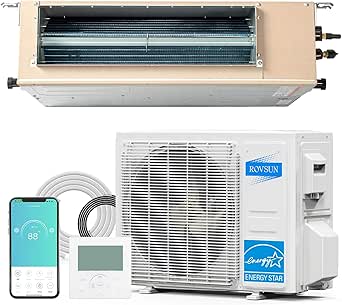 | Best for a Smaller Concealed-Duct Zone | Cooling capacity: 17,000 BTU | Heating capacity: 18,000 BTU | Efficiency listed: 20.3 SEER; confirm rating basis and exact model documentation | VIEW LATEST PRICE | See Our Full Breakdown |
| First Company 4HBC3RH 400 CFM Ceiling-Mount Fan Coil |  | Best Hydronic Ceiling-Mount Fan Coil | System type: Ceiling-mount horizontal hydronic fan coil | Coil: Three-row copper tube; chilled or hot water | Airflow: Listing conflict: title states 400 CFM; provided specification states 600 CFM | VIEW LATEST PRICE | See Our Full Breakdown |
| First 18HX5 Company Hx Fan Coil Unit, 1.5 Tons |  | Best Compact Direct-Expansion Replacement Coil | Capacity: 1.5 tons; 18 MBH | System type: Horizontal uncased DX fan coil | Electric heat: 5 kW | VIEW LATEST PRICE | See Our Full Breakdown |
| Daikin Atmosphera 12,000 BTU Heat Pump Mini-Split System |  | Best Small-Zone Split-System Alternative | Model: RXM12WVJU9 / FTXM12WVJU9 | Cooling capacity: 4,800–16,000 Btu/h | Heating capacity: 4,800–22,600 Btu/h | VIEW LATEST PRICE | See Our Full Breakdown |
| ducted fan coil unit | Electrical | Cooling capacity | Airflow | Refrigerant |
|---|---|---|---|---|
| COSTWAY 3-Ton Ducted Central A | 208/230 V, 60 Hz | 36,000 BTU (3 tons) | 850 CFM | R454B |
| ROVSUN 17000 BTU Smart WIFI Du | 230 V | 17,000 BTU | — | R-454B |
| First Company 4HBC3RH 400 CFM | — | — | Listing conflict: title states 400 CFM; provided specification states 600 CFM | — |
| First 18HX5 Company Hx Fan Coi | 208–230 V, single phase, 60 Hz | — | Not provided in supplied product details | — |
| Daikin Atmosphera 12,000 BTU H | 208/230 V | 4,800–16,000 Btu/h | — | R-32 |
More Details on Our Top Picks
COSTWAY 3-Ton Ducted Central Air Conditioner and Heat Pump System, 36,000 BTU, 19 SEER2, 208/230V
I put the COSTWAY first because it is the clearest match for a buyer seeking a complete ducted heating-and-cooling system, rather than a replacement coil alone. Its 36,000-BTU, 3-ton rating places it in a different scale from the ROVSUN 17,000-BTU concealed-duct system and the two First Company fan coils. That makes it the strongest candidate here for a larger ducted zone, provided a contractor confirms that the load calculation and ductwork support that capacity.
The indoor unit can be installed vertically or horizontally, giving a designer more flexibility than the fixed ceiling-mount format of the First Company 4HBC3RH. Its listed 850-CFM airflow, 19 SEER2, and 9 HSPF2 offer useful starting points for system planning; they do not replace a room-by-room load calculation or duct static-pressure check. R454B refrigerant, RS485 or 24V communication, and stated operation down to 5°F in heating and up to 125°F in cooling make this more fully specified than the component-only picks.
The tradeoff is the commitment. This is a heavy indoor/outdoor split system, requires a licensed professional, and needs a new compatible outdoor unit rather than dropping into an unrelated existing setup. Compared with Daikin’s smaller single-zone package, COSTWAY offers far more nominal capacity and an explicitly ducted central configuration, but it also calls for a larger installation and careful system design. I would shortlist it when replacing or creating a substantial ducted system, not when the project is a simple fan-coil swap.
Pros:- Complete 36,000-BTU ducted heat-pump system for heating and cooling.
- Indoor unit supports vertical or horizontal installation.
- Lists 19 SEER2, 9 HSPF2, and 850 CFM for system planning.
- Includes RS485 or 24V communication options and specifies a 5°F heating limit.
Cons:- Licensed professional installation is required.
- Needs a compatible new outdoor unit and substantial space for the indoor and outdoor equipment.
- Capacity and duct performance must be checked against the building rather than selected by square footage alone.
Best for: A homeowner or contractor planning a new 3-ton ducted heat-pump system with a suitable air handler location and professionally designed ductwork.
Not ideal for: Buyers seeking a standalone replacement coil, a DIY installation, a small single-room solution, or a unit to connect to an existing outdoor system without confirmed compatibility.
- Cooling capacity:36,000 BTU (3 tons)
- Efficiency:19 SEER2; 9 HSPF2
- Airflow:850 CFM
- Refrigerant:R454B
- Electrical:208/230 V, 60 Hz
- Indoor unit size:45.5 × 21 × 21 in (H × W × D)
- Outdoor operating range:Heating to 5°F; cooling up to 125°F
- Installation:Indoor unit supports vertical or horizontal installation; licensed professional required
Our verdict“I rank the COSTWAY first for buyers who want a clearly specified, full-size ducted heat-pump system and have professional installation lined up.”
ROVSUN 17000 BTU Smart WIFI Ducted Mini Split AC/Heating System with Inverter
The ROVSUN is my pick for buyers who want concealed-duct delivery in a smaller zone without stepping up to COSTWAY’s 3-ton scale. The listing identifies a 17,000-BTU inverter heat pump intended for residential and light-commercial use, with a wired controller, app and voice-control options, and a stated coverage claim of up to 1,000 square feet. That area figure is only a rough marketing guide; insulation, windows, climate, ceiling height, and duct design can change the required capacity considerably.
For a home where visible wall-mounted equipment is unwanted, the concealed-duct format is the main distinction from the Daikin Atmosphera, whose supplied description does not confirm a ducted indoor chassis. ROVSUN also lists 36-dB operation in mute mode and dehumidification, which may help with comfort in a bedroom, office, or other contained area. Its inverter compressor can vary output rather than operate only at a fixed rate, but the listing’s stated 20.3 SEER figure should be checked against the technical submittal for the exact model before I compare it directly with COSTWAY’s 19 SEER2 rating.
This system still requires professional installation, and the included line set is 16.4 feet; the listing says an extra power cord is needed. It also arrives in two boxes, so installation scheduling should wait until both are received. The product information gives a 230-volt supply and R-454B refrigerant, but buyers should confirm line-set routing, electrical details, condensate handling, controls, and included accessories with the installer. Compared with the larger COSTWAY, ROVSUN is more plausible for a single smaller ducted zone; compared with the First Company hydronic unit, it is a complete heat-pump package rather than a water-loop component.
Pros:- Concealed-duct mini-split format with heating and cooling.
- Inverter operation and a wired controller, plus app and voice-control features.
- Includes a stated 16.4-foot copper line set and signal cable.
- Mute mode is listed at 36 dB and the system includes dehumidification operation.
Cons:- Professional licensed HVAC installation is recommended, and additional power wiring is needed.
- Two separate boxes may arrive at different times.
- The stated 20.3 SEER figure and coverage claim should be verified against the exact system submittal and site load.
Best for: A buyer planning a professionally installed, concealed-duct heat-pump system for a smaller residential or light-commercial zone who values app and voice controls.
Not ideal for: A buyer needing a standalone hydronic coil, a large whole-home system, DIY installation, or a confirmed efficiency comparison without checking the exact model documentation.
- Cooling capacity:17,000 BTU
- Heating capacity:18,000 BTU
- Efficiency listed:20.3 SEER; confirm rating basis and exact model documentation
- Refrigerant:R-454B
- Electrical:230 V
- Noise listing:36 dB in mute mode
- Controls:Wired controller, app, and voice control
- Included line set:16.4 ft copper lines and signal cable; extra power cord required
Our verdict“I would choose ROVSUN over the COSTWAY for a smaller concealed-duct zone, after an installer confirms capacity, efficiency documentation, and the complete wiring requirements.”
First Company 4HBC3RH 400 CFM Ceiling-Mount Fan Coil
The First Company 4HBC3RH earns a place for a different kind of project: it is a hydronic fan coil for chilled- or hot-water service, not a refrigerant split system. If a building already has a boiler, chiller, or other compatible water loop, this ceiling-mount horizontal unit can move conditioned air through ductwork without adding a new outdoor heat pump. That makes it more appropriate for a hydronic retrofit than either the COSTWAY or ROVSUN, both of which are complete heat-pump systems.
Its copper-tube, three-row coil and 120-volt, three-speed motor offer a straightforward component specification. An insulated condensate drain pan is included, and the manual air vent gives the installer a way to purge air from the coil. The published dimensions—36-1/8 inches wide, 21-1/2 inches deep, and 10 inches high—help with ceiling-plenum planning, while its 50-pound weight is far below the listed indoor sections of the COSTWAY system. The product title says 400 CFM, while the provided specifications say 600 CFM; I would treat that discrepancy as a must-confirm detail, not choose a duct design based on either figure until the manufacturer documentation resolves it.
Connection orientation is another practical limitation: water connections are right-hand and the drain connection is left-hand. That arrangement may suit one ceiling layout and complicate another. Unlike the First Company 18HX5, this is a water-coil unit rather than a direct-expansion coil with electric heat, so the two are not substitute parts. I would select the 4HBC3RH only after confirming water temperature, coil capacity, fan performance, access, condensate routing, and controls with the HVAC designer.
Pros:- Designed for chilled- or hot-water operation.
- Three-row copper-tube coil and three-speed 120-volt motor.
- Insulated condensate pan is included.
- Compact 10-inch listed height and 50-pound listed weight can help with ceiling-plenum planning.
Cons:- Right-hand coil and left-hand drain connections limit layout flexibility.
- Listing conflicts between 400-CFM title information and 600-CFM specification information.
- Manual air vent requires service personnel to operate it.
Best for: A contractor or building owner replacing or adding a ceiling-mounted hydronic fan coil in a system with compatible chilled- or hot-water supply.
Not ideal for: A buyer without a hydronic loop, anyone seeking a complete heat-pump system, or a project where the specified right-hand coil and left-hand drain connections cannot be accommodated.
- System type:Ceiling-mount horizontal hydronic fan coil
- Coil:Three-row copper tube; chilled or hot water
- Airflow:Listing conflict: title states 400 CFM; provided specification states 600 CFM
- Motor:120 V, three speed
- Coil connections:Right-hand
- Drain connection:Left-hand
- Dimensions:36-1/8 W × 21-1/2 D × 10 in H
- Weight:50 lb
Our verdict“I recommend the 4HBC3RH for a compatible hydronic ceiling installation, but only after airflow and connection details are confirmed in the manufacturer submittal.”
First 18HX5 Company Hx Fan Coil Unit, 1.5 Tons
The 18HX5 is the most focused component pick in this group: a 1.5-ton horizontal, uncased direct-expansion fan coil with 5-kW electric heat. It is not a complete air-conditioning system; the description gives no outdoor unit, and the coil must match a compatible refrigerant circuit, controls, and duct arrangement. For a replacement project, those details matter more than a broad feature list. Its value is in the defined format and capacity, not plug-and-play compatibility.
At 10 inches high and 37-1/4 inches wide, the listed cabinet dimensions offer a useful starting point for a low-profile horizontal installation. The 208–230V, single-phase, 60Hz electrical specification also helps a contractor screen the job before ordering. Compared with the First Company 4HBC3RH, this model is for a DX refrigerant system with electric backup heat rather than a chilled-water or hot-water loop. Compared with the complete COSTWAY unit, it is a smaller indoor component and does not bring its own outdoor heat pump, controls package, or stated performance ratings.
The listing leaves important selection details unanswered, including airflow, external static pressure, coil performance data, refrigerant type, and exact compatibility requirements. The phrase “uncased” also deserves attention: the installer needs to confirm how the unit will be supported, insulated, accessed, and connected to ductwork in the intended location. I would not treat a matching 1.5-ton label as enough proof that it can replace another manufacturer’s air handler. It belongs on a shortlist only when a qualified technician can verify the complete system match.
Pros:- Defined 1.5-ton capacity for a smaller DX application.
- Horizontal uncased design with a listed 10-inch height.
- Includes 5-kW electric heat according to the product description.
- Lists 208–230V, single-phase, 60Hz electrical service.
Cons:- Standalone fan coil; no outdoor unit is described.
- Airflow, external static pressure, refrigerant type, and coil performance are not supplied.
- System compatibility and uncased installation details need professional confirmation.
Best for: A contractor sourcing a 1.5-ton horizontal DX fan coil with 5-kW electric heat for a confirmed compatible system and constrained installation space.
Not ideal for: A buyer who needs an outdoor unit, a complete heat pump, published airflow and performance data before selection, or a hydronic fan coil.
- Capacity:1.5 tons; 18 MBH
- System type:Horizontal uncased DX fan coil
- Electric heat:5 kW
- Electrical:208–230 V, single phase, 60 Hz
- Dimensions:10 in H × 37-1/4 in W × 21 in
- Airflow:Not provided in supplied product details
- Outdoor unit:Not included in the supplied description
Our verdict“I would consider the 18HX5 for a verified 1.5-ton DX replacement, but not as a complete system or a generic substitute for another air handler.”
Daikin Atmosphera 12,000 BTU Heat Pump Mini-Split System
The Daikin Atmosphera rounds out this list as a small-zone heat-pump alternative, rather than my first choice for a conventional concealed-duct installation. The supplied information describes a single-zone split system with a 12,000-BTU class indoor fan coil, outdoor unit, inverter-driven compressor, remote, and app controls. It offers both heating and cooling, and its R-32 refrigerant and broad listed capacity modulation give buyers useful system characteristics. Yet the listing does not identify the indoor unit as a concealed-duct air handler, so a buyer shopping specifically for ducted equipment should confirm the exact indoor-unit configuration before treating it as a match.
Its listed cooling range of 4,800–16,000 Btu/h and heating range of 4,800–22,600 Btu/h set it apart from the fixed-capacity impression of a basic coil, while the stated 27-dB noise figure and 29-pound indoor-unit weight suggest a smaller indoor section than COSTWAY’s 129.5-pound air handler. The manufacturer’s stated coverage estimate is about 600–800 square feet, but I would use a load calculation rather than that general figure to size a space. Compared with ROVSUN, Daikin has a smaller stated zone and a different listed refrigerant; ROVSUN is the clearer concealed-duct pick based on the supplied description.
The system requires its compatible outdoor unit, so this is not a drop-in fan-coil replacement for a different manufacturer’s equipment. The supplied 11.5 SEER figure should also be checked against current technical documents and the exact model pairing; it is not directly comparable with ratings shown under other efficiency conventions. The main reason to keep Daikin in consideration is a buyer who wants a matched single-zone package and whose project accepts the specific indoor-unit format. I would skip it for a ducted project unless the manufacturer confirms that the indoor chassis and duct connection suit the planned installation.
Pros:- Matched single-zone system supplies both heating and cooling.
- Inverter compressor adjusts output to demand.
- Includes remote and app controls, plus dust filtration.
- Listed R-32 refrigerant and indoor sound level of 27 dB.
Cons:- Supplied description does not confirm a concealed-duct indoor unit.
- Requires the compatible outdoor unit and is not described as a standalone replacement coil.
- Listed coverage and efficiency figures need confirmation against the exact installation and technical submittal.
Best for: A buyer seeking a matched single-zone Daikin heat-pump package for a modest space, provided the exact indoor-unit format suits the project.
Not ideal for: A buyer who specifically requires a concealed-duct fan coil, a standalone indoor coil, or compatibility with an existing non-Daikin outdoor unit.
- Model:RXM12WVJU9 / FTXM12WVJU9
- Cooling capacity:4,800–16,000 Btu/h
- Heating capacity:4,800–22,600 Btu/h
- Refrigerant:R-32
- Electrical:208/230 V
- Indoor unit dimensions:11.75 × 36.25 × 10.8125 in
- Indoor unit weight:29 lb
- Controls:Remote and app
Our verdict“I would choose Daikin only when its matched indoor-unit format fits the project; for a confirmed concealed-duct requirement, ROVSUN is the clearer small-zone candidate.”

How We Picked
I ranked these options by how clearly they serve a ducted fan-coil buyer, not by brand recognition or a single efficiency figure. First, I separated complete split systems from fan-coil components. A unit that includes an outdoor heat pump may be useful for a new system, while a standalone fan coil is relevant chiefly when the rest of the HVAC plant and controls are already in place. Mixing those categories without saying so can lead buyers to compare equipment that cannot perform the same job.
Next, I weighed capacity, installation format, operating mode, and compatibility details that are actually supplied. The COSTWAY earns the lead because its listing gives a clear 3-ton capacity, airflow, heating and cooling role, installation orientations, communications options, and operating-temperature information. ROVSUN places next for a smaller concealed-duct application with inverter operation and connected controls. Both are complete heat-pump systems, but their capacity and installation scale differ substantially.
The First Company units have a different advantage: they are identifiable fan-coil components for specific system designs. The 4HBC3RH is a hydronic ceiling-mount model with defined water-coil and connection details; the 18HX5 is a 1.5-ton horizontal direct-expansion coil with electric heat. Their rankings reflect how useful the available information is for matching and selecting a ducted installation, not a claim that either is inferior equipment. The Daikin is included because it has a named indoor fan coil and a complete single-zone heat-pump configuration, but the description does not confirm a concealed-duct indoor chassis. That uncertainty keeps it below the more clearly ducted options.
I also considered what is missing. When a listing does not give airflow, external static pressure, refrigerant connections, coil performance tables, or detailed control compatibility, I do not fill those gaps with assumptions. I treat unconfirmed fit as a real buying risk. Before ordering any of these units, I would have an HVAC contractor check the exact model documentation, the duct system or water loop, electrical requirements, accessory needs, and local code requirements.
| ducted fan coil unit | Refrigerant |
|---|---|
| COSTWAY 3-Ton Ducted Central A | R454B |
| ROVSUN 17000 BTU Smart WIFI Du | R-454B |
| First Company 4HBC3RH 400 CFM | — |
| First 18HX5 Company Hx Fan Coi | — |
| Daikin Atmosphera 12,000 BTU H | R-32 |
Factors to Consider When Choosing Best Ducted Fan Coil Units
I would start by identifying the equipment category, then work through fit and performance. A fan coil may be one component in a larger DX or hydronic system, while a product sold as a ducted heat pump may include an indoor air handler and outdoor unit together. The distinction changes what else you need to buy and what can connect to your existing installation.
Confirm whether you need a complete system or a replacement coil
The COSTWAY and ROVSUN listings describe complete split heat-pump systems; the Daikin listing also describes a matched indoor and outdoor split system, though its ducted format is not established in the supplied details. The First Company 18HX5 is a DX fan-coil component, and the 4HBC3RH is a hydronic fan coil. Before comparing features, identify whether your project has a refrigerant circuit or water loop, and whether an outdoor unit is already installed. A fan coil that does not match the existing system type is not a practical substitute just because the capacity looks similar.
Size from a load calculation, not a headline area claim
Capacity should follow the building’s heating and cooling load, including climate, insulation, window exposure, air leakage, occupancy, and room layout. The ROVSUN listing mentions an area up to 1,000 square feet, and Daikin gives an approximate 600–800-square-foot range, but neither estimate can account for every building. COSTWAY’s 36,000-BTU rating is a much larger class than ROVSUN’s 17,000 BTU or Daikin’s 12,000-BTU class. I would have a qualified HVAC professional calculate the load and confirm capacity at the actual operating conditions before selecting among them.
Match airflow and static pressure to the ductwork
A ducted unit needs to move the required air through the installed supply and return paths. Airflow figures alone do not show whether a fan can overcome the resistance of a particular duct system; external static pressure and fan performance data also matter. COSTWAY lists 850 CFM, but the First Company 4HBC3RH listing conflicts between 400 CFM in its title and 600 CFM in its specifications. I would resolve that discrepancy and obtain performance data before sizing or modifying ducts. The ROVSUN description does not supply an airflow figure in the provided details, so request its technical submittal.
Check installation orientation, access, and connections
Measure the installation space, including service access, filter access, condensate drainage, duct transitions, and clearances—not only the unit’s outside dimensions. COSTWAY allows vertical or horizontal placement, while the 4HBC3RH is a ceiling-mount horizontal unit with right-hand water connections and a left-hand drain. The 18HX5 is described as horizontal and uncased, which makes the enclosure and support plan part of the installation design. ROVSUN’s concealed-duct format can keep equipment out of view, but routing its line set and condensate drain still needs planning.
Compare efficiency ratings on the same basis
Efficiency values help, but they are not interchangeable when they use different test standards or refer to different system pairings. COSTWAY lists 19 SEER2 and 9 HSPF2; ROVSUN’s supplied material says 20.3 SEER and elsewhere describes a 20.3 SEER2 concealed-duct product. That inconsistency calls for confirmation in the current manufacturer documentation. Daikin’s listed SEER is 11.5, while the First Company components do not provide comparable system ratings here. Ask for the exact AHRI or manufacturer match and compare ratings for the complete equipment combination, rather than ranking systems from a single number.
Verify controls, power, and refrigerant or water compatibility
Compatibility can rule out a unit before performance does. COSTWAY lists 208/230V power and RS485 or 24V communication; ROVSUN lists 230V and says extra power cord is needed; Daikin lists 208/230V. The First Company 18HX5 lists 208–230V, single-phase electrical service, while the 4HBC3RH uses a 120V three-speed motor. For DX equipment, confirm the refrigerant, metering arrangement, line sizes, controller, and outdoor-unit match. For hydronic equipment, check water temperatures, flow, coil performance, pipe connections, and the heating or cooling source.
Plan for licensed installation and commissioning
The complete heat-pump systems involve electrical work, refrigerant piping, condensate management, system evacuation and charging procedures, and commissioning. COSTWAY explicitly requires a licensed professional, and ROVSUN recommends a licensed HVAC technician. A component-only fan coil also needs correct integration with the existing equipment and duct or water system. I would confirm installer qualifications, local permit requirements, warranty conditions, included accessories, and the process for startup and airflow balancing before ordering. A well-matched unit can still perform poorly if installation and commissioning are not handled correctly.
Frequently Asked Questions
What is the difference between a ducted fan coil and a complete ducted heat-pump system?
A fan coil is the indoor section that moves air across a heating or cooling coil and sends it through ductwork. It may be one component of a refrigerant-based system or a hydronic water-loop system. A complete ducted heat-pump package includes the indoor air handler and a compatible outdoor unit, along with controls and other required components. In this comparison, COSTWAY and ROVSUN are presented as complete split systems, while the First Company models are fan-coil components with different system requirements.
Which of these products is the clearest choice for a new ducted system?
The COSTWAY is the clearest choice in this group for a new, larger ducted heat-pump system because its listing supplies a 3-ton capacity, indoor and outdoor unit dimensions, airflow, efficiency figures, communication options, and vertical or horizontal indoor installation. ROVSUN is a smaller concealed-duct alternative. I would still have an HVAC contractor confirm the building load, duct capacity, electrical service, and exact equipment pairing before choosing either system.
Can I replace an existing fan coil with any unit of the same capacity?
No. A matching capacity label does not prove that units share the same refrigerant, coil design, airflow capability, controls, electrical requirements, cabinet dimensions, water connections, or duct static-pressure performance. The First Company 18HX5, for example, is a DX unit with electric heat, while the 4HBC3RH is hydronic. I would ask a qualified technician to match the full model information and installation requirements before treating any unit as a replacement.
Are the Daikin and ROVSUN models both suitable for concealed ductwork?
The supplied ROVSUN description explicitly calls it a concealed-duct mini-split system. The supplied Daikin description identifies a single-zone split system with an indoor fan coil but does not establish that its indoor unit is a concealed-duct model. Because indoor formats affect duct connections, mounting, clearances, and installation, I would confirm the exact Daikin model configuration with the manufacturer or installer before including it in a ducted-system shortlist.
What should I verify before ordering one of these fan coil units?
I would confirm the system type, capacity from a load calculation, airflow and external static pressure, refrigerant or water-loop compatibility, electrical supply, controls, connection orientation, cabinet clearance, condensate routing, and required accessories. I would also request current technical submittals, especially where listing details conflict or omit performance data. Finally, confirm that a licensed installer can commission the unit and that the proposed installation follows local code and manufacturer requirements.
Conclusion
My recommendation depends on the system you are building. For a new, larger ducted heat-pump installation, start with the COSTWAY and have a contractor verify that its 3-ton capacity and airflow suit the building. For a smaller concealed-duct zone with app controls, compare the ROVSUN against the project load and request its exact efficiency and performance documentation. If your building already has a hydronic loop, the First Company 4HBC3RH is the relevant component, but confirm the airflow discrepancy and side-specific connections before purchase. The 18HX5 is a narrower option for a verified 1.5-ton DX replacement with electric heat. Daikin belongs on the list when you want its matched single-zone split system, but I would confirm the indoor-unit format before calling it a ducted solution. Across all five, system compatibility and professional sizing matter more than a headline capacity or feature count.