For a nursery, I’d choose the YOWEXA CO2 Monitor with NDIR Sensor and 24-Hour History as the best overall because its trend record helps show whether ventilation changes are working. The GoveeLife H5140 stands out for connected monitoring, while the INKBIRDPLUS PTH-10C suits caregivers who want a portable, straightforward display. The main tradeoffs are sensor type and monitoring confidence, smart features versus simplicity, and a compact device versus a larger, easier-to-read screen. CO2 readings can help flag poor ventilation, but they do not measure every indoor hazard or replace safe-sleep practices. Read on for how all 11 options compare and which features matter most in a nursery.

Get health and wellness essentials delivered free with Prime
- Fast, free delivery on millions of items
- Prime Video, Amazon Music and more included
- Member-only deals all year
Key Takeaways
- History adds practical context: The YOWEXA model with 24-hour history offers a way to review room trends, unlike a reading-only approach.
- Smart monitoring and simple monitoring serve different households: GoveeLife H5140 is the connected pick, while the portable INKBIRDPLUS PTH-10C keeps the focus on local readings.
- More measurements do not automatically mean a better nursery monitor: The Lecoolife 16-in-1 has a broad set of readings and a large display, but buyers should prioritize reliable CO2 measurement and clear alerts.
- Power placement affects everyday usefulness: Plug-in models such as VETOUCH can stay in one spot, while portable monitors offer more freedom to check different rooms.
- Temperature and humidity are useful context, not substitutes for CO2: Several INKBIRD and Temtop options combine these readings, so compare the CO2 sensor and alert features rather than choosing by measurement count alone.
| INKBIRDPLUS PTH-10C Portable CO2 Detector |  | Best for Portable Spot Checks | Sensor: NDIR | CO2 measurement range: 400–5000 ppm | Display: Full-color LCD | VIEW ON AMAZON | See Our Full Breakdown |
| INKBIRD IAM-T2 Smart Indoor Air Quality Monitor |  | Best for Long-Term App Tracking | Measurements: CO₂, temperature, and humidity | Connectivity: Bluetooth 5.0 | Bluetooth range: Up to 100 meters unobstructed | VIEW ON AMAZON | See Our Full Breakdown |
| YOWEXA CO2 Monitor with NDIR Sensor and 24-Hour History | 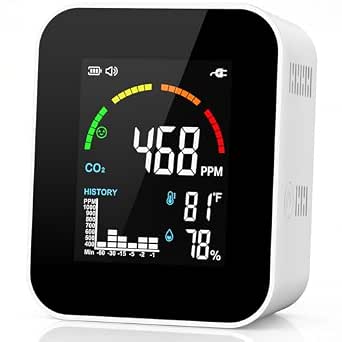 | Best for On-Screen Daily Trends | Sensor: NDIR | Measurements: CO2, temperature, and humidity | CO2 measurement interval: 4 seconds | VIEW ON AMAZON | See Our Full Breakdown |
| Lecoolife 16-in-1 Indoor Air Quality Monitor with 7-Inch Display |  | Best for Broad Air-Quality Monitoring | Measurements: CO₂, PM1.0, PM2.5, PM10, HCHO, TVOC, temperature, humidity, and AQI | Display: 7-inch screen with adjustable brightness | Alerts: Buzzer with mute function | VIEW ON AMAZON | See Our Full Breakdown |
| YOWEXA CO2 Monitor with NDIR Sensor |  | Best for a Low-Threshold Visual Alert | Sensor: NDIR | CO2 measurement range: 400–10,000 ppm | Accuracy: ±5% + 50 ppm | VIEW ON AMAZON | See Our Full Breakdown |
| VETOUCH Plug-In CO₂ Detector and Air Quality Monitor |  | Best Plug-In Nursery Pick | Model: L6088 | Sensor: NDIR; stated five-year lifespan | Measurements: CO₂, temperature, and humidity | VIEW ON AMAZON | See Our Full Breakdown |
| GoveeLife H5140 Smart CO₂ Air Quality Monitor |  | Best for Connected Monitoring | Model: H5140 | CO₂ sensor: SCD4x photoacoustic NDIR | CO₂ accuracy: ±(40 ppm + 5%) | VIEW ON AMAZON | See Our Full Breakdown |
| INKBIRD IAM-O2 Indoor Air Quality Monitor |  | Best for Cord-Free Placement | Model: IAM-O2 | Measurements: CO₂, temperature, and humidity | CO₂ measurement range: 0–9999 ppm | VIEW ON AMAZON | See Our Full Breakdown |
| INKBIRDPLUS Indoor CO₂ Air Quality Monitor with Temperature and Humidity |  | Best for Customizable Thresholds | Model: PTH-9C | Sensor: NDIR CO₂ sensor | Measurements: CO₂, temperature, and humidity | VIEW ON AMAZON | See Our Full Breakdown |
| SwitchBot Meter Pro CO2 Indoor Air Quality Monitor |  | Best Large-Readout Feature Set | CO₂ measuring range: 400–9000 ppm | CO₂ accuracy: ±(50 ppm + 5% of reading) | Sensor response: 1 second | VIEW ON AMAZON | See Our Full Breakdown |
| Temtop Portable Indoor CO2, Temperature, and Humidity Monitor |  | Best Portable Battery-Powered Pick | Brand and model: Temtop C1 | Sensor technology: NDIR | CO2 measurement range: 400–5,000 ppm | VIEW ON AMAZON | See Our Full Breakdown |
| ndir co2 monitor for nursery | Measurements | Display |
|---|---|---|
| INKBIRDPLUS PTH-10C Portable C | — | Full-color LCD |
| INKBIRD IAM-T2 Smart Indoor Ai | CO₂, temperature, and humidity | Backlit LCD |
| YOWEXA CO2 Monitor with NDIR S | CO2, temperature, and humidity | 3-inch color LCD with 3 backlight settings |
| Lecoolife 16-in-1 Indoor Air Q | CO₂, PM1.0, PM2.5, PM10, HCHO, TVOC, temperature, humidity, and AQI | 7-inch screen with adjustable brightness |
| YOWEXA CO2 Monitor with NDIR S | — | — |
| VETOUCH Plug-In CO₂ Detector a | CO₂, temperature, and humidity | 1.83-inch color screen; off, low, and high brightness; 180-degree rotation |
| GoveeLife H5140 Smart CO₂ Air | CO₂, temperature, and humidity | — |
| INKBIRD IAM-O2 Indoor Air Qual | CO₂, temperature, and humidity | — |
| INKBIRDPLUS Indoor CO₂ Air Qua | CO₂, temperature, and humidity | — |
| SwitchBot Meter Pro CO2 Indoor | — | CO₂, temperature, humidity, time, date, and comfort level |
| Temtop Portable Indoor CO2 | — | — |
More Details on Our Top Picks
INKBIRDPLUS PTH-10C Portable CO2 Detector
The lanyard and rechargeable battery make the PTH-10C a practical choice for parents who want to check nursery air in different rooms without leaving a monitor plugged in. Its NDIR sensor, color-coded screen, and customizable sound alert make rising CO2 easier to notice than a number-only display. Compared with the YOWEXA CO2 Monitor with NDIR Sensor, it offers much longer stated battery life, but its listed alarm threshold starts at 1,500 ppm by default, while the YOWEXA alarm is set at 1,000 ppm. That difference matters if you want an earlier audible prompt. The tradeoff is that the PTH-10C needs recharging after about 72 hours and lists no accuracy tolerance, so I would treat it as a portable room-check tool rather than a set-and-forget nursery monitor.
Pros:- NDIR sensor measures CO2 across a stated 400–5000 ppm range
- Lanyard and portable build make room-to-room checks convenient
- Color-coded readings help identify elevated levels at a glance
- Audible alert threshold can be customized
Cons:- Battery needs recharging after about 72 hours
- No accuracy tolerance is specified
- Default audible alert threshold is 1,500 ppm
Best for: Parents who want to carry a CO2 monitor between the nursery and other rooms and prefer color cues with a customizable audible alert.
Not ideal for: Caregivers seeking continuous, always-plugged-in monitoring or a published accuracy tolerance to judge small changes in readings.
- Sensor:NDIR
- CO2 measurement range:400–5000 ppm
- Display:Full-color LCD
- Default audible alert:1,500 ppm; customizable
- Battery capacity:1000 mAh
- Stated battery life:About 72 hours
- Charging time:About 3 hours
- Weight:4.96 ounces
Our verdict“Choose the PTH-10C if portability and adjustable alerts matter more than continuous power or a stated accuracy tolerance.”
INKBIRD IAM-T2 Smart Indoor Air Quality Monitor
App access and long-term records give the IAM-T2 a different nursery role from the simpler PTH-10C: it can track CO₂ alongside temperature and humidity, then keep offline readings for up to 30 days. That history can help parents compare conditions across naps or ventilation changes, while the app supports storage and export. Its 3000 mAh rechargeable battery is rated for over six months per charge, a major convenience advantage over the YOWEXA models, which are designed around USB power for ongoing monitoring. The tradeoff is that the app connection uses Bluetooth, not a stated remote internet connection, and its range depends on an unobstructed link. I would choose it for reviewing patterns nearby, not for checking nursery conditions from elsewhere or treating app records as a substitute for a dedicated alarm system.
Pros:- Tracks CO₂, temperature, and humidity together
- Stores up to 30 days of readings offline
- App supports up to one year of data storage and export
- Battery is rated for over six months per charge
Cons:- Bluetooth range depends on an unobstructed connection
- No CO₂ accuracy tolerance or alarm threshold is listed in the supplied specifications
- Battery-life and storage figures are manufacturer claims
Best for: Parents who want CO₂, temperature, and humidity history in an app and can keep a phone within Bluetooth range when checking readings.
Not ideal for: Families who need remote access outside Bluetooth range or prefer a monitor with clearly specified measurement accuracy and alarm thresholds.
- Measurements:CO₂, temperature, and humidity
- Connectivity:Bluetooth 5.0
- Bluetooth range:Up to 100 meters unobstructed
- Battery:3000 mAh rechargeable lithium
- Stated battery life:Over six months per charge
- Offline data storage:Up to 30 days
- App data storage:Up to 1 year, with export
- Display:Backlit LCD
Our verdict“Pick the IAM-T2 if app-based history and multi-condition tracking matter more than remote connectivity or published accuracy figures.”
YOWEXA CO2 Monitor with NDIR Sensor and 24-Hour History
The 24-hour CO2 chart is the YOWEXA’s main nursery advantage: it helps show whether levels climb during a closed-door nap, rather than leaving parents to interpret one isolated reading. It also tracks temperature and humidity, and its 3-inch color LCD has adjustable backlighting for different room conditions. Compared with the INKBIRDPLUS PTH-10C, this model offers a visible short-term history, but it is less convenient as a portable monitor for daily use because continuous monitoring requires USB power. Its backup battery is intended for power-saving use and provides up to 24 hours, while the history disappears after a restart. The 10-second alarm at 1,000 ppm can be muted, though families wanting records that persist through power interruptions may prefer the IAM-T2’s stated offline storage.
Pros:- NDIR sensor measures CO2, temperature, and humidity
- 24-hour CO2 bar chart makes daily changes easier to spot
- Adjustable backlight offers three settings
- Alarm at 1,000 ppm can be muted
Cons:- Continuous monitoring requires USB power
- Historical data is lost when the device restarts
- Power-saving mode is not intended for daily monitoring
Best for: Parents who want a local visual record of nursery CO2 changes over the past day and can keep the monitor connected to USB power.
Not ideal for: Caregivers who need history retained after a restart, long-term app records, or reliable daily monitoring on battery alone.
- Sensor:NDIR
- Measurements:CO2, temperature, and humidity
- CO2 measurement interval:4 seconds
- Display:3-inch color LCD with 3 backlight settings
- History:24-hour CO2 bar chart; data is lost on restart
- Alarm:Sounds for 10 seconds at 1,000 ppm or higher; can be muted
- Power:USB Type-C continuous power; backup battery for power-saving mode
- Backup battery life:Up to 24 hours
Our verdict“Choose this YOWEXA for a useful on-screen daily CO2 trend when USB power is available and restart-proof records are not required.”
Lecoolife 16-in-1 Indoor Air Quality Monitor with 7-Inch Display
CO2 is only one part of this monitor’s picture: the Lecoolife also reports particulates, HCHO, TVOC, temperature, humidity, and AQI on a large 7-inch screen. That makes it a better fit than the focused INKBIRDPLUS PTH-10C for parents who want to see several indoor-air readings in one place, and the display is easier to read from across a room. The tradeoff is size: at 1.5 pounds with an 8-inch-wide package, it is less suited to moving between rooms or keeping on a crowded nursery shelf. The supplied data also warns that strong odors or touching the sensors may affect accuracy, and calibration adjustments may be needed. I would choose it for a stationary, broad air-quality overview, not for a compact CO2-only setup.
Pros:- Tracks CO₂, PM1.0, PM2.5, PM10, HCHO, TVOC, temperature, humidity, and AQI
- Large 7-inch screen presents multiple readings at a glance
- Display brightness and temperature units are adjustable
- Buzzer alerts can be muted
Cons:- Large, 1.5-pound design is less convenient to reposition
- Strong odors or touching sensors may affect accuracy
- Calibration adjustments may be needed
Best for: Parents who want a large, stationary nursery display showing CO2 alongside particulates, formaldehyde-related readings, TVOC, and other air indicators.
Not ideal for: Families with limited shelf space or those seeking a compact, portable CO2 monitor with specified accuracy and calibration details.
- Measurements:CO₂, PM1.0, PM2.5, PM10, HCHO, TVOC, temperature, humidity, and AQI
- Display:7-inch screen with adjustable brightness
- Alerts:Buzzer with mute function
- Temperature units:°F or °C
- Time format:12-hour or 24-hour
- Model:AK22B
- Item weight:1.5 pounds
- Package dimensions:8.03 × 5.75 × 2.83 inches
Our verdict“Choose the Lecoolife if broad air-quality coverage and a large fixed display matter more than portability or a simple CO2-focused design.”
YOWEXA CO2 Monitor with NDIR Sensor
A 1,000 ppm alarm and kid-friendly emoticons make this YOWEXA easy to interpret at a glance, especially for parents who want a clear prompt before CO2 reaches the PTH-10C’s default 1,500 ppm alert point. It also states an accuracy of ±5% + 50 ppm and measures up to 10,000 ppm, giving buyers more specification detail than the YOWEXA model with the 24-hour chart. However, its battery lasts up to three hours, so it is a poor choice for portable all-day monitoring; USB power is recommended for continuous use. The display refreshes every second, but measurements are taken every four seconds, so the faster screen update does not mean a new sensor reading each second. I would favor it for a plugged-in nursery display over a monitor that needs to roam with the family.
Pros:- NDIR sensor with stated accuracy of ±5% + 50 ppm
- 1,000 ppm alarm offers an earlier alert point than the PTH-10C’s default
- Color screen includes three backlight levels and visual emoticons
- One-second display refresh and one-touch alarm mute
Cons:- Battery life is only up to three hours
- USB power is recommended for uninterrupted monitoring
- Manual calibration requires placing the device outdoors
Best for: Parents who want an easy-to-read, USB-powered nursery monitor with a stated 1,000 ppm alarm threshold and published CO2 accuracy.
Not ideal for: Caregivers who need long battery operation, retained trend history, or a monitor to carry through the day without a power source.
- Sensor:NDIR
- CO2 measurement range:400–10,000 ppm
- Accuracy:±5% + 50 ppm
- Measurement interval:4 seconds
- Display refresh rate:1 second
- Response time:3 minutes
- CO2 alarm threshold:1,000 ppm
- Battery life:Up to 3 hours
- Dimensions and weight:5.12 × 2.36 × 3.54 inches; 9.6 ounces
Our verdict“Choose this YOWEXA for a clear, plugged-in display and a stated 1,000 ppm alert, but skip it if battery operation or historical records are priorities.”
VETOUCH Plug-In CO₂ Detector and Air Quality Monitor
The VETOUCH L6088 suits a nursery where I want a dedicated, always-powered monitor with readings visible at a glance. Its NDIR sensor refreshes every two seconds, while temperature and humidity readings add context when adjusting the room. The screen’s brightness settings and 180-degree rotation help when the outlet is low or the display needs to face across the room. Compared with the battery-powered INKBIRD IAM-O2, VETOUCH avoids charging routines, but it must stay near an outlet. Its adjustable 85 dB alarm and flashing light can make elevated CO₂ harder to miss; that alert may also be disruptive during naps. This measures CO₂ only, so I would not treat it as a smoke or carbon monoxide alarm.
Pros:- NDIR sensor refreshes readings every two seconds.
- Displays CO₂, temperature, and humidity together.
- Brightness controls and 180-degree screen rotation help with outlet placement.
- Adjustable audible and flashing-light CO₂ alerts.
Cons:- Requires an outlet, limiting placement and portability.
- Measures CO₂ only and cannot replace smoke or carbon monoxide alarms.
- The 85 dB alarm may disturb a sleeping child if it sounds.
Best for: Caregivers who want a compact, outlet-powered nursery monitor with visible CO₂, temperature, and humidity readings and an audible alert.
Not ideal for: Families who need to move the monitor between rooms, want battery operation, or expect one device to detect smoke or carbon monoxide.
- Model:L6088
- Sensor:NDIR; stated five-year lifespan
- Measurements:CO₂, temperature, and humidity
- CO₂ accuracy:±5% from 400–4999 ppm
- Refresh rate:2 seconds
- Display:1.83-inch color screen; off, low, and high brightness; 180-degree rotation
- Alarm:Adjustable 85 dB audible alarm and flashing red light
- Power:Corded electric; 110–240 V
- Warranty:1 year
Our verdict“Choose VETOUCH for an outlet-powered nursery setup with quick readings and adjustable alerts, but skip it if portability or multi-hazard detection matters.”
GoveeLife H5140 Smart CO₂ Air Quality Monitor
The GoveeLife H5140 is the connected choice for caregivers who want more than a reading on the device itself. Its app, email, and buzzer alerts can help track nursery conditions when someone is elsewhere, while historical data export makes it easier to review patterns rather than react to one measurement. It also measures temperature and humidity, and works with Alexa and Google Assistant. Compared with the simpler plug-in VETOUCH L6088, GoveeLife offers a richer remote-monitoring setup, but adds app dependence and setup steps. It runs continuously from AC power, and the clock only appears after app connection. The product information also notes that outdoor calibration through the app may be needed, a task that makes this less straightforward for buyers seeking a ready-to-use nursery display.
Pros:- Provides buzzer, app, and email alerts.
- Tracks and exports up to two years of historical data.
- Measures CO₂, temperature, and humidity.
- Connects with Alexa and Google Assistant.
Cons:- Needs continuous AC power, limiting placement away from outlets.
- Clock display depends on an app connection.
- May require outdoor calibration through the app.
Best for: Tech-comfortable caregivers who want remote alerts, saved CO₂ history, and smart-assistant connectivity for a nursery.
Not ideal for: Buyers who prefer a standalone monitor, need cordless placement, or do not want app setup and possible outdoor calibration.
- Model:H5140
- CO₂ sensor:SCD4x photoacoustic NDIR
- CO₂ accuracy:±(40 ppm + 5%)
- Refresh rate:5 seconds
- Measurements:CO₂, temperature, and humidity
- Connectivity:App, Alexa, and Google Assistant
- Alerts:Buzzer, app, and email
- Historical data:Up to 2 years; data export supported
- Power:AC power via Type-C cable
Our verdict“Pick GoveeLife if remote alerts and long-term data matter more than a simple setup or battery-powered placement.”
INKBIRD IAM-O2 Indoor Air Quality Monitor
The INKBIRD IAM-O2 stands out when the nursery’s best monitor location is not beside an outlet. Its rechargeable battery is stated to last 3–6 months per charge, and the unit can sit on a table or hang on a wall, making it easier to reposition than the corded VETOUCH L6088. A backlit LCD, audible alert, and color-coded lights give caregivers both a numeric reading and a quick visual cue; temperature and humidity are included too. The tradeoff is that battery life still brings a charging task, and the supplied specifications do not state CO₂ accuracy or refresh rate. Compared with the app-focused GoveeLife H5140, IAM-O2 is more flexible about placement but offers less documented connected monitoring and data history.
Pros:- Rechargeable battery is stated to last 3–6 months per charge.
- Measures CO₂, temperature, and humidity.
- Audible alert and color-coded lights make changes easier to notice.
- Can be placed on a table or mounted on a wall.
Cons:- Requires periodic battery recharging.
- Provided specifications do not state CO₂ accuracy or refresh rate.
- No app connectivity or historical-data feature is specified.
Best for: Caregivers who need to place a nursery monitor away from outlets and want battery operation with simple visual and audible alerts.
Not ideal for: Buyers who need specified CO₂ accuracy, remote app alerts, or a monitor that never needs recharging.
- Model:IAM-O2
- Measurements:CO₂, temperature, and humidity
- CO₂ measurement range:0–9999 ppm
- Temperature accuracy:±0.2°C (±0.36°F)
- Humidity accuracy:±1.8% RH
- Display and alerts:Backlit LCD, audible alert, and color-coded indicator lights
- Battery:1 included lithium-ion battery; stated 3–6 months per charge
- Weight:3.68 ounces
- Mounting:Tabletop or wall-mounted
Our verdict“Choose the IAM-O2 for flexible, cordless nursery placement, but choose a connected model if remote alerts and saved readings are priorities.”
INKBIRDPLUS Indoor CO₂ Air Quality Monitor with Temperature and Humidity
The INKBIRDPLUS PTH-9C is a flexible pick for caregivers who want to set CO₂ alerts around their own preferences and keep the monitor movable. It combines an NDIR sensor with temperature and humidity readings, supports manual calibration, and can run on battery or USB power. Its listed CO₂ stages give a clear progression from normal to warning and dangerous ranges, while customizable alerts offer more control than the fixed-style alarm description for the VETOUCH L6088. That control comes with extra effort: calibration requires an open environment and a 200-second button sequence. Battery runtime is not stated, so I cannot recommend it over the longer-stated battery life of the INKBIRD IAM-O2 for caregivers who want fewer charging uncertainties. Its wall-hanging hole and USB input add useful placement options.
Pros:- NDIR sensor measures CO₂ alongside temperature and humidity.
- Customizable CO₂ alerts and listed concentration stages.
- Supports manual calibration.
- Battery-powered design can also use 5V USB input and hang on a wall.
Cons:- Manual calibration requires an open environment and a 200-second procedure.
- Battery runtime is not specified.
- No app connectivity or remote alerts are listed.
Best for: Caregivers who want an NDIR-based portable monitor with customizable CO₂ alerts and are comfortable handling calibration.
Not ideal for: Buyers who want documented battery runtime, app-based monitoring, or calibration-free setup.
- Model:PTH-9C
- Sensor:NDIR CO₂ sensor
- Measurements:CO₂, temperature, and humidity
- CO₂ stages:Normal: 400–700 ppm; warning: 700–1500 ppm; dangerous: 1500–5000 ppm
- Power:Battery powered; USB input 5V-1A
- Calibration:Manual; press three buttons and leave in an open environment for 200 seconds
- Color:Black
- Mounting:Wall-hanging hole
Our verdict“Choose the PTH-9C if adjustable CO₂ thresholds and flexible power options matter more than simple calibration or known battery runtime.”
SwitchBot Meter Pro CO2 Indoor Air Quality Monitor
The SwitchBot Meter Pro CO2 packs CO₂, temperature, humidity, time, date, and a comfort level onto a large display, which makes it a strong choice for caregivers who want several room cues in one place. Its Swiss-made NDIR sensor measures every second, and sound and visual alerts work without the optional hub. Compared with the INKBIRD IAM-O2, SwitchBot adds a fuller information display and app-alert potential, though app notifications require a SwitchBot Hub. It can run for up to 12 months on battery and has an adjustable bracket and wall-mount holes, so placement is not limited to an outlet. The tradeoff is a 400–9000 ppm measurement range and the need for a separate hub for remote alerts; families seeking a simple, cordless monitor may prefer the more straightforward IAM-O2.
Pros:- Displays CO₂, temperature, humidity, time, date, and comfort level together.
- Swiss-made NDIR sensor measures CO₂ every second.
- Offers customizable sound and visual alerts.
- Battery life is stated at up to 12 months, with wall-mount and adjustable-bracket options.
Cons:- App notifications require a SwitchBot Hub.
- The supplied product information does not specify a power or charging method despite the stated battery life.
- Its larger set of displayed information may be more than caregivers seeking a basic reading need.
Best for: Caregivers who want a detailed nursery display with fast readings, multiple comfort indicators, and the option to add hub-based app alerts.
Not ideal for: Buyers who want app notifications without extra hardware or prefer a simpler monitor with fewer displayed details.
- CO₂ measuring range:400–9000 ppm
- CO₂ accuracy:±(50 ppm + 5% of reading)
- Sensor response:1 second
- Temperature accuracy:±0.2°C (±0.36°F)
- Humidity accuracy:±1.8% RH
- Display:CO₂, temperature, humidity, time, date, and comfort level
- Alerts:Customizable sound and visual alerts; app notifications require a SwitchBot Hub
- Battery life:Up to 12 months
- Dimensions and weight:92 × 79 × 25 mm; 154 g
Our verdict“Pick SwitchBot for a detailed, fast-refresh nursery display and local alerts, but factor in the hub requirement if you want notifications on your phone.”
Temtop Portable Indoor CO2, Temperature, and Humidity Monitor
The Temtop C1 suits nursery buyers who want NDIR CO2 readings alongside temperature and humidity in a portable unit. Its 5-second refresh rate and adjustable audio and display settings make it easier to check changing room conditions without keeping lights or alerts active overnight. Compared with the VETOUCH Plug-In CO₂ Detector, this model is less tied to a wall outlet and offers more flexible placement; compared with the GoveeLife H5140, its listed feature set is simpler and does not emphasize smart monitoring. The main tradeoff is power: the claimed standby life is up to 70 days, but real-time monitoring requires it to stay plugged in, so it is not a set-and-forget battery monitor. Its CO2 range reaches 5,000 ppm, but it does not detect carbon monoxide, a separate hazard requiring a dedicated alarm.
Pros:- Measures CO2, temperature, and humidity in one device.
- NDIR sensing, 1 ppm CO2 resolution, and a 5-second refresh rate.
- Portable design with versatile mounting options.
- Audio alerts and display illumination can be disabled.
Cons:- Real-time monitoring requires the device to remain plugged in, despite its standby battery life.
- Does not detect carbon monoxide, so a separate CO alarm is needed.
- Provides a simpler feature set than smart-connected alternatives such as the GoveeLife H5140.
Best for: Caregivers who want a portable NDIR monitor for checking nursery CO2, temperature, and humidity, with the option to mute alerts and move it between rooms.
Not ideal for: Parents seeking continuous cordless monitoring or one device for both CO2 and carbon monoxide detection; real-time operation requires USB power, and the C1 does not measure CO.
- Brand and model:Temtop C1
- Sensor technology:NDIR
- CO2 measurement range:400–5,000 ppm
- CO2 accuracy:±40 ppm + 5% of reading (400–2,500 ppm)
- CO2 resolution:1 ppm
- Refresh rate:5 seconds
- Temperature range:-10°C to 60°C (14°F to 140°F)
- Humidity range:0–99% RH
- Standby battery life:Up to 70 days
Our verdict“Choose the Temtop C1 if you want a portable, adjustable NDIR monitor for nursery CO2 and comfort conditions, and can keep it plugged in during continuous monitoring.”

How We Picked
I ranked these monitors around the needs of a nursery: clear CO2 readings, an explicitly identified NDIR sensor where specified, readable displays, useful alerts or history, and practical power options. I also weighed whether extra readings, app access, portability, or a larger screen genuinely help a caregiver act on ventilation information. A monitor should be easy to position and interpret without adding needless setup or relying on features a household will not use.
The order favors products whose stated features support ongoing room checks and informed ventilation decisions. The YOWEXA model with 24-hour history leads for its trend context; GoveeLife earns attention for smart monitoring, and the portable INKBIRDPLUS is a simpler alternative. Models with broad measurement sets or less information about history and connectivity rank lower for this specific use, even if their feature lists appear extensive. Product names alone cannot establish sensor accuracy, calibration needs, or alert behavior, so I treat those as points buyers should verify in the product documentation.
| ndir co2 monitor for nursery | Measurements |
|---|---|
| INKBIRDPLUS PTH-10C Portable C | — |
| INKBIRD IAM-T2 Smart Indoor Ai | CO₂, temperature, and humidity |
| YOWEXA CO2 Monitor with NDIR S | CO2, temperature, and humidity |
| Lecoolife 16-in-1 Indoor Air Q | CO₂, PM1.0, PM2.5, PM10, HCHO, TVOC, temperature, humidity, and AQI |
| YOWEXA CO2 Monitor with NDIR S | — |
| VETOUCH Plug-In CO₂ Detector a | CO₂, temperature, and humidity |
| GoveeLife H5140 Smart CO₂ Air | CO₂, temperature, and humidity |
| INKBIRD IAM-O2 Indoor Air Qual | CO₂, temperature, and humidity |
| INKBIRDPLUS Indoor CO₂ Air Qua | CO₂, temperature, and humidity |
| SwitchBot Meter Pro CO2 Indoor | — |
| Temtop Portable Indoor CO2 | — |
Factors to Consider When Choosing Ndir Co2 Monitor For Nursery
Choosing a nursery CO2 monitor is less about collecting the most readings and more about making the information easy to use. I’d first confirm the sensor technology and then match the display, alerts, and power setup to how caregivers actually use the room.
Confirm the CO2 Sensor Type and What the Reading Represents
Check that the listing identifies an NDIR sensor rather than assuming every device called an air quality monitor measures CO2 the same way. Some monitors estimate indoor air quality using other sensors, and an estimated value is not interchangeable with a direct CO2 reading. Look for the manufacturer’s explanation of calibration, accuracy, and operating limits; those details matter more than a long list of pollutants or environmental readings. A nursery monitor is a ventilation aid, not a detector for every gas or airborne particle. Avoid choosing by product title alone, especially when several models from one brand have similar names. If specifications are unclear, confirm them with the maker before relying on the reading.
Choose Alerts You Can Understand and Act On
A number on a screen is useful only when caregivers know what it means and what action to take. Check whether the device offers visual, audible, or app alerts, and whether thresholds can be adjusted or are fixed. For a sleeping baby, consider whether an audible alarm could disturb rest and whether a visual indicator can be seen from the doorway. App notifications may help when a caregiver is elsewhere, but they depend on connectivity, phone settings, and a working network. Do not assume that an alert makes the room safe automatically; it signals a condition to investigate, such as ventilation. Favor clear instructions and legible status cues over complicated alarm controls.
Decide Whether History or Live Readings Matter More
A live reading tells you what is happening now, while saved history can reveal recurring changes through naps, closed-door periods, or overnight use. History is helpful when you are trying to understand whether a ventilation routine changes room conditions, but it is not essential for every household. Check how long data is retained, whether it appears on the device or in an app, and whether the monitor needs a connection to save it. A device with a large display may be easier for quick checks than one whose useful information sits behind an app. Avoid paying attention to charts without a clear plan for using them. If you only need a quick room check, simple readings and straightforward alerts may be a better fit.
Match Power and Placement to the Nursery
Portable, rechargeable, battery-powered, and plug-in designs each change where the monitor can sit and how often it needs attention. A plug-in unit can work well in a fixed location, but the outlet may dictate placement and leave a cord near the sleeping area. A portable monitor is easier to move between rooms, though you need to track charging or battery replacement. Place the sensor where it can sample room air without being blocked by furniture, placed beside a vent, or positioned where a child can reach it. Follow the maker’s placement guidance rather than setting it directly beside a window or humidifier. Think through the nursery layout before buying; a suitable power option can be more useful than extra features.
Treat Extra Measurements as Context, Not a Scorecard
Temperature and humidity readings can add helpful room context, while multi-sensor devices may also report other air-quality measures. Those readings can help caregivers notice environmental changes, but more metrics do not prove that the CO2 measurement is more accurate. Identify which readings are direct measurements, which are estimates, and whether the device explains their limits. A large display can make several values easier to see, yet it can also create clutter if the key CO2 status is hard to pick out. Prioritize a clear CO2 reading and dependable use before choosing a monitor for its measurement count. This is where a simpler device can beat a feature-heavy model for day-to-day nursery checks.
Check Calibration, Maintenance, and Household Fit
Before buying, find out whether the sensor needs manual calibration, automatic baseline adjustment, or occasional maintenance, and follow the manufacturer’s directions. A monitor that is easy to keep in service is more useful than one with advanced functions that caregivers cannot maintain correctly. Consider who will read it: a caregiver checking from across the room may need a large, high-contrast display, while someone comfortable with an app may prefer connected access. Also check how settings behave after a power interruption and whether multiple caregivers can access notifications. Do not assume a device is maintenance-free because it has a digital screen. Choose the least complicated setup that fits the people responsible for monitoring the room.
Frequently Asked Questions
Does an NDIR CO2 monitor make a nursery safe on its own?
No. An NDIR monitor reports carbon dioxide levels and can offer clues about ventilation, but it does not check every indoor hazard or replace safe-sleep practices, supervision, or working smoke and carbon monoxide alarms. Use it as one source of information about room air, not as a medical or safety device. If a reading rises, follow the monitor’s guidance and consider improving ventilation when appropriate. Check the manufacturer’s stated limits and do not treat an alert as proof that all other conditions are safe.
Should I choose a monitor with 24-hour history or one with app alerts?
Choose history if you want to spot recurring patterns, such as changes during a closed-door nap or overnight. Choose app alerts if caregivers may need a notification while away from the room and can keep the app and network available. These functions solve different problems, so neither is automatically better. Some buyers may value both, but first confirm how data is stored and whether alerts remain useful if the internet connection drops. If quick checks are your main goal, a readable on-device display may matter more than either feature.
Can I rely on a multi-in-1 air monitor for nursery CO2 readings?
It may be suitable, but verify that its specifications identify a direct CO2 sensor such as NDIR and explain how the reading is produced. A high measurement count does not tell you whether the CO2 value is direct, accurate, or easy to interpret. Check the sensor’s stated accuracy, calibration method, and any limits described by the manufacturer. Also confirm that the CO2 reading is easy to distinguish from estimates for other air-quality indicators. If those details are missing, a simpler monitor with clearly documented CO2 sensing may be the more transparent choice.
Where should I place a CO2 monitor in a baby’s room?
Follow the product’s placement instructions and set the monitor where room air can reach its sensor without obstruction. Avoid placing it directly beside a window, vent, humidifier, or other source that may create a reading unrepresentative of the room. Keep cords and the device itself out of the baby’s reach, and do not attach it to the crib unless the maker specifically permits that use. Placement can affect readings, so use a consistent location when comparing trends over time. If the room layout makes the recommended position difficult, contact the manufacturer for guidance.
Is a portable monitor or a plug-in model better for a nursery?
A portable monitor suits a household that wants to move the device between a nursery and other rooms, but its charging or battery routine becomes part of ownership. A plug-in model can stay in a fixed location and avoid regular charging, though outlet access and cord placement may limit where it goes. Neither form is inherently more accurate; check the sensor specifications rather than using power style as a proxy for performance. Think about who will move or maintain the device and whether the nursery has a safe, practical outlet position. The better choice is the one that caregivers will keep positioned and powered as directed.
Conclusion
For most nursery setups, I’d choose the YOWEXA CO2 Monitor with NDIR Sensor and 24-Hour History as the best overall because trend information adds context beyond a single reading. The INKBIRDPLUS PTH-10C is my best value-style choice for caregivers who want a portable, simpler monitor, while the GoveeLife H5140 is the best fit for buyers who specifically want connected monitoring. For beginners, I’d favor whichever of these has the clearest display and simplest alert setup for the people using it; confirm those details before purchase. If you want a large screen and many environmental readings, the Lecoolife 16-in-1 is the specific-needs pick, though I would verify its CO2 sensor details and decide whether the extra metrics are useful. None of these devices replaces safe-sleep guidance or other household safety alarms, so choose the monitor that makes ventilation information easiest to understand and act on.