Looking for an NDIR CO2 monitor for sleep tracking? I’d start with the Aranet4 for its long battery life and 90-day app history, the SwitchBot Meter Pro CO2 for its large at-a-glance display, or the YOWEXA 24-hour-history model if you want a short overnight trend chart without relying on an app. The main tradeoff is how each handles the night: some preserve useful history, while others prioritize a bright screen and immediate alerts.

Get health and wellness essentials delivered free with Prime
- Fast, free delivery on millions of items
- Prime Video, Amazon Music and more included
- Member-only deals all year
These devices track indoor carbon dioxide alongside other room conditions; they do not track sleep stages, diagnose sleep problems, or measure ventilation directly. For overnight use, I weigh NDIR sensing, useful readings or history, quiet-friendly alerts, and a power setup that can last through the night. The ranking favors models that make it easier to connect changing CO2 readings with a bedroom’s ventilation routine, while still recognizing that a loud alarm or a chart erased at restart can undermine that goal.
Key Takeaways
Aranet4 is my best overall pick for overnight trends because its app keeps up to 90 days of history and its battery can last up to four years.
SwitchBot is easiest to read across the room, but app notifications require a SwitchBot Hub and its listed CO2 accuracy varies with the reading.
YOWEXA’s 24-hour chart offers a quick view of overnight changes, though the record is lost when the unit restarts and continuous monitoring needs USB power.
YOWEXA’s simpler monitor and Temtop suit buyers who value direct readings and alerts more than long-term app records; both have power-related limits for ongoing tracking.
CO2 readings are not sleep measurements: use them to examine bedroom air conditions, not as a substitute for a sleep tracker or medical device.
| Aranet4 Indoor Air Quality Monitor |  | Best Overall for Overnight Trend Tracking | Sensor: NDIR | Measurements: CO2, temperature, relative humidity, atmospheric pressure | Display: E-ink | VIEW ON AMAZON | See Our Full Breakdown |
| SwitchBot Meter Pro CO2 Indoor Air Quality Monitor |  | Best Large Display and At-a-Glance Readings | Measurements: CO2, temperature, humidity | CO2 range: 400–9000 ppm | CO2 accuracy: ±(50 ppm + 5% of reading) | VIEW ON AMAZON | See Our Full Breakdown |
| YOWEXA CO2 Monitor with NDIR Sensor and 24-Hour History | 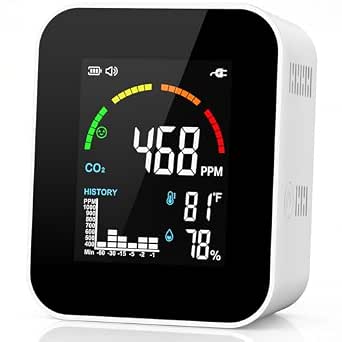 | Best On-Device Overnight Trend Chart | Sensor: NDIR | Measurements: CO2, temperature, humidity | CO2 history: 24-hour bar chart; erased on restart | VIEW ON AMAZON | See Our Full Breakdown |
| Temtop Portable Indoor CO2 Monitor with Temperature and Humidity |  | Best Portable Basic Monitor | Sensor technology: NDIR | CO2 range: 400–5000 ppm | CO2 accuracy: ±40 ppm + 5% of reading (400–2500 ppm) | VIEW ON AMAZON | See Our Full Breakdown |
| YOWEXA CO2 Monitor with NDIR Sensor |  | Best Simple Visual-Alert Option | Sensor: NDIR with automatic calibration | CO2 range: 400–10,000 ppm | Accuracy: ±5% + 50 ppm | VIEW ON AMAZON | See Our Full Breakdown |
| ndir co2 monitor for sleep tracking | Sensor | Measurements | Display | Battery life |
|---|---|---|---|---|
| Aranet4 Indoor Air Quality Mon | NDIR | CO2, temperature, relative humidity, atmospheric pressure | E-ink | Up to 4 years |
| SwitchBot Meter Pro CO2 Indoor | — | CO2, temperature, humidity | — | Up to 12 months |
| YOWEXA CO2 Monitor with NDIR S | NDIR | CO2, temperature, humidity | 3-inch color LCD, three backlight settings | — |
| Temtop Portable Indoor CO2 Mon | — | — | — | — |
| YOWEXA CO2 Monitor with NDIR S | NDIR with automatic calibration | — | Color screen with three adjustable backlight levels | Up to 3 hours |
More Details on Our Top Picks
Aranet4 Indoor Air Quality Monitor
The Aranet4 is my leading choice when the point of a bedroom monitor is to see more than a momentary number. Its app stores up to 90 days of history, letting you compare overnight CO2 patterns across different ventilation routines rather than relying on memory. It measures CO2, temperature, humidity, and atmospheric pressure, so a change in the room is not reduced to a single reading.
Its other advantage is a wireless design with up to four years of battery life, which avoids making a cable part of the bedside setup. Compared with the SwitchBot, it puts more emphasis on persistent app history and less on displaying time and multiple readings on a large screen. Color-coded alerts and an optional buzzer provide feedback, but anyone sensitive to nighttime sound should check the alert settings and placement rather than assume the buzzer belongs beside the bed.
The tradeoff is that the history lives in the companion app and is limited to 90 days, while the unit uses two AA batteries. It also does not promise an on-device overnight chart like the YOWEXA history model. I’d choose it for comparing room patterns across weeks; I’d skip it if I wanted an extensive local screen display or records beyond the stated app window.
Pros:- App history covers up to 90 days for comparing overnight patterns.
- NDIR CO2 sensor also tracks temperature, humidity, and atmospheric pressure.
- Wireless operation with battery life rated up to four years.
- Color-coded alerts and optional buzzer offer visual and audible cues.
Cons:- App history is limited to 90 days.
- Requires two AA batteries, so it is not rechargeable by USB.
- Its screen does not provide the large multi-reading layout found on SwitchBot.
Best for: Sleep-focused buyers who want to compare bedroom CO2 and other air readings across many nights without leaving a monitor plugged in.
Not ideal for: Buyers who want a large all-in-one bedside screen, a chart stored indefinitely, or no battery replacement at all.
- Sensor:NDIR
- Measurements:CO2, temperature, relative humidity, atmospheric pressure
- Display:E-ink
- Battery life:Up to 4 years
- Batteries:2 AA batteries, included
- App history:Up to 90 days
- Dimensions:2.76 × 2.76 × 0.94 inches
- Weight:3.67 ounces
Our verdict“I recommend the Aranet4 for most overnight CO2 tracking because its long battery life and 90-day history make repeated bedroom comparisons practical.”
SwitchBot Meter Pro CO2 Indoor Air Quality Monitor
SwitchBot is a strong fit when I want a quick bedside or dresser glance at room conditions without opening an app. Its large screen combines CO2, temperature, humidity, time, date, and a comfort indicator, giving it a more complete immediate view than the Aranet4’s e-ink presentation. A Swiss-made NDIR sensor measures CO2 every second, while sound and screen alerts can draw attention to a reading.
That screen-first approach has a clear overnight benefit: checking a value is straightforward, and the adjustable bracket or wall-mount option gives more flexibility than a device that must sit in one fixed orientation. The built-in battery is rated for up to 12 months, well short of the Aranet4’s stated four years but still suited to portable placement. Its listed CO2 range of 400–9000 ppm is broad, although the stated accuracy is ±(50 ppm + 5% of reading), so the reading-dependent component is worth noticing when comparing small changes.
Remote app notifications require a SwitchBot Hub, which adds a dependency the Aranet4’s supplied app-history description does not specify. For sleep tracking, I’d favor SwitchBot if screen legibility and room context matter more than a supplied long-term history feature. I’d skip it if hub-free phone alerts or a clearly stated multi-day record is the main requirement.
Pros:- Large display presents several readings plus time and date.
- Swiss-made NDIR sensor measures CO2 every second.
- Sound and screen alerts are available.
- Portable body supports wall mounting or placement with an adjustable bracket.
Cons:- App notifications require a SwitchBot Hub.
- CO2 accuracy includes a reading-dependent component.
- Battery life of up to 12 months is shorter than the Aranet4’s rating.
Best for: People who want CO2, temperature, humidity, time, and alerts visible together on a prominent bedroom display.
Not ideal for: Buyers who need app notifications without a hub or prioritize stated long-term historical records over a readable screen.
- Measurements:CO2, temperature, humidity
- CO2 range:400–9000 ppm
- CO2 accuracy:±(50 ppm + 5% of reading)
- Measurement rate:Every second
- Temperature accuracy:±0.2 °C / 0.36 °F
- Humidity accuracy:±1.8% RH
- Battery life:Up to 12 months
- Mounting:Wall mount or adjustable bracket
Our verdict“Choose SwitchBot when a clear, information-rich screen matters more than hub-free notifications or a specified long-term history.”
YOWEXA CO2 Monitor with NDIR Sensor and 24-Hour History
This YOWEXA model earns its place through one sleep-relevant feature: a 24-hour CO2 bar chart on the monitor. That gives me a quick way to see whether readings moved during the night without first checking a phone. It also tracks temperature and humidity, and the 3-inch color LCD offers three backlight settings, which helps adapt the display to a darker room.
Compared with the Aranet4, the chart is much shorter-term and the data is not protected against a restart. Still, it is more immediately useful for a single overnight review than a device described mainly around live readings. The screen refreshes every second, while measurements occur every four seconds; these are separate timings, so the faster screen refresh does not mean a new CO2 measurement arrives every second. Its alarm sounds at 1000 ppm and can be muted or disabled, a useful option for a bedroom where alerts should not wake someone.
Continuous monitoring needs USB Type-C power. The backup battery can support up to 24 hours in power-saving mode, but that mode does not support daily monitoring, and the history is lost when the device restarts. I’d select it for short-term, on-device pattern checks, not for a dependable archive. The Aranet4 is a better fit for month-to-month comparisons; this YOWEXA offers a more direct local chart for recent readings.
Pros:- Displays a 24-hour CO2 bar chart on the device.
- Measures CO2, temperature, and humidity.
- Three backlight settings suit different bedroom lighting conditions.
- Alarm can be muted or disabled.
Cons:- Historical data is lost when the unit restarts.
- Continuous monitoring requires USB power.
- Power-saving battery mode is not intended for daily monitoring.
Best for: Buyers who want a recent overnight CO2 chart on the device itself and can keep it connected to USB power.
Not ideal for: People who need history preserved through restarts, multi-week records, or reliable daily operation on battery alone.
- Sensor:NDIR
- Measurements:CO2, temperature, humidity
- CO2 history:24-hour bar chart; erased on restart
- Measurement interval:Every 4 seconds
- Display:3-inch color LCD, three backlight settings
- Alarm threshold:1000 ppm
- Power:USB Type-C with backup battery
- Battery operation:Up to 24 hours in power-saving mode
Our verdict“I’d choose this YOWEXA over the basic model for its local overnight chart, provided USB power and temporary history are acceptable.”
Temtop Portable Indoor CO2 Monitor with Temperature and Humidity
Temtop is a straightforward portable option for someone who wants to keep an eye on CO2, temperature, and humidity without needing a chart-heavy interface. Its NDIR sensor and five-second refreshes provide regular updates, and the stated CO2 resolution is 1 ppm. That resolution describes the displayed increment, not a guarantee that every small change is meaningful; the supplied accuracy specification is ±40 ppm plus 5% of the reading from 400 to 2500 ppm.
Multiple mounting options, adjustable audio alerts, and the ability to disable display illumination give it useful flexibility around a sleeping area. Its standby battery life is rated up to 70 days, but the product description says real-time monitoring requires the device to remain plugged in. That makes it less self-sufficient for overnight monitoring than the Aranet4, whose battery is rated for years, and it lacks the YOWEXA history model’s local chart. Its role is best understood as a portable live-reading monitor, not a record-keeping system.
Temtop also explicitly does not detect carbon monoxide. CO2 and CO are different gases, so this product should not be treated as a carbon monoxide alarm or as a replacement for one. I’d pick it when portable placement and simple alerts are the priorities. I’d pass if I wanted to review a saved overnight curve, avoid a power cable during continuous monitoring, or combine air-quality monitoring with CO safety coverage.
Pros:- NDIR sensor measures CO2 alongside temperature and humidity.
- Five-second refreshes and 1 ppm display resolution.
- Audio alerts and display illumination can be disabled.
- Portable design supports multiple mounting options.
Cons:- Real-time monitoring requires the unit to remain plugged in.
- Does not detect carbon monoxide.
- No historical chart or app record is specified.
Best for: Buyers seeking a portable live CO2, temperature, and humidity monitor with flexible placement and adjustable alerts.
Not ideal for: Anyone who needs saved overnight history, continuous monitoring without a cable, or a carbon monoxide detector.
- Sensor technology:NDIR
- CO2 range:400–5000 ppm
- CO2 accuracy:±40 ppm + 5% of reading (400–2500 ppm)
- CO2 resolution:1 ppm
- Refresh rate:Every 5 seconds
- Temperature range:-10°C to 60°C
- Humidity range:0–99% RH
- Standby battery life:Up to 70 days
Our verdict“Temtop makes sense as a portable live-reading monitor, but I would choose Aranet4 or the YOWEXA history model for reviewing overnight trends.”
YOWEXA CO2 Monitor with NDIR Sensor
The basic YOWEXA suits buyers who want to see a room’s current CO2 reading and get a clear visual or audible warning without paying for a long-history feature set. Its color display, emoticon indicators, and adjustable backlight make the status easy to scan, while the alarm is set to sound at 1000 ppm or higher. It measures every four seconds and refreshes the screen every second, so the display may update more often than the underlying CO2 measurement.
Compared with the 24-hour-history YOWEXA, this model lacks a stated trend chart and adds little for someone trying to compare the shape of an entire night. It may still be a sensible direct-reading choice when an alert is more important than saving data. The stated response time is three minutes, a separate measure from the four-second measurement interval; buyers should not treat those specifications as interchangeable. Its accuracy is listed as ±5% + 50 ppm.
The key limitation for sleep use is power: the battery lasts up to three hours, while continuous monitoring can be supplied through USB. That favors a fixed, powered bedside location over a device you expect to leave unplugged overnight. The Aranet4 is far better suited to long wireless sessions, and the chart-equipped YOWEXA is a stronger pick for reviewing recent trends. I’d choose this one for simple status cues while plugged in, not for portable, uninterrupted overnight tracking.
Pros:- NDIR sensor with automatic calibration.
- Color display uses visual indicators and adjustable backlighting.
- Alarm threshold is 1000 ppm and can be muted with one touch.
- Supports continuous monitoring through USB power.
Cons:- Battery life is up to three hours.
- Response time is listed as three minutes.
- No overnight history chart is specified.
Best for: People who want a color-coded current reading and a configurable CO2 alarm at a fixed, USB-powered bedroom location.
Not ideal for: Buyers who want a saved overnight chart, long battery runtime, or a monitor they can leave unplugged through the night.
- Sensor:NDIR with automatic calibration
- CO2 range:400–10,000 ppm
- Accuracy:±5% + 50 ppm
- Measurement interval:Every 4 seconds
- Response time:3 minutes
- Alarm threshold:1000 ppm
- Display:Color screen with three adjustable backlight levels
- Battery life:Up to 3 hours
Our verdict“This YOWEXA is a useful powered visual-alert monitor, but the 24-hour-history version is the more relevant choice for reviewing sleep-period trends.”

How We Picked
I ranked these five monitors for one particular job: observing bedroom CO2 and related room conditions overnight. I gave the most weight to NDIR sensing, the usefulness of available history, and whether power and alert options suit a typical night. I also looked at whether the display makes readings easy to check without requiring a phone and whether the product clearly states limits that could affect an overnight record.
That focus puts the Aranet4 first because its extended app history and long battery life give it a strong fit for comparing nights over time. SwitchBot follows for a readable, information-rich screen, but its hub requirement for app alerts and reading-dependent accuracy matter. The YOWEXA with a 24-hour chart ranks above the basic YOWEXA for a sleep-focused comparison because it exposes a recent trend, despite its restart limitation. Temtop and the basic YOWEXA remain practical direct-reading choices, but neither offers the same supplied long-range history as the Aranet4.
I did not treat a fast display refresh as proof of better sleep analysis. A monitor’s refresh interval, response time, accuracy statement, and saved history describe different things. I also did not interpret CO2 as a direct measure of sleep quality or health. None of the supplied descriptions establishes sleep-stage sensing, clinical use, or carbon monoxide detection. My rankings reflect the stated features and tradeoffs, not independent lab testing or claims about medical benefit.
| ndir co2 monitor for sleep tracking | Sensor | Measurements | Battery life |
|---|---|---|---|
| Aranet4 Indoor Air Quality Mon | NDIR | CO2, temperature, relative humidity, atmospheric pressure | Up to 4 years |
| SwitchBot Meter Pro CO2 Indoor | — | CO2, temperature, humidity | Up to 12 months |
| YOWEXA CO2 Monitor with NDIR S | NDIR | CO2, temperature, humidity | — |
| Temtop Portable Indoor CO2 Mon | — | — | — |
| YOWEXA CO2 Monitor with NDIR S | NDIR with automatic calibration | — | Up to 3 hours |
Factors to Consider When Choosing Ndir Co2 Monitor For Sleep Tracking
For sleep-related use, I treat a CO2 monitor as a way to observe bedroom air conditions overnight, not as a sleep tracker. The best fit depends on whether you value a lasting record, an easy-to-read live display, or a portable sensor that can be placed in different parts of the room.
Choose history that matches your question
If you want to compare changes across several nights, the Aranet4’s up-to-90-day app history is the clearest fit in this lineup. If you only need to review the recent day on the device, the YOWEXA history model has a 24-hour chart, but its record disappears when the monitor restarts. SwitchBot’s description emphasizes its live display and alerts, while no saved-history period is specified. Temtop and the basic YOWEXA are also better treated as live-reading devices based on the listed details. Match your pick to the length of record you actually plan to inspect.
Separate measurement timing from screen refresh
A display that refreshes every second does not necessarily take a new CO2 measurement every second. The YOWEXA models measure every four seconds while their displays refresh once per second; Temtop refreshes every five seconds, and SwitchBot measures CO2 every second. The listed response time is another specification: the basic YOWEXA states three minutes. I would compare these numbers carefully, but I would not use them alone to declare a monitor more suitable for sleep. For overnight patterns, a readable, retained history can matter more than frequent screen updates.
Plan power and placement before bedtime
Power affects both placement and whether monitoring can continue through the night. The Aranet4’s long battery rating supports flexible placement without a cable; SwitchBot offers up to 12 months of battery life and a bracket or wall-mount option. Temtop’s standby rating is up to 70 days, yet real-time monitoring requires the unit to remain plugged in. The history-equipped YOWEXA needs USB for continuous monitoring, while the basic YOWEXA’s battery lasts up to three hours. Check the intended operating mode rather than treating standby and continuous use as the same thing.
Decide whether alerts belong in a sleeping room
Audible alerts can be useful when you want an immediate warning, but they may be disruptive near a bed. Aranet4 has color-coded alerts and an optional buzzer; SwitchBot offers sound and screen alerts, and the YOWEXA monitors let you mute or disable their alarm. Temtop allows audio alerts and display illumination to be disabled. I’d place a monitor where it can sample room air without shining directly at a sleeper, and choose alert settings that fit the household. A muted alert does not remove the value of later checking the reading or chart.
Read accuracy and range without overinterpreting
CO2 range, resolution, accuracy, and response time answer different questions. Temtop lists 1 ppm resolution, but its accuracy specification is broader than a one-unit change. SwitchBot’s accuracy includes both a fixed and reading-dependent component; the two YOWEXA products also provide their own accuracy statements. I would avoid treating tiny differences between readings as definitive evidence of a room change. Follow the manufacturer’s placement and calibration guidance, and look for repeated patterns rather than making decisions from one isolated number.
Keep CO2 monitoring separate from sleep and safety devices
These products measure CO2 and, depending on the model, temperature, humidity, or other air conditions. They do not measure sleep stages or establish sleep quality. Temtop explicitly does not detect carbon monoxide, and none of these options should be treated as a substitute for a dedicated CO alarm. If your goal is to study sleep itself, use a purpose-built sleep tracker for that task; use an NDIR monitor to observe bedroom CO2 and related environmental readings.
Frequently Asked Questions
Can an NDIR CO2 monitor track sleep?
It can track CO2 in the room during the hours you are asleep, but it does not track sleep stages, movement, or sleep quality. I’d use an NDIR monitor to examine how bedroom CO2 changes overnight and use a separate sleep tracker if sleep metrics are the goal. A CO2 pattern is an environmental measurement, not a sleep diagnosis.
Which model is best for comparing overnight readings across several weeks?
The Aranet4 is the strongest match among these five because its companion app provides up to 90 days of history. That makes it better suited to comparing multiple nights than the YOWEXA model whose on-device chart spans 24 hours and loses data after a restart. The supplied descriptions do not state a comparable long-term history for the other models.
Does a one-second display refresh mean the monitor measures CO2 every second?
No. Refresh describes how often a screen updates, while measurement interval describes how often the sensor takes a reading. The history-equipped YOWEXA refreshes its LCD every second but measures every four seconds. SwitchBot’s description separately states that it measures CO2 every second, so I would check each model’s measurement specification rather than infer it from the screen.
Should I leave an audible CO2 alarm on while sleeping?
That depends on the room and how you intend to use the monitor. An audible alert may draw attention to a reading, but sound near the bed could interrupt sleep; several listed models allow alerts to be muted, disabled, or adjusted. I’d decide whether an immediate sound is useful and place the monitor so its display and alert behavior suit the bedroom. A monitor’s alarm is not a substitute for a dedicated safety alarm.
Does any monitor in this roundup detect carbon monoxide?
Temtop’s product information explicitly says it cannot detect carbon monoxide, and the listed features for the other monitors describe CO2 rather than CO detection. Carbon dioxide and carbon monoxide are different gases. I would use a dedicated carbon monoxide alarm where needed and keep it separate from a CO2 monitor used to observe bedroom air conditions.
Conclusion
For most buyers focused on overnight patterns, I’d choose the Aranet4: its long battery rating and 90-day app history make it the most practical option for comparing multiple nights. Pick SwitchBot if a large, information-rich display is more useful than a specified long-term record and you are comfortable with the hub requirement for app notifications. Choose the YOWEXA with 24-hour history for a short local chart, as long as you can keep it powered and accept that a restart erases the record.
If you only need live readings and flexible placement, Temtop offers a portable format but requires USB for real-time monitoring; the basic YOWEXA makes more sense for powered visual alerts than for a full night on battery. Whichever model fits, I’d use its readings to observe bedroom CO2—not to judge sleep quality or replace a dedicated carbon monoxide alarm.