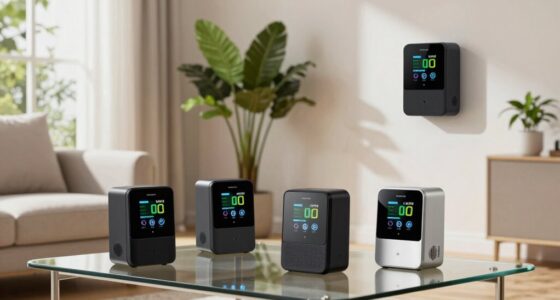
For tracking fine dust during home renovation, my best overall pick is the Temtop P600, a focused PM2.5 and PM10 meter that prioritizes particle readings over a long list of unrelated indoor-air metrics. The FABISENSE Portable PM2.5 and PM10 Monitor is a more portable alternative, while the GoveeLife H5106 suits buyers who want a connected monitor with an LED display. The main tradeoff is between a dedicated particle meter that keeps readings focused and a multi-sensor monitor that adds broader room context but may not measure every renovation hazard. A monitor can show particle changes, but it cannot confirm whether dust contains lead, silica, or other specific materials. Read on for the full breakdown of all 15 options and how to choose one for your project.

Get health and wellness essentials delivered free with Prime
- Fast, free delivery on millions of items
- Prime Video, Amazon Music and more included
- Member-only deals all year
Key Takeaways
- The Temtop P600 and FABISENSE focus on PM2.5 and PM10: that emphasis makes them easier to match to dust-monitoring tasks than models whose headline is a high count of unrelated measurements.
- Multi-sensor counts do not equal stronger dust monitoring: several 10-in-1 and 16-in-1 options add gases, temperature, humidity, or AQI, but buyers should check which particle readings are actually included.
- Display size and visibility vary widely: the Fil-Fresh 16-in-1 advertises a 7.2-inch display, while compact models such as the Temtop S1 favor a smaller footprint.
- Connectivity changes how readings fit into a renovation routine: the GoveeLife H5106 and 2CO9TB are smart-monitor candidates, while portable particle meters suit buyers who want to carry a device between rooms.
- None of these monitors identifies dust composition: PM readings can help track airborne particle changes, but they cannot determine whether renovation dust contains lead, asbestos, or silica.
| GoveeLife Smart Air Quality Monitor H5106 with LED Display |  | Best for Connected Home Monitoring | Measurements: PM2.5, temperature, humidity | Response time: 2 seconds | PM2.5 accuracy: ±15 µg/m³ from 0 to 100 µg/m³; ±15% from 100 to 1000 µg/m³ | VIEW ON AMAZON | See Our Full Breakdown |
| 10-in-1 Indoor Air Quality Monitor with Color Display |  | Best for Portable, App-Free Checks | Measurements: PM0.3, PM2.5, PM10, CO2, CO, HCHO, TVOC, AQI, temperature, humidity | Sampling interval: 1.2 seconds | Display: Color-coded levels from Good to Serious | VIEW ON AMAZON | See Our Full Breakdown |
| Fil-Fresh 16-in-1 Indoor Air Quality Monitor with 7.2-Inch Display |  | Best for a Large, Easy-Read Display | Measurements: CO2, PM2.5, PM1.0, PM10, HCHO, TVOC, temperature, humidity, time | Display: 7.2-inch LED with 3 brightness levels | Alerts: 7 air quality alerts | VIEW ON AMAZON | See Our Full Breakdown |
| 2CO9TB Smart WiFi Air Quality Monitor with PM1.0, PM2.5, PM10, Temperature and Humidity Sensors |  | Best Compact Wi-Fi Pick | Measurements: PM1.0, PM2.5, PM10, temperature, humidity | Display: 2.8-inch color LCD | Connectivity: 2.4 GHz Wi-Fi | VIEW ON AMAZON | See Our Full Breakdown |
| BREATHE Airmonitor Plus Gen 2 Indoor Air Quality Monitor |  | Best for Detailed App History | Measurements: CO₂, PM1, PM2.5, PM10, TVOC, formaldehyde (HCHO), temperature, humidity | CO₂ sensor: NDIR | Particle sensor: Laser | VIEW ON AMAZON | See Our Full Breakdown |
| FABISENSE Portable PM2.5 and PM10 Air Quality Monitor |  | Best for Focused Dust Checks | Model: PTH-26PM | Measurements: PM2.5, PM10, temperature, and humidity | Display: Color LCD | VIEW ON AMAZON | See Our Full Breakdown |
| Bcetasy 11-in-1 Indoor Air Quality Monitor with Stand |  | Best for Broad Renovation Monitoring | Model: HAQ-WW | Measurements: AQI, CO2, PM1.0, PM2.5, PM10, particle count, HCHO, TVOC, temperature, and humidity | Sensors: NDIR infrared CO2, laser particle, semiconductor, photoelectric, temperature, and humidity | VIEW ON AMAZON | See Our Full Breakdown |
| Lwyinp MT13S 10-in-1 Indoor Air Quality Monitor |  | Best for Multi-Room Portability | Model: MT13S | Measurements: CO2, HCHO, TVOC, AQI, PM2.5, PM1.0, PM10, temperature, humidity, and time | Connectivity: Bluetooth | VIEW ON AMAZON | See Our Full Breakdown |
| 16-in-1 Indoor Air Quality Monitor with Color Screen |  | Best for Fast-Refreshing Readings | Manufacturer: AQItech | Model: AK16C | Measurements: PM1.0, PM2.5, PM10, CO2, TVOC, HCHO, temperature, and humidity | VIEW ON AMAZON | See Our Full Breakdown |
| 16-in-1 Indoor Air Quality Monitor with Color Display |  | Best for Simple Audio Controls | Measured parameters: PM1.0, PM2.5, PM10, CO2, TVOC, HCHO, temperature, and humidity | Update interval: 1.5 seconds | Battery runtime: 4–5 hours | VIEW ON AMAZON | See Our Full Breakdown |
| Thrustmax 16-in-1 Indoor Air Quality Monitor with PM2.5, CO2, TVOC, HCHO, AQI, Temperature and Humidity |  | Best for Multi-Pollutant Renovation Checks | Measurements: PM1, PM2.5, PM10, CO2, TVOC, HCHO, AQI, temperature, humidity | Display: Color screen | Alerts: AQI buzzer alerts | VIEW ON AMAZON | See Our Full Breakdown |
| Temtop S1 PM2.5 Air Quality Monitor & Indoor Thermometer | 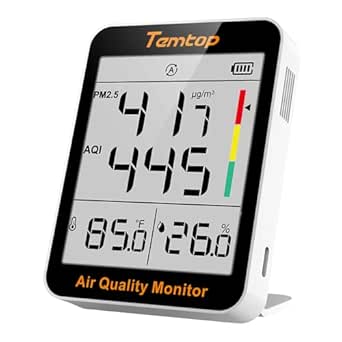 | Best for Simple, Long-Running Room Checks | Measurements: PM2.5, AQI, temperature, humidity | Particle sensor: Miniature laser particle sensor | Battery life: Up to 60 days, as stated in product description | VIEW ON AMAZON | See Our Full Breakdown |
| Lecoolife AK27 10-in-1 Indoor Air Quality Monitor |  | Best for At-a-Glance Room Readings | Model: AK27 | Measurements: PM1.0, PM2.5, PM10, HCHO, TVOC, temperature, humidity, AQI, time | Display: Large color display | VIEW ON AMAZON | See Our Full Breakdown |
| Temtop P600 PM2.5 and PM10 Air Quality Monitor |  | Best for Particle Trends | Model: P600-FBA | Measurements: PM2.5 and PM10 | Sensor lifespan: More than 20,000 hours | VIEW ON AMAZON | See Our Full Breakdown |
| Laser Particle Counter, PM2.5 PM10 Dust Particle Meter 3-Channel |  | Best for Detailed Dust Logging | Particle count channels: 0.3, 2.5, and 10 μm | Particle count range: Up to 2,000,000 pieces per liter | Mass concentration range: PM2.5/PM10: 0–1000 μg/m³ | VIEW ON AMAZON | See Our Full Breakdown |
| pm25 monitor for home renovation dust | Measurements | Display |
|---|---|---|
| GoveeLife Smart Air Quality Mo | PM2.5, temperature, humidity | — |
| 10-in-1 Indoor Air Quality Mon | PM0.3, PM2.5, PM10, CO2, CO, HCHO, TVOC, AQI, temperature, humidity | Color-coded levels from Good to Serious |
| Fil-Fresh 16-in-1 Indoor Air Q | CO2, PM2.5, PM1.0, PM10, HCHO, TVOC, temperature, humidity, time | 7.2-inch LED with 3 brightness levels |
| 2CO9TB Smart WiFi Air Quality | PM1.0, PM2.5, PM10, temperature, humidity | 2.8-inch color LCD |
| BREATHE Airmonitor Plus Gen 2 | CO₂, PM1, PM2.5, PM10, TVOC, formaldehyde (HCHO), temperature, humidity | — |
| FABISENSE Portable PM2.5 and P | PM2.5, PM10, temperature, and humidity | Color LCD |
| Bcetasy 11-in-1 Indoor Air Qua | AQI, CO2, PM1.0, PM2.5, PM10, particle count, HCHO, TVOC, temperature, and humidity | Backlit LCD with color-coded air quality grading |
| Lwyinp MT13S 10-in-1 Indoor Ai | CO2, HCHO, TVOC, AQI, PM2.5, PM1.0, PM10, temperature, humidity, and time | High-definition color screen with three-color air quality visualization |
| 16-in-1 Indoor Air Quality Mon | PM1.0, PM2.5, PM10, CO2, TVOC, HCHO, temperature, and humidity | HD color screen |
| 16-in-1 Indoor Air Quality Mon | — | HD color screen with color-coded readings |
| Thrustmax 16-in-1 Indoor Air Q | PM1, PM2.5, PM10, CO2, TVOC, HCHO, AQI, temperature, humidity | Color screen |
| Temtop S1 PM2.5 Air Quality Mo | PM2.5, AQI, temperature, humidity | — |
| Lecoolife AK27 10-in-1 Indoor | PM1.0, PM2.5, PM10, HCHO, TVOC, temperature, humidity, AQI, time | Large color display |
| Temtop P600 PM2.5 and PM10 Air | PM2.5 and PM10 | Visual indicators and histogram |
| Laser Particle Counter | — | — |
More Details on Our Top Picks
GoveeLife Smart Air Quality Monitor H5106 with LED Display
For renovation dust, the GoveeLife H5106 makes the most sense for someone who wants to track PM2.5 changes over time and check readings remotely. Its two-second refresh gives frequent updates while sanding or cleaning, and Wi-Fi supports remote monitoring and data export—useful for comparing conditions before and after running an air purifier. It also measures temperature and humidity, unlike a particle-only device such as the FABISENSE Portable PM2.5 and PM10 Air Quality Monitor. The tradeoff is that this is a plug-in monitor, not a portable jobsite tool: there is no built-in battery, and controlling appliances is limited to compatible GoveeLife models. Its stated PM2.5 accuracy also allows a sizable margin, so I would use it to follow trends rather than treat each reading as a precise measurement.
Pros:- Refreshes PM2.5 readings every two seconds
- Wi-Fi supports remote monitoring and data export
- Measures temperature and humidity alongside PM2.5
- Can control compatible GoveeLife appliances
Cons:- Requires Type-C power and has no built-in battery
- Compatible appliance control is limited to supported GoveeLife devices
- PM2.5 accuracy range may make exact readings less useful than trend tracking
Best for: Homeowners who want app-based PM2.5 tracking and data exports while monitoring a renovation room from elsewhere in the home
Not ideal for: People who need battery-powered readings in rooms without a convenient outlet or want to move the monitor around a renovation site
- Measurements:PM2.5, temperature, humidity
- Response time:2 seconds
- PM2.5 accuracy:±15 µg/m³ from 0 to 100 µg/m³; ±15% from 100 to 1000 µg/m³
- Connectivity:Bluetooth and 2.4 GHz Wi-Fi
- Data history:13-day graphs; export data from the past 2 years
- Power:Type-C cable; no built-in battery
- Dimensions:5.31 x 1.57 x 2.47 inches
Our verdict“Choose the H5106 if connected, ongoing PM2.5 trend tracking matters more than carrying a monitor between rooms.”
10-in-1 Indoor Air Quality Monitor with Color Display
This monitor is a practical pick for people who want to carry one device between a dusty work area and occupied rooms without setting up an account or Wi-Fi. It tracks PM2.5, PM10, and several gases, and its color-coded display and audible alerts make changes easier to spot at a glance. The rechargeable battery is listed for up to 96 hours, a major advantage over the Fil-Fresh AK22, whose wireless use lasts up to eight hours. That portability comes with a different compromise: no app or remote history, so readings are local rather than something I could check from another room or export later. For renovation dust specifically, the particle readings are the main draw; its broader gas measurements may help with other indoor-air concerns, but the supplied information does not include sensor accuracy figures.
Pros:- Measures PM0.3, PM2.5, and PM10 along with gases and environmental conditions
- Color-coded display and audible alerts make changes easier to notice
- Rechargeable battery is listed for up to 96 hours
- Operates without Wi-Fi, Bluetooth, or an app
Cons:- No app, remote access, or data export
- Battery is described as nonstandard
- No accuracy figures are provided in the product data
Best for: Renovators who want a portable monitor with clear on-device alerts and no app or network setup
Not ideal for: Buyers who need remote monitoring, exported records, or app-based history to compare dust levels across renovation stages
- Measurements:PM0.3, PM2.5, PM10, CO2, CO, HCHO, TVOC, AQI, temperature, humidity
- Sampling interval:1.2 seconds
- Display:Color-coded levels from Good to Serious
- Battery capacity:2000mAh
- Battery life:Up to 96 hours
- Charging:USB-C
- Connectivity:No Wi-Fi, Bluetooth, or app required
Our verdict“Pick this model for long portable sessions and straightforward alerts, but skip it if you need a connected record of renovation dust.”
Fil-Fresh 16-in-1 Indoor Air Quality Monitor with 7.2-Inch Display
The Fil-Fresh AK22 puts readability ahead of long battery life. Its 7.2-inch display presents PM2.5, PM1.0, PM10, and other air-quality readings in one place, while adjustable brightness helps keep the screen visible without forcing the same lighting level all day. Compared with the smaller-screen 2CO9TB Smart WiFi Air Quality Monitor, this is easier to read from across a room, but it gives up that model’s app-based remote monitoring. The AK22 also works without an app or Wi-Fi, which keeps setup simple. Its main renovation-dust limitation is just eight hours of wireless use per charge; continuous monitoring will likely mean keeping USB-C power nearby. I would favor it as a stationary room display that can be moved occasionally, not as an all-day roaming monitor.
Pros:- Large 7.2-inch display shows multiple readings together
- Three brightness levels allow screen adjustment
- Tracks PM1.0, PM2.5, PM10, CO2, HCHO, and TVOC
- Simple operation without an app or Wi-Fi
Cons:- Wireless battery life is limited to up to eight hours
- No app, Wi-Fi, or remote monitoring
- Large display may be less convenient to place in tight work areas
Best for: Homeowners who want a prominent, readable air-quality display near a renovation area and do not need app connectivity
Not ideal for: People who need a monitor to run wirelessly through long workdays or want to review readings remotely
- Measurements:CO2, PM2.5, PM1.0, PM10, HCHO, TVOC, temperature, humidity, time
- Display:7.2-inch LED with 3 brightness levels
- Alerts:7 air quality alerts
- Battery:2500mAh; up to 8 hours of wireless use
- Charging:USB-C
- Sampling interval:1–2 seconds
- Connectivity:No app or Wi-Fi required
Our verdict“Choose the AK22 for a readable, app-free room display, provided you can keep it near USB-C power for extended monitoring.”
2CO9TB Smart WiFi Air Quality Monitor with PM1.0, PM2.5, PM10, Temperature and Humidity Sensors
The 2CO9TB is the compact connected option in this group: its 3.5-inch-wide body measures PM1.0, PM2.5, and PM10, and its app offers remote readings and historical data. That makes it a useful fit for checking a renovation room from elsewhere without giving up the ability to move the monitor between spaces. Compared with the GoveeLife H5106, it adds PM1.0 and PM10 readings and rechargeable operation, while the GoveeLife lists a specific two-second refresh rate and data export. The 2CO9TB’s supplied details do not state sampling speed or sensor accuracy, so I would treat its readings as room-condition indicators rather than precision measurements. Wi-Fi is limited to 2.4 GHz, and the product data does not specify battery life, making it harder to plan long off-cable sessions.
Pros:- Tracks PM1.0, PM2.5, and PM10
- App supports remote monitoring and historical data
- Rechargeable design can be moved between rooms
- Compact dimensions suit smaller work areas
Cons:- Supports 2.4 GHz Wi-Fi only
- Battery runtime is not specified in the supplied product data
- Sampling interval and sensor accuracy are not provided
Best for: People who want a small, rechargeable monitor with app-based access to particulate readings and history
Not ideal for: Buyers who need a stated battery runtime, documented measurement accuracy, or compatibility with Wi-Fi bands beyond 2.4 GHz
- Measurements:PM1.0, PM2.5, PM10, temperature, humidity
- Display:2.8-inch color LCD
- Connectivity:2.4 GHz Wi-Fi
- Power:Rechargeable battery; USB charging
- Interface:USB Type-C
- Dimensions:3.5 x 2.76 x 1.38 inches
- Operating humidity:10%-80%
Our verdict“Choose the 2CO9TB if compact size and app access matter most, but look elsewhere if documented accuracy or battery runtime is a priority.”
BREATHE Airmonitor Plus Gen 2 Indoor Air Quality Monitor
For renovation projects where I want to compare readings across days, the BREATHE Airmonitor Plus Gen 2 stands out for its 90-day app history and data export. It tracks PM1, PM2.5, and PM10 alongside CO2, TVOC, formaldehyde, temperature, and humidity, so dust is part of a broader indoor-air picture. Its laser particle sensor and NDIR CO2 sensor are specified, while the GoveeLife H5106 offers a stated two-second refresh and a longer export window; the BREATHE model instead gives a longer listed in-app history. Portable use is limited to six hours, so it is better suited to a room with USB-C power than a full workday of carrying it around. Remote monitoring and alerts also depend on 2.4 GHz Wi-Fi.
Pros:- Tracks PM1, PM2.5, and PM10 alongside several gas and environmental readings
- App offers configurable PM2.5 alerts, historical graphs, and data export
- Provides up to 90 days of app history
- Can run from its rechargeable battery or USB-C power
Cons:- Portable battery use lasts up to six hours
- Remote monitoring requires 2.4 GHz Wi-Fi
- The product data does not provide a PM2.5 accuracy figure
Best for: Renovation planners who want app alerts and a longer record for comparing PM2.5 conditions before, during, and after dusty work
Not ideal for: People who need all-day wireless monitoring or cannot use a 2.4 GHz Wi-Fi connection
- Measurements:CO₂, PM1, PM2.5, PM10, TVOC, formaldehyde (HCHO), temperature, humidity
- CO₂ sensor:NDIR
- Particle sensor:Laser
- Connectivity:2.4 GHz Wi-Fi
- App features:Remote readings, configurable CO₂ and PM2.5 alerts, historical graphs, data export
- App data history:Up to 90 days
- Battery life:Up to 6 hours
- Power:Rechargeable battery or USB-C
Our verdict“Choose the BREATHE if a detailed app record and configurable dust alerts matter more than long battery-powered sessions.”
FABISENSE Portable PM2.5 and PM10 Air Quality Monitor
For renovation dust, I value this monitor’s focus: it reports PM2.5 and PM10 alongside temperature and humidity, without crowding the display with gas readings that may be less relevant during sanding or demolition. Its audible threshold alarm can flag rising particulate levels while I am working elsewhere in the room, and the rechargeable design makes it easy to move between work zones. Compared with the broader Bcetasy 11-in-1, FABISENSE gives up CO2 and chemical indicators but offers a simpler dust-checking role. The tradeoff is limited detail in the supplied specs: there is no stated sampling interval or measurement accuracy, and the preset alarm thresholds may not suit every renovation plan. It fits buyers who want portable particle readings rather than an all-in-one air dashboard.
Pros:- Measures both PM2.5 and PM10, useful for checking fine and larger airborne particles
- Audible alarm can draw attention when particulate readings cross preset thresholds
- Rechargeable 1000mAh battery supports use away from a fixed outlet
- Shows temperature and humidity alongside particle readings
Cons:- Does not measure CO2, HCHO, or TVOC
- Product data does not specify measurement accuracy or sampling interval
- Preset alarm thresholds may offer limited flexibility for different work zones
Best for: Home renovators who want a simple, portable PM2.5 and PM10 check with an audible threshold alert.
Not ideal for: Buyers who need CO2 or VOC readings, documented measurement accuracy, or a specified sampling interval.
- Model:PTH-26PM
- Measurements:PM2.5, PM10, temperature, and humidity
- Display:Color LCD
- Battery:Rechargeable 1000mAh lithium-ion
- Alarm:Audible buzzer with preset thresholds
- Included items:Air quality detector, USB charging cable, and user manual
Our verdict“Choose FABISENSE for straightforward, portable PM2.5 and PM10 checks with an audible alert, not for broader pollutant tracking.”
Bcetasy 11-in-1 Indoor Air Quality Monitor with Stand
The Bcetasy is the widest-ranging choice in this group for someone tracking more than dust: it combines PM1.0, PM2.5, and PM10 with CO2, HCHO, TVOC, particle count, temperature, and humidity. That extra context can help when renovation work involves finishes, adhesives, or ventilation concerns as well as airborne particles. Its color-coded backlit LCD makes a quick room check easier than interpreting a list of numbers. Against the simpler FABISENSE, this model provides a much broader pollutant picture, but that breadth also means more readings to interpret. The rechargeable battery is rated for 11–12 hours, useful for moving it around during a work session, though it will need charging for longer monitoring. Product information also notes that restarting may be needed for recalibration, which can interrupt continuous tracking.
Pros:- Tracks PM1.0, PM2.5, PM10, particle count, CO2, HCHO, and TVOC
- Color-coded display makes status easier to scan at a glance
- 2500mAh battery is rated for 11–12 hours per charge
- Includes a stand and uses USB-C charging
Cons:- May need restarting for recalibration, interrupting continuous monitoring
- Battery runtime is limited to about 11–12 hours per charge
- The number of readings may be more than dust-focused buyers need
Best for: Renovators who want one portable device to track dust, CO2, and chemical indicators around painting, flooring, or furnishing work.
Not ideal for: Buyers who want uninterrupted multi-day monitoring or a very simple dust-only readout without recalibration interruptions.
- Model:HAQ-WW
- Measurements:AQI, CO2, PM1.0, PM2.5, PM10, particle count, HCHO, TVOC, temperature, and humidity
- Sensors:NDIR infrared CO2, laser particle, semiconductor, photoelectric, temperature, and humidity
- Display:Backlit LCD with color-coded air quality grading
- Battery capacity:2500mAh
- Battery life:11–12 hours per charge
- Charging:USB-C
- Included items:Air quality monitor, stand, USB charging cable, and user manual
Our verdict“Pick the Bcetasy if renovation work calls for a broad pollutant dashboard, and choose FABISENSE instead for simpler particle checks.”
Lwyinp MT13S 10-in-1 Indoor Air Quality Monitor
The MT13S suits renovation jobs where I want to carry one monitor between rooms or into a vehicle, while still seeing PM1.0, PM2.5, and PM10 beside CO2, formaldehyde, TVOC, temperature, and humidity. Its color screen gives those readings a more accessible presentation than a basic particle-only device such as the FABISENSE, and Bluetooth time calibration can keep the clock aligned. That connection is a convenience rather than a core dust-monitoring advantage, though: it requires a phone, and the supplied details do not describe measurement accuracy or battery runtime. The controls also take multiple button presses to reach different functions, so frequent adjustments may feel less direct than the Bcetasy’s color-coded overview. This is a flexible portable option, but its appeal depends on wanting broad readings in more than one setting.
Pros:- Measures PM1.0, PM2.5, and PM10 alongside CO2, HCHO, and TVOC
- Color screen presents multiple readings in one portable unit
- Bluetooth supports automatic time calibration
- Temperature units can be adjusted
Cons:- Time calibration requires connecting a phone via Bluetooth
- Multiple button presses are needed to access different functions
- Product data does not state battery runtime or measurement accuracy
Best for: Renovators who plan to carry a multi-pollutant monitor between rooms, a home, and a vehicle.
Not ideal for: Buyers who want a simple interface, published battery runtime, or dust measurements with stated accuracy figures.
- Model:MT13S
- Measurements:CO2, HCHO, TVOC, AQI, PM2.5, PM1.0, PM10, temperature, humidity, and time
- Connectivity:Bluetooth
- Display:High-definition color screen with three-color air quality visualization
- Color:Black
- Included items:Air quality monitor, charging cable, and user manual
- Number of items:1
Our verdict“Choose the MT13S for portable, broad air-quality readings across several settings, but skip it if direct controls and clear battery-runtime details matter more.”
16-in-1 Indoor Air Quality Monitor with Color Screen
For watching conditions change as dusty work starts or stops, this AQItech model’s stated 1.5-second update interval is its clearest distinction. It tracks PM1.0, PM2.5, and PM10 along with CO2, TVOC, HCHO, temperature, and humidity, so the screen offers more context than the focused FABISENSE. The included USB-C cable and AC adapter make it practical to keep powered in a work area, but its 4–5-hour battery runtime is shorter than the Bcetasy’s 11–12-hour rating. That makes it less convenient for a full day of moving between rooms without a nearby outlet. The product data does not provide measurement accuracy figures, either, so I would treat its frequent updates as useful trend information rather than proof of precise particle measurement.
Pros:- Stated 1.5-second update interval helps show changing readings quickly
- Measures PM1.0, PM2.5, and PM10 plus CO2, TVOC, and HCHO
- Color screen presents several air-quality readings together
- Includes USB-C charging cable and AC adapter
Cons:- Battery runs for only 4–5 hours per charge
- Product data does not provide measurement accuracy figures
- At 14 ounces, it is heavier than a minimal portable dust monitor
Best for: Renovators who want frequent on-screen updates and plan to monitor near an outlet or in shorter sessions.
Not ideal for: Buyers who need all-day cordless monitoring or published measurement accuracy for particle readings.
- Manufacturer:AQItech
- Model:AK16C
- Measurements:PM1.0, PM2.5, PM10, CO2, TVOC, HCHO, temperature, and humidity
- Sampling interval:1.5 seconds
- Battery runtime:4–5 hours
- Charging port:USB-C
- Display:HD color screen
- Weight:14 ounces
- Included items:Monitor, USB-C charging cable, AC adapter, and user manual
Our verdict“Pick the AQItech for quickly refreshed, broad readings near a power source, not for long cordless renovation sessions.”
16-in-1 Indoor Air Quality Monitor with Color Display
This 16-in-1 monitor covers the same core renovation pollutants as the AQItech AK16C, including PM1.0, PM2.5, and PM10, and lists the same 1.5-second update interval. Its differentiator is not broader measurement but adjustable audio prompts: double-tap control lets me change sound behavior without searching through a complex menu. That can suit someone who wants a prompt while checking readings but needs control over audible interruptions in a shared home. The tradeoff is familiar from the AQItech: a stated 4–5-hour battery runtime makes both models better for shorter checks or outlet-powered use than a full day of cordless monitoring. Compared with the Lwyinp MT13S, this model spells out its update rate and charging accessories, but its supplied data still gives no accuracy figures.
Pros:- Measures PM1.0, PM2.5, and PM10 plus CO2, TVOC, and HCHO
- Readings update every 1.5 seconds
- Double-tap audio prompt control offers a direct way to manage sound
- Includes USB Type-C cable and AC adapter
Cons:- Battery runtime is limited to 4–5 hours per charge
- Product data does not provide measurement accuracy figures
- Its broad set of readings may be unnecessary for buyers focused only on renovation dust
Best for: Home renovators who want broad air readings, quick updates, and direct control over audible prompts.
Not ideal for: Buyers who need long battery life, documented measurement accuracy, or a device intended for unattended all-day portable use.
- Measured parameters:PM1.0, PM2.5, PM10, CO2, TVOC, HCHO, temperature, and humidity
- Update interval:1.5 seconds
- Battery runtime:4–5 hours
- Charging port:USB Type-C
- Display:HD color screen with color-coded readings
- Controls:Single-tap power and °C/°F switching; double-tap audio prompt control
- Included accessories:USB Type-C cable, AC adapter, and user manual
- Warranty support:12 months
- Color:Dark gray
Our verdict“Choose this model over the similar AQItech AK16C if adjustable audio prompts matter, while recognizing that both are short-runtime monitors.”
Thrustmax 16-in-1 Indoor Air Quality Monitor with PM2.5, CO2, TVOC, HCHO, AQI, Temperature and Humidity
For renovation rooms where dust is only one concern, the Thrustmax pairs PM1, PM2.5, and PM10 readings with CO2, TVOC, and HCHO measurements. That broader view can help buyers track particles alongside selected gases and room conditions, while its color display and AQI buzzer make changes easier to notice without studying a chart. Compared with the Temtop P600, which focuses on particle readings and a 12-hour histogram, this model covers more categories but offers less specific trend-recording detail in the supplied data. Its rechargeable battery and hanging hole suit moving it between work areas, though roughly 7 hours per charge may not cover a full day of monitoring. I’d also treat the advertised sensor count cautiously: the description conflicts between 16-in-1 and 13-in-1.
Pros:- Measures PM1, PM2.5, and PM10 alongside CO2, TVOC, and HCHO.
- Color display and AQI buzzer help flag changing conditions at a glance.
- Rechargeable USB-C design can be moved between rooms.
- Rear hanging hole supports placement away from a work surface.
Cons:- About 7 hours of stated battery use may require recharging during longer workdays.
- Product description gives conflicting 16-in-1 and 13-in-1 sensor counts.
- Provided details do not describe historical logging or data export.
Best for: Home renovators who want PM readings plus CO2, TVOC, HCHO, temperature, and humidity on one portable display.
Not ideal for: People who need all-day untethered monitoring or a clearly documented sensor count before buying.
- Measurements:PM1, PM2.5, PM10, CO2, TVOC, HCHO, AQI, temperature, humidity
- Display:Color screen
- Alerts:AQI buzzer alerts
- Battery:2000 mAh; about 7 hours of use
- Charging:USB Type-C
- Mounting:Rear hanging hole
- Dimensions:8.86 × 5.28 × 1.61 inches
- Weight:14.1 ounces
Our verdict“Choose the Thrustmax if renovation monitoring should cover several pollutant categories, but not if long battery life or detailed trend records are priorities.”
Temtop S1 PM2.5 Air Quality Monitor & Indoor Thermometer
The Temtop S1 takes a narrower approach than the Thrustmax: it tracks PM2.5 and AQI, then adds temperature and humidity rather than a list of gas sensors. That simplicity is useful when the main renovation question is whether airborne fine particles are rising, while the comfort readings add context about the room. Its stated up-to-60-day battery life is the standout advantage for leaving it in a bedroom or office between work sessions; the product description attributes this to reduced laser-sensor energy use. By contrast, the Temtop P600 also measures PM10 and provides a 12-hour histogram, making it more informative for particle-size comparisons and short-term trends. The S1’s tradeoff is limited scope: it does not list PM10, HCHO, or TVOC, and the supplied information gives no dimensions or detailed logging features.
Pros:- Tracks PM2.5 and AQI alongside temperature and humidity.
- Up to 60 days of stated battery life reduces frequent charging.
- Compact, portable format suits moving it between rooms.
- Display presents the core readings together for quick checks.
Cons:- Does not list PM10, HCHO, or TVOC measurements.
- Provided product information does not specify dimensions, charging method, or data logging.
- Its narrower readings offer less pollutant context than the Thrustmax.
Best for: DIY renovators who want a compact, low-maintenance PM2.5 and AQI check in rooms where the monitor can stay in place.
Not ideal for: Buyers who need PM10 readings, multiple gas measurements, or recorded renovation-dust trends.
- Measurements:PM2.5, AQI, temperature, humidity
- Particle sensor:Miniature laser particle sensor
- Battery life:Up to 60 days, as stated in product description
- Temperature range:10–50 °C
- Temperature accuracy:±1 °C
- Operating humidity:10–99%
- Mounting:Surface mount
Our verdict“Pick the Temtop S1 for straightforward PM2.5 checks with long stated battery life, and choose a broader monitor if renovation dust is not your only concern.”
Lecoolife AK27 10-in-1 Indoor Air Quality Monitor
The Lecoolife AK27 is aimed at renovators who want a large, color-coded display to make room checks quick, rather than a portable instrument with detailed records. It lists PM1.0, PM2.5, and PM10 alongside HCHO, TVOC, temperature, humidity, and AQI, so its measurement mix is broader than the Temtop S1’s PM2.5-focused set. The screen’s AQI colors can make a change easier to spot while moving between rooms, and the listed footprint is compact enough for a desk or shelf. Still, the supplied details do not explain battery runtime, logging, or charging, and the power information only says an included “A battery.” Compared with the Thrustmax, the AK27 also does not list CO2 or buzzer alerts. I’d favor it for simple visual checking, not for buyers who need clearly documented power and monitoring features.
Pros:- Lists PM1.0, PM2.5, and PM10 measurements.
- Also tracks HCHO, TVOC, temperature, humidity, and AQI.
- Large color display with color-coded AQI indicators.
- Compact listed dimensions suit shelves, desks, and bedside tables.
Cons:- Power details are unclear, with the battery described only as an included A battery.
- No runtime, charging, or data-logging details are supplied.
- Does not list CO2 or buzzer alerts, unlike the Thrustmax.
Best for: Renovators who want PM1.0, PM2.5, and PM10 plus selected gas readings displayed prominently in a room.
Not ideal for: Buyers who need CO2 readings, audible alerts, or well-specified battery runtime and data-history functions.
- Model:AK27
- Measurements:PM1.0, PM2.5, PM10, HCHO, TVOC, temperature, humidity, AQI, time
- Display:Large color display
- AQI indication:Color-coded indicators
- Power:1 included A battery, as listed
- Dimensions:4.17 × 3.54 × 1.96 inches
- Weight:15.1 ounces
- Manufacturer:Lecoolife
Our verdict“The AK27 suits buyers who value a broad set of readings on a prominent display, but its unclear power details make it a less certain choice for extended monitoring.”
Temtop P600 PM2.5 and PM10 Air Quality Monitor
For a renovation-dust check centered on particles, the Temtop P600 trades broad pollutant coverage for a more focused view of PM2.5 and PM10. Its 12-hour histogram helps show whether particle levels have been rising or falling, which is more useful for comparing work periods than a single glance at a current reading. Color-coded health indicators keep that information accessible, and the built-in stand supports placement on a table or use in different locations. Compared with the Temtop S1, the P600 adds PM10 and a defined trend display, but it does not list temperature or humidity. It is also narrower in scope than the Thrustmax, which includes CO2, TVOC, and HCHO. The P600 makes most sense when particle monitoring is the priority; the supplied details do not describe gas sensing or data export.
Pros:- Measures both PM2.5 and PM10.
- 12-hour histogram shows recent particle-level trends.
- Color-coded indicators make readings easier to interpret quickly.
- Portable body with built-in stand supports table placement and mobile checks.
Cons:- Provided details list no gas measurements or temperature and humidity readings.
- Data history is described as a 12-hour histogram, with no export function specified.
- Its particle-only focus offers less room context than the Thrustmax.
Best for: Renovators who want to compare PM2.5 and PM10 levels over a 12-hour window while moving the monitor between locations.
Not ideal for: Buyers who want CO2, TVOC, HCHO, temperature, humidity, or records that can be exported for later analysis.
- Model:P600-FBA
- Measurements:PM2.5 and PM10
- Sensor lifespan:More than 20,000 hours
- Data storage:12-hour histogram
- Display:Visual indicators and histogram
- Mounting:Table mount; built-in stand
- Maximum supply voltage:5 V DC
- Dimensions:6.3 × 1.97 × 2.36 inches
- Warranty:12 months
Our verdict“Choose the P600 when PM2.5/PM10 trends matter more than gas readings or comfort data.”
Laser Particle Counter, PM2.5 PM10 Dust Particle Meter 3-Channel
This laser particle counter is the most data-oriented option in this group: it reports particle counts at 0.3, 2.5, and 10 μm, plus PM2.5 and PM10 mass concentrations, temperature, and humidity. For a renovation, that combination can support closer tracking of airborne dust than a basic display-only monitor. Its 999-record storage, trend curves, and USB PDF export give it a clear advantage over the Temtop P600’s 12-hour histogram when you want to keep or review a longer history. A tripod and customizable alarm also suit fixed-point monitoring during work. The tradeoff is added complexity: the listed mass-concentration accuracy is ±12 μg/m³, and battery life is stated as 9+ hours rather than continuous mains operation. It also lacks the Thrustmax’s listed CO2, TVOC, and HCHO measurements.
Pros:- Counts particles in three size channels: 0.3, 2.5, and 10 μm.
- Measures PM2.5 and PM10 mass concentration, temperature, and humidity.
- Stores up to 999 records with trend curves and USB PDF export.
- Custom alarm thresholds and included tripod support hands-free monitoring.
Cons:- Battery life is stated as 9+ hours, so extended sessions may need power management.
- Does not list CO2, TVOC, or HCHO measurements, unlike the Thrustmax.
- Listed PM2.5/PM10 accuracy is ±12 μg/m³, which may not suit buyers seeking tighter stated precision.
Best for: Renovators, contractors, or detail-focused homeowners who want particle counts, customizable alarms, and exportable records from fixed-point monitoring.
Not ideal for: Buyers seeking a simple glanceable monitor with gas readings, or anyone who needs uninterrupted monitoring beyond the stated battery runtime.
- Particle count channels:0.3, 2.5, and 10 μm
- Particle count range:Up to 2,000,000 pieces per liter
- Mass concentration range:PM2.5/PM10: 0–1000 μg/m³
- Mass concentration accuracy:±12 μg/m³
- Resolution:1 μg/m³
- Temperature range:−10 to 60 °C; °C/°F switchable
- Humidity range:0–100%
- Data storage:Up to 999 records; USB PDF export
- Battery:2000 mAh rechargeable; 9+ hours stated
Our verdict“Choose this counter for renovation projects where particle-size counts and saved records matter more than broad gas monitoring or simplicity.”
How We Picked
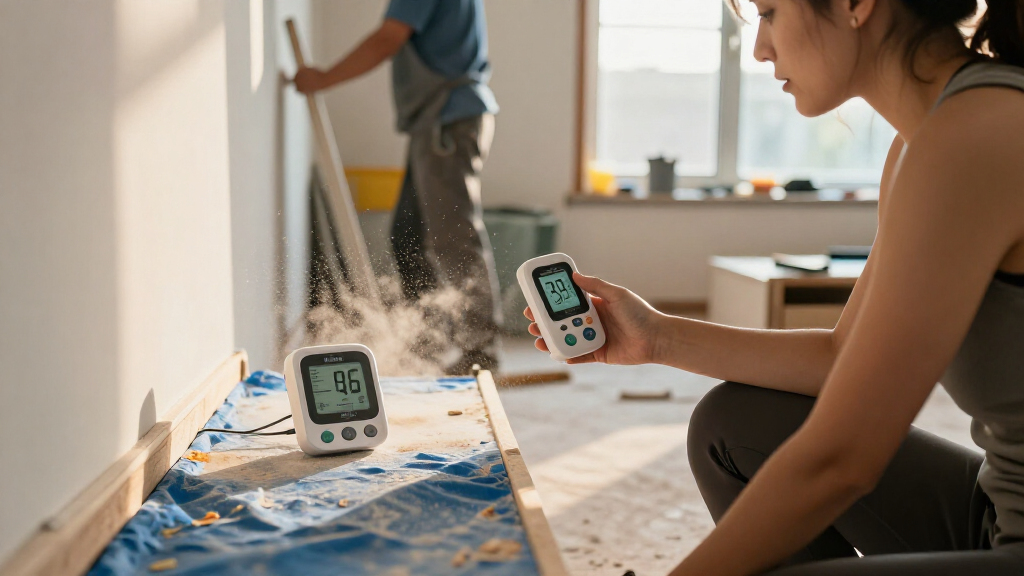
I ranked these monitors around the job implied by the query: tracking airborne particles while renovation work creates dust. My main criteria were whether PM2.5 and PM10 are named in the product description, whether the device appears focused on particle monitoring or bundles it with broader air-quality functions, and how its display, portability, and connected features may fit room-to-room use. I also considered whether the product’s stated purpose makes it a clear match for renovation monitoring rather than general indoor comfort checks.
The ranking favors clear particle-monitoring purpose and practical usability over the number of advertised sensors. That is why dedicated PM2.5/PM10 meters rank ahead of many 10-in-1 and 16-in-1 devices when their descriptions do not clearly establish an advantage for dust tracking. Smart features, larger displays, and broader readings still have value, but they move a product up only when they serve a distinct buyer need. Product descriptions do not establish laboratory accuracy or the ability to identify hazardous dust, so I do not treat either as proven.
Factors to Consider When Choosing Pm25 Monitor For Home Renovation Dust
Choosing a renovation monitor is less about finding the longest feature list and more about deciding what you need the readings to do. These factors can help you match a device to your work pattern, room layout, and expectations for what a consumer monitor can tell you.
Choose PM readings before counting sensors
Start by confirming that the device explicitly measures PM2.5, and check for PM10 if you also want a broader particle-size reading. A 10-in-1 or 16-in-1 label may sound more capable, but added temperature, humidity, gas, or AQI readings do not automatically improve particle tracking. Before buying, look for details about the particle sensor and how the device presents its readings; a headline feature count alone does not settle those questions. If your main task is comparing dust levels before, during, and after work, a focused meter may be easier to interpret. If you also want a general room monitor, a multi-sensor model can earn its extra complexity. The tradeoff is simplicity versus broader context, not a guarantee of better measurement.
Decide whether you need a reading at one spot or several
Renovation dust can vary from room to room, so think about whether the monitor will stay in a single occupied area or move near different work zones. A portable unit is easier to carry, but frequent relocation can make comparisons less meaningful if you change placement each time. For repeat checks, use a consistent location and allow the monitor time to settle according to its instructions. A large display can help when you want to read values from across a room, while a smaller device takes less space on a temporary work surface. Neither format replaces appropriate dust controls or protective equipment. Pick a form factor that supports a repeatable routine rather than one that only looks convenient on paper.
Treat connectivity as a workflow choice
App access or Wi-Fi can be useful if you want to check a room without standing beside the monitor, but it adds setup and dependence on a phone or network. A local screen is often simpler for quick checks, particularly if several people need to see the same reading. Before choosing a connected model, check what the app actually provides and whether alerts, history, or remote viewing are included; the word “smart” does not specify those functions by itself. For short projects, a clear on-device display may be enough. For work spread across multiple rooms or days, a connected record may suit your routine better. Favor the features you will use consistently over connectivity that adds friction.
Separate dust monitoring from hazard identification
A PM2.5 monitor reports particle concentrations, not the material those particles are made of. Renovation dust could come from ordinary drywall or wood work, but a monitor cannot distinguish that from lead-containing dust, silica, asbestos, or other specific hazards. If the building age, materials, or planned work raises a concern, consult qualified professionals and use appropriate testing or controls rather than relying on a consumer air monitor. A low reading does not certify a room as safe, and a changing reading does not reveal the source. This distinction matters most when sanding, cutting, or disturbing older materials. Buy a monitor to track airborne particle changes, not to replace hazard assessment.
Plan how you will compare readings
One isolated number offers less practical insight than readings taken under consistent conditions. Note where the monitor sits, what work is happening, and whether ventilation or filtration has changed between checks. Avoid comparing readings taken from different locations or at different distances from a dust source as though they were equivalent. Consumer devices can differ in their sensors and displays, so focus on trends from the same unit rather than assuming different models will agree precisely. If you need formal evidence or verified exposure measurements, check whether a qualified measurement service is required for your situation. A simple log can make a modest monitor more useful without overstating its precision.
Pay for features that solve a real project problem
A larger screen, app connection, or extra air-quality readings can be worthwhile if they make monitoring easier for your household. They are less useful when the device will sit beside one work area and only needs to show particle levels. Compare the product’s stated measurements and controls before treating a high sensor count as added value. Also check practical details such as power needs, placement guidance, and whether the instructions describe maintenance or sensor care. A lower-complexity particle meter can be the more sensible purchase for a short, focused project; broader monitoring may suit a home where the device will remain in use after renovation. The best fit depends on continued use, not feature count alone.
Frequently Asked Questions
Can a PM2.5 monitor tell me whether renovation dust contains lead or asbestos?
No. A PM2.5 reading describes airborne particle concentration, not chemical composition or material identity. The monitor cannot tell whether particles came from drywall, wood, lead paint, asbestos-containing material, or another source. If the building or work raises a concern about hazardous materials, seek qualified testing and follow applicable safety guidance before disturbing them. Use the monitor only as a tool for tracking particle changes, not as a clearance test.
Should I choose PM2.5 only, or is PM10 useful during renovation too?
PM2.5 focuses on smaller particles, while PM10 adds a broader particle-size category that may help you observe more kinds of airborne dust. A device listing both readings gives you more particle context, but the extra measurement does not identify the dust source or hazard. If you want a straightforward view of fine-particle changes, PM2.5 may be enough for your routine. If comparing a wider range of dust is useful to you, a clearly specified PM2.5-and-PM10 meter is a better fit. Check the exact readings listed rather than relying on a general “air quality” label.
Will a monitor show whether my dust-control steps are working?
It can help you observe whether readings from the same monitor change after you alter ventilation, filtration, or work practices. For a fair comparison, keep the device in the same position and note what changed between readings. A drop in the displayed value is not proof that a room is free of hazardous dust or that an exposure limit has been met. Readings can also vary with placement and conditions. Treat the monitor as a trend indicator, and use proper controls and professional guidance where the work calls for them.
Is a 16-in-1 monitor a better renovation choice than a dedicated particle meter?
Not automatically. A 16-in-1 device may add useful information about other indoor-air conditions, but the sensor count does not show how well it measures particles or whether it includes the particle sizes you want. A dedicated PM2.5/PM10 meter keeps the task focused and may be easier to interpret during dusty work. Choose a multi-sensor model if those additional readings have a clear use in your home. Compare the listed PM measurements and usability rather than choosing by count.
Where should I place the monitor, and can I move it between rooms?
Follow the manufacturer’s placement instructions and use a consistent position when comparing readings over time. Moving the device between rooms can help you check different areas, but readings from different locations should not be treated as directly equivalent. Keep it away from a spot where it could be struck, covered, or exposed to conditions outside its guidance. Allow the unit to settle as its instructions specify after moving it. For a useful project record, note the room and placement with each reading.
Conclusion
For most renovation projects, I would start with the Temtop P600 as the best overall because its stated PM2.5 and PM10 focus aligns directly with dust tracking. The FABISENSE portable monitor is my best value-style fit for buyers who want a dedicated, movable particle meter, while the BREATHE Airmonitor Plus Gen 2 is the premium candidate for shoppers seeking a broader indoor-air monitor rather than a particle-only tool. Beginners who want an easy-to-read general monitor may prefer the GoveeLife H5106, especially if its connected features suit their routine. For a large display, consider the Fil-Fresh 16-in-1; for a compact PM2.5-focused option, compare the Temtop S1. No pick can identify hazardous material, so match the monitor to particle tracking and use professional assessment for safety questions.