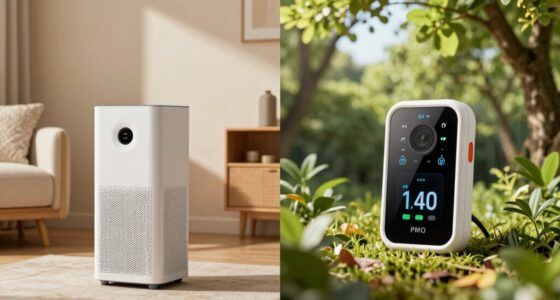
When humidity rises, your PM2.5 sensor can show sudden spikes because moisture interferes with its optical measurements. Water vapor condenses onto particles and sensor components, scattering and absorbing light irregularly. This causes the sensor to interpret the moisture as more particles, leading to inflated readings. If you want to understand how moisture affects your sensor and what you can do about it, keep exploring this topic for helpful insights.
Key Takeaways
- High humidity causes moisture to condense on sensor components, leading to false particle detection.
- Water vapor increases light scattering in optical sensors, resulting in artificially elevated PM2.5 readings.
- Moisture alters the optical properties of particles, making them appear larger or more reflective.
- Sensor calibration can be affected by humidity, causing overestimations during humid conditions.
- Many sensors lack humidity compensation, so spikes during humidity rises often reflect moisture effects, not actual air quality changes.

Monitoring PM2.5 levels is crucial for evaluating air quality, but humidity can profoundly influence sensor readings. When humidity rises, you might notice sudden spikes in your PM2.5 data, which can be confusing or alarming. These fluctuations aren’t always due to actual increases in airborne particles but often result from how moisture interacts with your sensor. Understanding this relationship helps you interpret readings more accurately and avoid unnecessary concern or misjudgment about air quality.
Most low-cost PM2.5 sensors rely on optical principles, using a light source and a detector to measure particles suspended in the air. When particles pass through the sensor’s path, they scatter light, which the detector measures to estimate particle concentration. However, humidity affects this process because water vapor can condense onto particles and the sensor itself. As humidity climbs, tiny water droplets can cling to dust, pollen, or other particles, making them larger or more reflective. This causes the sensor to perceive more particles than actually exist, resulting in a spike in the reading.
Additionally, moisture can directly interfere with the sensor’s optical components. Water droplets on the sensor’s lens or light path scatter or absorb the light differently, artificially inflating the particle count. Even if your sensor is designed to be somewhat resistant to humidity, no sensor is completely immune. During humid conditions, the sensor’s calibration can become skewed, leading to overestimations of particle concentration. This effect is particularly noticeable in environments with high relative humidity, like rainy days, fog, or humid indoor spaces.
You might also notice that readings tend to spike during the daytime when humidity levels fluctuate more rapidly, or after periods of rain when moisture is still lingering in the air. It’s important to note that these spikes aren’t necessarily reflective of a real increase in airborne pollutants, but rather a technical artifact caused by water vapor’s influence on the sensor. To get a clearer picture of air quality, you should consider humidity levels alongside PM2.5 data, or use sensors equipped with humidity correction features.
In practice, understanding this phenomenon helps you avoid overreacting to temporary spikes that are simply due to moisture. Some advanced sensors incorporate humidity compensation algorithms to minimize this issue, but many basic models do not. When humidity rises, it’s wise to interpret your data cautiously, recognizing that some increases may be misleading. By doing so, you ensure more accurate assessment of your environment’s air quality and make better-informed decisions about ventilation, filtration, or exposure.
Being aware of the sensor’s limitations in humid conditions can help you make smarter choices and better protect your health.

GoveeLife Smart Air Quality Monitor CO2 Detector H5140, Display & Alarm
- High-Precision CO2 Sensor: Accurate ±(40ppm + 5%) with quick 5s updates
- Multi-Function Display: Shows CO₂, temperature, humidity, and clock
- Customizable Alerts: Buzzer, app notifications, and email warnings
As an affiliate, we earn on qualifying purchases.
Frequently Asked Questions
How Often Should I Calibrate My PM2.5 Sensor?
You should calibrate your PM2.5 sensor at least once every six months to guarantee accuracy. If you notice fluctuating readings or suspect interference from humidity, consider calibrating more frequently. Regular calibration helps maintain precise measurements and accounts for sensor drift over time. Additionally, follow manufacturer guidelines for calibration procedures and use certified calibration standards to keep your sensor reliable and your air quality data trustworthy.
Can Humidity Levels Be Permanently Adjusted on the Sensor?
No, humidity levels can’t be permanently adjusted on your sensor. Ironically, your device isn’t a thermostat or a magic wand; it simply measures particles, and humidity affects those readings. Instead, you can calibrate or compensate for humidity effects through software settings or calibration routines. Keep in mind, though, that even with adjustments, high humidity will continue to influence your sensor’s accuracy, so regular calibration remains essential.
What Is the Ideal Humidity Range for Accurate Readings?
You should aim to keep humidity levels between 30% and 50% for the most accurate PM2.5 sensor readings. When humidity is within this range, the sensor can more reliably detect particulate matter without interference from moisture. If humidity exceeds this range, readings may become skewed, causing spikes. Use a dehumidifier or humidifier to maintain consistent levels and guarantee your sensor provides precise and trustworthy data.
Do All PM2.5 Sensors React Similarly to Humidity?
Not all PM2.5 sensors react the same way to humidity. Some sensors, especially optical ones, can be more sensitive and give false readings as humidity increases. Others, like certain laser-based sensors, have built-in compensation to minimize this effect. You should check your sensor’s specifications and calibration. If humidity impacts your readings, consider using a sensor with humidity compensation or controlling environmental conditions for more accurate results.
How Do Environmental Changes Affect Long-Term Sensor Accuracy?
Imagine you’re in a time when technology was less advanced—environmental changes can substantially impact your sensor’s accuracy over time. As humidity, temperature, or dust levels fluctuate, your PM2.5 sensor’s readings may drift or become less reliable. Regular calibration and environmental compensation help maintain accuracy. By staying vigilant and updating your device, you guarantee your air quality data remains trustworthy, even amidst changing conditions.

ECOWITT WN1821 Weather Station Kit, Includes WN1821 Indoor CO2 Detector Display Console, and Multi-Channel WN31 Thermometer and Hygrometer Sensor, 915 MHz
- Display Type: 4.9-inch LCD screen
- Connectivity: Wi-Fi enabled
- Power Options: DC or battery powered
As an affiliate, we earn on qualifying purchases.
Conclusion
As you’ve seen, humidity can cause your PM2.5 sensor readings to spike unexpectedly, often leading to false alarms. Remarkably, research shows that in high-humidity environments, sensor readings can increase by up to 30%, even without changes in actual air quality. So, next time your sensor jumps during humid days, remember it’s likely due to moisture interference. Understanding this helps you interpret the data more accurately and take better steps to ensure clean air around you.

Smart WiFi Indoor Air Quality Monitor, Remote CO2, Temperature, Humidity, TVOC & Air Pressure Tracking, Power Status Monitoring, 3.7" E-Ink Display with App for Home, Bedroom, Office & School
- Tracks Multiple Indoor Air Parameters: CO2, temperature, humidity, TVOC, air pressure
- Custom Alerts and Notifications: Set thresholds; receive app, email, SMS alerts
- Professional-Grade Sensor Technology: SCD4x sensor with anti-interference tech
As an affiliate, we earn on qualifying purchases.

Ambient Weather AQIN Pro Wireless Indoor Air Quality Particulate Monitor
- Large Display: Real-time air quality data including PM and CO2
- High-Quality Sensor: Measures fine particles and indoor pollution
- Smart Connectivity: Integrates with Ambient Weather Network, Google Home, Alexa
As an affiliate, we earn on qualifying purchases.