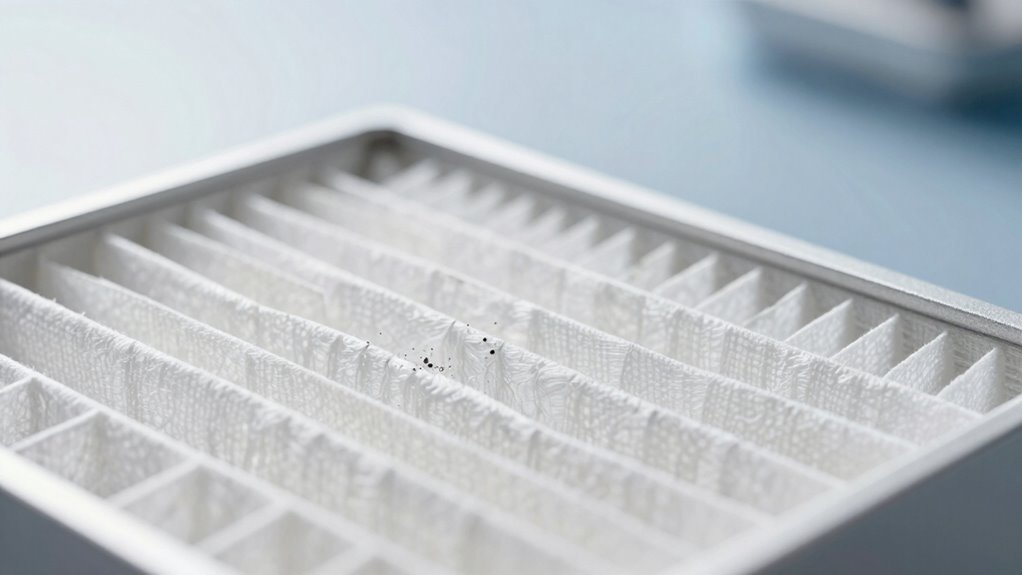
A HEPA filter’s “99.97%” rating means it can trap at least 99.97% of airborne particles that are 0.3 microns in size. This standard is established through rigorous testing, ensuring the filter effectively captures tiny particles like pollen, dust, smoke, and bacteria. The percentage reflects the efficiency in removing these contaminants from the air you breathe. If you want to understand how this measurement impacts air quality and filter performance, keep exploring more details.
Key Takeaways
- The “99.97%” indicates the filter’s efficiency in capturing 0.3-micron particles under standardized testing conditions.
- It signifies that the HEPA filter traps at least 99.97% of tiny airborne particles, including dust, pollen, and bacteria.
- The percentage reflects a precise measurement, not an estimate, ensuring high filtration performance.
- The “99.97%” standard applies specifically to particles around 0.3 microns, considered the most penetrating particle size.
- Maintaining and replacing HEPA filters regularly is essential to preserve this high level of air filtration efficiency.
Have you ever wondered how air purifiers effectively remove tiny particles and allergens? The secret lies in their filtration standards, especially when it comes to HEPA filters. You might see labels claiming a filter captures “99.97%” of particles, but what does that actually mean? Understanding the HEPA standard helps you gauge how well a purifier can clean the air in your home or office. It’s not just a marketing figure; it’s a precise measurement based on rigorous testing.
HEPA, which stands for High-Efficiency Particulate Air, is a standard that originated in the 1950s for use in nuclear facilities. Today, it’s widely used to certify air purifiers and vacuum cleaners. When a filter claims to meet HEPA standards, it must capture at least 99.97% of particles that are 0.3 microns in diameter. To give you perspective, these are particles about 300 nanometers across, roughly 1/300th the width of a human hair. This size is particularly important because 0.3 microns is considered the most penetrating particle size, meaning it’s the hardest for filters to trap. If a filter can efficiently block these, it’s even more effective at capturing smaller or larger particles, which tend to be easier to filter.
HEPA filters capture 99.97% of 0.3-micron particles, the most penetrating size for airborne contaminants.
The “99.97%” figure isn’t based on a vague estimate but on standardized testing conditions. During certification, the filter is exposed to a controlled stream of particles, and the percentage captured is measured. This testing ensures consistency across products and brands, so you can trust that a HEPA filter genuinely performs at this high level of efficiency. It’s worth noting that this standard applies primarily to particles, not gases or odors. For these, you’ll need additional filtration media like activated carbon.
When you see a HEPA label and the “99.97%” figure, it signals that the filter is among the most effective at trapping airborne particles, including pollen, pet dander, dust mites, smoke, and some bacteria. It’s a reliable choice if you’re sensitive to allergens or want to improve indoor air quality. Remember, though, that the filter’s effectiveness also depends on proper maintenance and regular replacement. A HEPA filter that’s clogged or dirty won’t perform flawlessly, so keeping up with maintenance ensures you get the full benefit of the standard’s promise.
In essence, that “99.97%” isn’t just a marketing number; it’s a certification of high efficiency based on rigorous testing. It guarantees that your air purifier can trap the tiniest particles, including those with high penetration potential, helping you breathe cleaner, healthier air every day.
Frequently Asked Questions
How Are HEPA Filters Tested for Efficiency?
You test HEPA filters by challenging them with a controlled stream of small particles, typically 0.3 microns in size. You measure how many particles pass through the filter, then compare that number to the total particles introduced. If 99.97% or more are captured, the filter meets HEPA standards. This testing is done in a controlled environment to guarantee consistent, accurate results.
Do HEPA Standards Differ Internationally?
Yes, HEPA standards differ internationally. In the US, HEPA filters must remove at least 99.97% of 0.3-micron particles, while European standards often require similar or slightly different performance benchmarks. Some countries may have less strict criteria or additional testing requirements. You should verify the specific standards in each country to confirm the filter meets the local regulations and provides the level of air purity you need.
Can HEPA Filters Remove Viruses Effectively?
You should know that HEPA filters can remove over 99.9% of airborne viruses, making them highly effective for virus control. This efficiency is due to their ability to trap tiny particles as small as 0.3 microns, which includes many viruses attached to droplets or aerosols. So, if you’re using a HEPA filter in your home or workspace, you’re substantially reducing the risk of airborne virus transmission.
How Often Should HEPA Filters Be Replaced?
You should replace HEPA filters every 6 to 12 months, depending on use and environment. If you notice reduced airflow, increased dust buildup, or persistent odors, it’s time for a change. Regular inspection helps guarantee peak filtration and air quality. In high-traffic or polluted areas, consider replacing filters more frequently. Always follow the manufacturer’s guidelines for your specific filter model to maintain its effectiveness.
Are HEPA Standards Sufficient for Allergy Sufferers?
HEPA standards are generally sufficient for allergy sufferers because they filter out 99.97% of airborne particles as small as 0.3 microns. This includes common allergens like pollen, pet dander, and dust mites. However, you should also consider frequent filter replacements, proper room ventilation, and maintaining a clean environment to maximize allergy relief. Combining these measures can markedly improve your indoor air quality and reduce allergy symptoms.
Conclusion
Understanding HEPA standards is like holding a tiny, invisible shield that guards you from the tiniest threats. When you see “99.97%,” it’s not just a number—it’s a promise of a fortress built at the microscopic level. Remember, even the strongest shields have their limits, but knowing what HEPA truly does helps you breathe easier, confident that you’re protected against the unseen enemies lurking in the air around you.