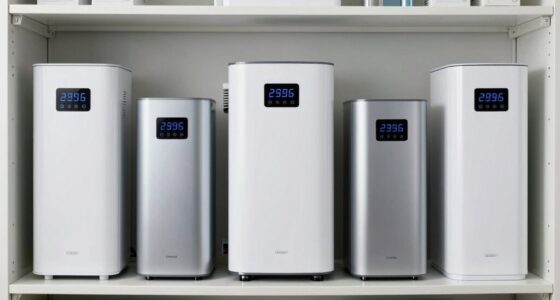
A PM2.5 monitor for wildfire smoke can show when fine particles are building up indoors, but the right choice depends on whether you need a portable reading, ongoing room monitoring, or outdoor context. My best overall pick is the Temtop P600 for its focus on PM2.5 and PM10, while the IQAir AirVisual Outdoor stands out for outdoor monitoring and the GoveeLife H5106 for connected indoor tracking. The main tradeoffs are portability versus always-on monitoring, particle-focused readings versus extra air-quality metrics, and simple displays versus app and alert features. A PM reading is useful, but it is not a substitute for an official health advisory or a certified smoke detector. Read on for the full breakdown, ranking logic, and advice for matching a monitor to your home and smoke-season routine.

Get health and wellness essentials delivered free with Prime
- Fast, free delivery on millions of items
- Prime Video, Amazon Music and more included
- Member-only deals all year
Key Takeaways
- Particle-focused monitors lead this roundup for smoke checks: the Temtop P600 and AIOMEST AI-5800D measure PM2.5 and PM10, while multi-sensor models add context at the cost of a less focused feature set.
- Indoor and outdoor monitoring solve different problems: the IQAir AirVisual Outdoor is the lineup’s outdoor-specific option; indoor monitors show conditions where you spend time, which can differ from nearby outdoor readings.
- Portability changes how you use a monitor: compact options such as the EG Portable, Huma-i HI-100, and SNDWAY are easier to move between rooms or take along, but may not suit buyers seeking continuous room tracking.
- Connected features are a separate priority from particle measurement: the 2CO9TB and GoveeLife H5106 offer smart monitoring, while simpler display-led models favor quick local checks without depending on an app.
- Extra sensors do not automatically make a better smoke monitor: CO2, TVOC, temperature, and humidity can help explain room conditions, but PM2.5 remains the core reading for tracking fine particles from wildfire smoke.
| 16-in-1 Indoor Air Quality Monitor with PM2.5, CO2, TVOC, HCHO, AQI, Temperature and Humidity |  | Best for Broad Indoor Air Checks | Measurements: PM1, PM2.5, PM10, CO2, HCHO, TVOC, AQI, temperature and humidity | Display: Color screen | Alerts: AQI buzzer alerts | VIEW ON AMAZON | See Our Full Breakdown |
| Temtop P600 PM2.5 and PM10 Air Quality Monitor |  | Best for Straightforward Particle Tracking | Particle measurements: PM2.5 and PM10 | Sensor lifespan: More than 20,000 hours | Data storage: Up to 12 hours | VIEW ON AMAZON | See Our Full Breakdown |
| 2CO9TB Smart WiFi Air Quality Monitor with PM Sensors, Temperature and Humidity |  | Best for Remote Smoke Checks | Sensors: PM1.0, PM2.5, PM10, temperature and humidity | Display: 2.8-inch color LCD | Connectivity: 2.4 GHz WiFi | VIEW ON AMAZON | See Our Full Breakdown |
| BREATHE Airmonitor Plus Gen 2 Indoor Air Quality Monitor |  | Best for Smoke Trend History | Measurements: CO₂, PM1, PM2.5, PM10, TVOC, formaldehyde (HCHO), temperature and humidity | CO₂ sensor: NDIR | Particle sensor: Laser | VIEW ON AMAZON | See Our Full Breakdown |
| EG Portable Air Quality Monitor with PM2.5 and AQI Readings |  | Best Simple Portable Pick | Measurements: PM2.5 and AQI | Sensor: Laser sensor with built-in fan | Power: Battery powered; DC 5V micro-USB charging | VIEW ON AMAZON | See Our Full Breakdown |
| Ambient Weather PM2.5 Wireless Indoor Particulate Monitor |  | Best for Smart-Home Alerts | Sensor: Sensirion particle sensor | Monitoring focus: Fine particulate matter and air pollution | Connectivity: Ambient Weather Network | VIEW ON AMAZON | See Our Full Breakdown |
| AIOMEST AI-5800D Air Quality Monitor for PM2.5 and PM10 |  | Best for PM2.5 and PM10 Spot Checks | Model: AI-5800D | Measured particles: PM2.5 and PM10 | Minimum particle diameter: 0.3 μm | VIEW ON AMAZON | See Our Full Breakdown |
| IQAir AirVisual Outdoor Air Quality Monitor |  | Best for Outdoor Wildfire-Supply Tracking | Model: AirVisual Outdoor | Measurements: PM1, PM2.5, PM10, AQI, temperature, relative humidity, and atmospheric pressure | Optional measurement: CO2 with optional sensor module | VIEW ON AMAZON | See Our Full Breakdown |
| Temtop S1 PM2.5 Air Quality Monitor with Indoor Thermometer and Hygrometer | 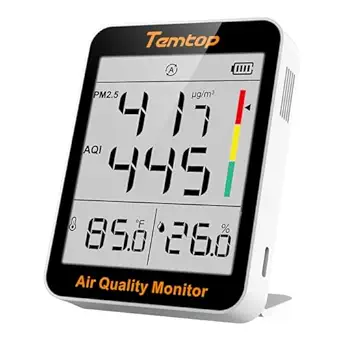 | Best for Portable Indoor Checks | Measurements: PM2.5, AQI, temperature, and humidity | Temperature range: 10–50 °C | Temperature accuracy: ±1 °C | VIEW ON AMAZON | See Our Full Breakdown |
| 16-in-1 Indoor Air Quality Monitor with CO2 Detection and AQI Alerts |  | Best for Broad Indoor Air Checks | Brand: HSCLPM | Model: AK23 | Measurements: CO2, PM1.0, PM2.5, PM10, HCHO, TVOC, temperature, and humidity | VIEW ON AMAZON | See Our Full Breakdown |
| SNDWAY Portable PM2.5 Air Quality Monitor with Temperature, Humidity, LED Display, and Alarm |  | Best for Quick Spot Checks | PM2.5 range: 0–500 μg/m³ | PM2.5 resolution: 1 μg/m³ | Response time: <1 second single response; ≤10 seconds composite response | VIEW ON AMAZON | See Our Full Breakdown |
| Huma-i HI-100 Portable Air Quality Monitor |  | Best for PM2.5 and PM10 Checks on the Go | Model: HI-100 | Measurements: PM2.5 and PM10 | Display: OLED | VIEW ON AMAZON | See Our Full Breakdown |
| Portable PM2.5 & PM10 Air Quality Monitor with Temperature & Humidity Display, Rechargeable |  | Best for Seeing More Readings at a Glance | Measurements: PM2.5, PM10, temperature, and humidity | Display: Bright color LCD | Battery: 1000 mAh rechargeable lithium | VIEW ON AMAZON | See Our Full Breakdown |
| LSENLTY 4-in-1 PM2.5 and PM10 Air Quality Monitor (Temp/Humidity/PM2.5/PM10) – Portable Detector with Alarm, 0–1000 µg/m³ Range for Home, Office, School |  | Best for High Particle Readings and Flexible Placement | Model: PTH-26P | PM2.5 range: 0–1000 μg/m³ | PM10 range: 0–1000 μg/m³ | VIEW ON AMAZON | See Our Full Breakdown |
| GoveeLife H5106 Smart Air Quality Monitor with PM2.5, Temperature, and Humidity Sensors |  | Best for Connected Indoor Monitoring | Model: H5106 | Measurements: PM2.5, temperature, and humidity | PM2.5 accuracy: ±15 μg/m³ from 0 to 100 μg/m³; ±15% from 100 to 1000 μg/m³ | VIEW ON AMAZON | See Our Full Breakdown |
| pm25 monitor for wildfire smoke | Measurements |
|---|---|
| 16-in-1 Indoor Air Quality Mon | PM1, PM2.5, PM10, CO2, HCHO, TVOC, AQI, temperature and humidity |
| Temtop P600 PM2.5 and PM10 Air | — |
| 2CO9TB Smart WiFi Air Quality | — |
| BREATHE Airmonitor Plus Gen 2 | CO₂, PM1, PM2.5, PM10, TVOC, formaldehyde (HCHO), temperature and humidity |
| EG Portable Air Quality Monito | PM2.5 and AQI |
| Ambient Weather PM2.5 Wireless | — |
| AIOMEST AI-5800D Air Quality M | — |
| IQAir AirVisual Outdoor Air Qu | PM1, PM2.5, PM10, AQI, temperature, relative humidity, and atmospheric pressure |
| Temtop S1 PM2.5 Air Quality Mo | PM2.5, AQI, temperature, and humidity |
| 16-in-1 Indoor Air Quality Mon | CO2, PM1.0, PM2.5, PM10, HCHO, TVOC, temperature, and humidity |
| SNDWAY Portable PM2.5 Air Qual | — |
| Huma-i HI-100 Portable Air Qua | PM2.5 and PM10 |
| Portable PM2.5 & PM10 Air Qual | PM2.5, PM10, temperature, and humidity |
| LSENLTY 4-in-1 PM2.5 and PM10 | — |
| GoveeLife H5106 Smart Air Qual | PM2.5, temperature, and humidity |
More Details on Our Top Picks
16-in-1 Indoor Air Quality Monitor with PM2.5, CO2, TVOC, HCHO, AQI, Temperature and Humidity
For wildfire smoke, this monitor’s main advantage is that it puts PM1, PM2.5 and PM10 alongside CO2, gases, temperature and humidity on one color screen. That broader view can help you check whether particle levels change as you ventilate or run an air cleaner, while the AQI buzzer provides an audible prompt when readings rise. Compared with the Temtop P600, it covers more than particulate matter, but the P600 offers a simpler focus on PM2.5 and PM10 with histogram review. This model is portable and can hang on a wall, though its about seven-hour battery life means it is better for spot checks than all-day cordless monitoring. The listing also gives conflicting measurement-count claims, so I would rely on the stated sensor list rather than the “16-in-1” label.
Pros:- Measures PM1, PM2.5 and PM10 alongside several other indoor air indicators
- Color screen and AQI buzzer make rising readings easier to notice
- Portable body includes a wall-hanging hole
- USB-C charging and a rechargeable battery support short-term room checks
Cons:- Battery lasts about seven hours, limiting extended cordless use
- The listing conflicts on whether the monitor measures 13 or 16 metrics
- No app-based remote monitoring or history is specified
Best for: Households that want PM readings plus CO2, gas, temperature and humidity checks on one portable display.
Not ideal for: People who need continuous cordless monitoring through a full day or want a clearly documented measurement count.
- Measurements:PM1, PM2.5, PM10, CO2, HCHO, TVOC, AQI, temperature and humidity
- Display:Color screen
- Alerts:AQI buzzer alerts
- Battery capacity:2000 mAh
- Battery life:About 7 hours
- Charging:USB Type-C
- Weight:14.1 ounces
- Dimensions:8.86 x 5.28 x 1.61 inches
Our verdict“Choose this for a broad, on-device indoor air snapshot, but pick a longer-running or app-connected monitor for ongoing smoke tracking.”
Temtop P600 PM2.5 and PM10 Air Quality Monitor
The Temtop P600 keeps its job clear: it measures PM2.5 and PM10, the particle readings most relevant when checking indoor air during wildfire smoke. Color-coded indicators help make a reading easier to interpret at a glance, while its 12-hour histogram storage can show whether levels have been rising or falling. That makes it a more focused choice than the 16-in-1 Indoor Air Quality Monitor, which adds gas and comfort readings but has a short battery runtime and inconsistent measurement-count claims. The P600’s handheld format and back stand suit room-to-room checks, and it can also be carried outside. Its limitations are equally plain: the data window is brief, and the supplied information does not state accuracy or display dimensions. I’d choose it for basic particle checks, not long-term trend records.
Pros:- Measures both PM2.5 and PM10
- Color-coded indicators make particle readings easier to scan
- Histogram stores up to 12 hours of readings
- Lightweight handheld design includes a back stand
Cons:- Stores only up to 12 hours of data
- Accuracy and display dimensions are not specified in the supplied details
- Does not list app connectivity or remote alerts
Best for: People who want a portable, easy-to-read PM2.5 and PM10 monitor without needing app access or extra gas sensors.
Not ideal for: Buyers who need remote alerts, extended historical records, or published accuracy details before choosing a monitor.
- Particle measurements:PM2.5 and PM10
- Sensor lifespan:More than 20,000 hours
- Data storage:Up to 12 hours
- Design:Lightweight handheld with back stand
- Included accessories:Charging cable and user manual
- Warranty:12 months
Our verdict“Pick the P600 for focused, portable PM2.5 and PM10 checks; choose an app-connected alternative if you need remote monitoring and longer history.”
2CO9TB Smart WiFi Air Quality Monitor with PM Sensors, Temperature and Humidity
If you want to check particle readings without standing beside the monitor, the 2CO9TB’s 2.4 GHz WiFi app and historical data give it a clear advantage over the handheld Temtop P600, which stores a shorter on-device record and lists no remote access. It tracks PM1.0, PM2.5 and PM10, with temperature and humidity readings for added room context. Its adjustable PM2.5 alarm can help flag changes while you are elsewhere, and the 2.8-inch color LCD keeps readings visible locally too. The compact rechargeable design is suited to moving between rooms, but WiFi is limited to 2.4 GHz, so it may not fit networks configured only for 5 GHz. Unlike the BREATHE Airmonitor Plus Gen 2, the supplied details do not specify a 90-day history or data export.
Pros:- Tracks PM1.0, PM2.5 and PM10, plus temperature and humidity
- App supports remote monitoring and historical data
- Adjustable PM2.5 and temperature alarms
- Compact rechargeable design with a 2.8-inch color LCD
Cons:- Connects to 2.4 GHz WiFi only
- Battery runtime is not specified in the supplied details
- History duration and data export are not specified
Best for: People who want to view PM readings and historical data remotely from a phone while checking several rooms.
Not ideal for: Buyers whose WiFi setup does not support 2.4 GHz or who need clearly specified long-term data export.
- Sensors:PM1.0, PM2.5, PM10, temperature and humidity
- Display:2.8-inch color LCD
- Connectivity:2.4 GHz WiFi
- Power:Rechargeable battery; USB Type-C charging
- Dimensions:3.5 x 2.76 x 1.38 inches
- Operating humidity:10%-80%
- Enclosure material:ABS
Our verdict“Choose the 2CO9TB for app-based remote particle checks, but favor a monitor with stated long-term history if records are a priority.”
BREATHE Airmonitor Plus Gen 2 Indoor Air Quality Monitor
The BREATHE Airmonitor Plus Gen 2 stands out for readers who want more than a current PM2.5 reading: its app offers 90-day history and data export, useful for reviewing how indoor particle levels shift over time. It tracks PM1, PM2.5 and PM10 alongside CO₂, TVOC, formaldehyde, temperature and humidity, with a laser particle sensor and NDIR CO₂ sensor listed in the specs. Compared with the 2CO9TB, it has a specifically stated 90-day record and export, making it the stronger fit for reviewing trends; the 2CO9TB may suit buyers seeking a compact app-connected monitor without that documented record window. The tradeoff is modest cordless runtime: up to six hours. It can run continuously on USB-C, but that makes placement less flexible than a monitor intended for long battery use.
Pros:- Tracks PM1, PM2.5 and PM10 alongside five other indoor metrics
- App offers configurable PM2.5 alerts, 90-day history and data export
- Can run on USB-C power for continuous monitoring
- Lists a laser particle sensor and NDIR CO2 sensor
Cons:- Portable battery use lasts up to six hours
- App connectivity requires 2.4 GHz WiFi
- Continuous operation depends on access to USB-C power
Best for: Households that want app alerts and a long record of indoor PM readings to review smoke-related changes over time.
Not ideal for: People who need a monitor to run cordless all day or whose WiFi network does not support 2.4 GHz.
- Measurements:CO₂, PM1, PM2.5, PM10, TVOC, formaldehyde (HCHO), temperature and humidity
- CO₂ sensor:NDIR
- Particle sensor:Laser
- Battery life:Up to 6 hours
- App connectivity:2.4 GHz WiFi
- App features:Remote readings, configurable CO₂ and PM2.5 alerts, 90-day history and data export
- Power:Rechargeable battery or USB-C
Our verdict“Choose the BREATHE for app alerts and extended PM trend records, provided you can keep it powered or accept short cordless sessions.”
EG Portable Air Quality Monitor with PM2.5 and AQI Readings
The EGVOC is the most stripped-back choice here: it measures PM2.5 and AQI, displaying readings in either µg/m³ or AQI. That narrow focus can be an advantage when you want a portable particle check for a room, car or hotel rather than a screen full of unrelated measurements. Compared with the Temtop P600, it does not list PM10 measurement or a histogram, but its compact, 0.17 kg design and battery power suit quick checks on the move. A built-in fan and laser sensor are specified, while micro-USB charging gives you a way to recharge it. The main compromise is limited documentation: the supplied details do not state battery life, storage, alerts or app support. I’d treat it as a simple spot-check monitor, not a tool for tracking smoke trends over time.
Pros:- Displays PM2.5 in µg/m³ or as AQI
- Built-in fan and laser sensor are specified
- Portable for home, car and hotel-room checks
- Battery powered with micro-USB charging
Cons:- Measures PM2.5 and AQI rather than a broader set of pollutants
- Battery life is not specified
- No data history, app connectivity or alert features are listed
Best for: Travelers and householders who want a compact device for quick PM2.5 checks in rooms, cars or temporary stays.
Not ideal for: Buyers who need PM10 readings, historical trends, remote alerts or a stated battery runtime.
- Measurements:PM2.5 and AQI
- Sensor:Laser sensor with built-in fan
- Power:Battery powered; DC 5V micro-USB charging
- Color:Black
- Weight:0.17 kg
- Model:EGVOC
Our verdict“Pick the EGVOC for uncomplicated portable PM2.5 spot checks, but choose the Temtop P600 if you also want PM10 and a short reading history.”
Ambient Weather PM2.5 Wireless Indoor Particulate Monitor
For wildfire smoke, I’d pick the Ambient Weather PM2.5 Monitor when I want readings to feed into a connected home rather than rely on checking a handheld screen. Its Sensirion particle sensor monitors fine particles, while Ambient Weather Network support adds data sharing and alerts that can help flag changing indoor conditions. Google Home and Alexa compatibility make it a more connected choice than the Temtop S1, which displays PM2.5 and AQI locally but does not list smart-home integrations. The tradeoff is that this model is described as an indoor monitor, so it is not a substitute for the IQAir AirVisual Outdoor when I need ongoing outdoor measurements. It runs from the included AC adapter, with AA backup batteries sold separately; that backup detail matters if I want readings to continue during a power interruption.
Pros:- Sensirion particle sensor monitors fine particulate matter.
- Ambient Weather Network support enables data sharing and alerts.
- Works with Google Home and Amazon Alexa.
- Includes an AC adapter, with AA battery backup capability.
Cons:- AA backup batteries are not included.
- Indoor-focused design does not match the IQAir AirVisual Outdoor for weatherproof outdoor monitoring.
- The supplied information does not list a display or a measurement range.
Best for: Homeowners who want indoor PM2.5 monitoring with network alerts and Google Home or Alexa connectivity.
Not ideal for: People seeking a weatherproof outdoor smoke monitor or a self-contained portable unit; this model is intended for indoor use and relies on an AC adapter for normal power.
- Sensor:Sensirion particle sensor
- Monitoring focus:Fine particulate matter and air pollution
- Connectivity:Ambient Weather Network
- Smart-home compatibility:Google Home and Amazon Alexa
- Power:AC adapter included
- Backup power:2 AA batteries; not included
- Dimensions:2.8 x 4.0 x 2.7 in
Our verdict“Choose this if connected indoor PM2.5 alerts matter more than portability or outdoor monitoring.”
AIOMEST AI-5800D Air Quality Monitor for PM2.5 and PM10
The AIOMEST AI-5800D is a practical choice when I want to check both PM2.5 and PM10 directly, especially during smoky conditions when I’m comparing readings in different rooms or locations. Its laser scattering sensor measures particles from 0.3 μm, and the wide stated PM2.5 range gives it room to display elevated readings. A backlit LCD, simple run and stop controls, and a kickstand suit spot checks better than the network-oriented Ambient Weather PM2.5 Monitor, which emphasizes alerts and smart-home connections instead. In return, the AIOMEST listing does not specify Wi-Fi, app access, or automatic alerts, so I would need to check the display myself. Real-time and timed modes add flexibility, but this is a measurement tool rather than a connected household notification system.
Pros:- Measures PM2.5 and PM10 simultaneously.
- Laser scattering sensor detects particles from 0.3 μm.
- Offers real-time and timed measurement modes.
- Backlit LCD and kickstand support convenient spot checks.
Cons:- No Wi-Fi, app connectivity, or remote alerts are listed.
- A display-based spot-check approach requires someone to read the monitor.
- The supplied information does not state its power source or battery life.
Best for: People who want a standalone display for comparing PM2.5 and PM10 readings during indoor or outdoor spot checks.
Not ideal for: Households that need remote alerts, smart-home integration, or a continuously connected record of changing smoke levels.
- Model:AI-5800D
- Measured particles:PM2.5 and PM10
- Minimum particle diameter:0.3 μm
- PM2.5 measurement range:0–999.9 μg/m³
- PM10 measurement range:0–1999 μg/m³
- Measurement modes:Real-time and timed
- Display:Backlit dot matrix LCD
- Warranty:12 months
Our verdict“Choose the AI-5800D for direct PM2.5 and PM10 readings, not for unattended alerts or smart-home monitoring.”
IQAir AirVisual Outdoor Air Quality Monitor
When I need to know what wildfire smoke is doing outside, the IQAir AirVisual Outdoor is the clear specialist in this group. Its weatherproof build and continuous readings for PM1, PM2.5, and PM10 provide a broader outdoor picture than the indoor-focused Ambient Weather monitor or portable Temtop S1. Temperature, humidity, pressure, and AQI add context that can help me follow changing conditions, while up to two years of local data storage preserves a record during internet outages. That capability comes with a more involved installation: the unit uses PoE power and includes a 12 m cable, and connectivity options include Wi-Fi or Ethernet, with 4G requiring extra hardware and a data plan. CO2 also requires an optional module. I’d choose it for sustained outdoor monitoring, not quick room-to-room checks.
Pros:- Weatherproof design supports continuous outdoor monitoring.
- Measures PM1, PM2.5, PM10, AQI, temperature, humidity, and atmospheric pressure.
- Wi-Fi and Ethernet connectivity, with optional 4G.
- Stores up to two years of data without an internet connection.
Cons:- CO2 monitoring requires an optional sensor module.
- 4G requires an optional modem and data plan.
- PoE power and the 12 m cable make installation less straightforward than using a portable monitor.
Best for: Homeowners, schools, or facility managers who need continuous, weatherproof outdoor particulate readings and historical data.
Not ideal for: Renters or buyers seeking a simple portable indoor monitor; this is an outdoor installation with PoE power, and some capabilities require optional equipment.
- Model:AirVisual Outdoor
- Measurements:PM1, PM2.5, PM10, AQI, temperature, relative humidity, and atmospheric pressure
- Optional measurement:CO2 with optional sensor module
- Connectivity:Wi-Fi, Ethernet (LAN), optional 4G
- Power:48V PoE power supply; 100–240V AC adapter
- Cable length:12 m (35 ft)
- Data storage:Up to 2 years
- Weatherproof:Yes
- Sensor slots:4, including 2 preinstalled PM sensor modules
Our verdict“Choose this for long-term outdoor wildfire-smoke tracking; choose the Temtop S1 or Ambient Weather monitor for simpler indoor use.”
Temtop S1 PM2.5 Air Quality Monitor with Indoor Thermometer and Hygrometer
The Temtop S1 suits buyers who want a compact display they can move between rooms as smoke conditions shift. It combines PM2.5 and AQI with temperature and humidity, giving more immediate context than a PM-only spot checker such as the AIOMEST AI-5800D. Its stated battery life of up to 60 days per charge also makes it easier to place away from an outlet than the AC-powered Ambient Weather monitor. The compromise is that PM2.5 and AQI readings may require a manual refresh, so it is less suited to hands-off monitoring or alerting during a fast-changing smoke event. Its temperature range is limited to 10–50 °C, too, and the listing describes a surface-mount device rather than a weatherproof outdoor monitor. I’d treat it as a portable indoor indicator, not an outdoor station.
Pros:- Displays PM2.5, AQI, temperature, and humidity together.
- Portable surface-mount design can be moved between locations.
- Battery life is listed as up to 60 days per charge.
- Laser particle sensor is specified for PM2.5 monitoring.
Cons:- PM2.5 and AQI readings may need a manual refresh.
- Temperature range is limited to 10–50 °C.
- No network connection or remote alert feature is listed.
Best for: People who want to move a battery-powered monitor between bedrooms, living areas, or other indoor spaces.
Not ideal for: Buyers who need continuous automatic updates, remote alerts, or weatherproof outdoor readings.
- Measurements:PM2.5, AQI, temperature, and humidity
- Temperature range:10–50 °C
- Temperature accuracy:±1 °C
- Operating humidity:10–99%
- Mounting type:Surface mount
- Battery life:Up to 60 days per charge
- Battery description:Alkaline
- Included components:Air quality monitor and user manual
Our verdict“Choose the Temtop S1 for portable indoor readings, but pick a connected monitor if you want alerts without checking the screen.”
16-in-1 Indoor Air Quality Monitor with CO2 Detection and AQI Alerts
I’d choose this 16-in-1 monitor when wildfire smoke is one part of a broader indoor air check. It tracks PM1.0, PM2.5, and PM10 alongside CO2, HCHO, TVOC, temperature, and humidity; the seven-color AQI indicator makes changing conditions easier to spot at a glance. That wider sensor mix goes beyond the focused PM readings of the AIOMEST AI-5800D, while its rechargeable design is more portable than the fixed outdoor IQAir AirVisual Outdoor. The tradeoff is a listed battery life of up to 12 hours, far shorter than the Temtop S1’s stated runtime, so I’d expect to recharge it frequently if it is moved around. The listing also warns that battery and charging heat can affect temperature readings. I would not rely on its temperature figure while charging.
Pros:- Tracks PM1.0, PM2.5, and PM10 alongside CO2, HCHO, and TVOC.
- Seven-color AQI indicator helps make changing air conditions visible.
- Large display presents multiple readings at a glance.
- Rechargeable battery supports portable use.
Cons:- Battery life is listed as up to 12 hours, shorter than the Temtop S1’s stated runtime.
- Temperature readings may be affected by heat from the battery.
- Temperature readings may be less accurate while charging.
Best for: People who want a portable indoor monitor that checks particulate matter alongside gases and common comfort readings.
Not ideal for: Buyers focused only on dependable long-duration PM monitoring or temperature readings while the device is charging.
- Brand:HSCLPM
- Model:AK23
- Measurements:CO2, PM1.0, PM2.5, PM10, HCHO, TVOC, temperature, and humidity
- AQI indicator:7 color levels
- Power source:Rechargeable battery
- Battery life:Up to 12 hours
- Color:White
- Dimensions:1 x 1 x 1 in
Our verdict“Choose this for a broad portable indoor air snapshot, but choose a longer-running PM monitor for extended wildfire-smoke checks.”
SNDWAY Portable PM2.5 Air Quality Monitor with Temperature, Humidity, LED Display, and Alarm
For wildfire-smoke checks in different rooms, vehicles, or outdoor locations, the SNDWAY pairs a pocketable body with a PM2.5 reading that updates in under a second. Its audible threshold alarm can alert you when readings pass your chosen limit, while temperature and humidity add context to the conditions around the monitor. Compared with the GoveeLife H5106, this is the more mobile choice: it works without a fixed USB power connection, though its battery lasts only over 4.5 hours per charge. The listed measurement range tops out at 500 μg/m³, lower than the LSENLTY’s 1000 μg/m³ range. I’d choose it for brief, hands-on checks, not continuous monitoring through a long smoke event. The product details do not list app connectivity or data history, so readings are primarily for immediate decisions.
Pros:- Compact 60 × 60 × 26 mm body suits mobile spot checks.
- PM2.5 response time is listed as under one second.
- Audible alarm can flag readings above a set threshold.
- Also displays temperature and humidity.
Cons:- Runs for only over 4.5 hours per charge.
- Listed PM2.5 range ends at 500 μg/m³, below the LSENLTY’s 1000 μg/m³ range.
- Product details do not list wireless connectivity or stored reading history.
Best for: People who want to carry a PM2.5 monitor between rooms, a car, and outdoor locations for short spot checks.
Not ideal for: Buyers who need overnight or all-day cordless monitoring, a record of past readings, or a listed PM2.5 range above 500 μg/m³.
- PM2.5 range:0–500 μg/m³
- PM2.5 resolution:1 μg/m³
- Response time:<1 second single response; ≤10 seconds composite response
- Sensor:Laser particulate matter sensor
- Temperature range and accuracy:10–50°C; ±0.3°C
- Humidity range and accuracy:0–99% RH; ±3% RH
- Battery and runtime:580 mAh lithium-ion; over 4.5 hours per charge
- Dimensions:60 × 60 × 26 mm
Our verdict“Choose the SNDWAY for fast, portable wildfire-smoke spot checks, but pick a wired monitor for continuous tracking.”
Huma-i HI-100 Portable Air Quality Monitor
The HI-100 earns its place for people who want to check both PM2.5 and PM10 while moving between indoor and outdoor settings. Its OLED graph or icon display gives more than a single bare number, and LED indicators provide another quick visual cue. Compared with the SNDWAY, it adds PM10 readings but does not list temperature, humidity, an audible alarm, or battery runtime, so the supplied details give less guidance about comfort conditions or long outings. The GoveeLife H5106 offers remote monitoring and data export, which this pocket-sized model does not list. I’d treat the HI-100 as a portable particulate checker rather than a connected home monitor; the listed feature set is focused, and buyers needing smoke alerts or broader air data should choose a more fully specified option.
Pros:- Measures both PM2.5 and PM10.
- OLED screen offers graph and icon display modes.
- LED status indicators provide a quick visual signal.
- Portable for indoor and outdoor checks.
Cons:- Product details list particulate measurements only, without temperature or humidity.
- No audible alarm or threshold-alert feature is listed.
- Battery capacity and operating time are not provided in the product details.
Best for: Commuters and travelers who want a compact display for checking PM2.5 and PM10 in different locations.
Not ideal for: Households seeking audible smoke alerts, temperature and humidity readings, or app-based monitoring and data records.
- Model:HI-100
- Measurements:PM2.5 and PM10
- Display:OLED
- Display modes:Graph or icon
- Status indicators:LED
- Air intake:Built-in fan
- Included items:Micro 5-pin USB cable and user manual
Our verdict“Pick the HI-100 if checking two particle sizes on the go matters more than alarms, extra sensors, or connectivity.”
Portable PM2.5 & PM10 Air Quality Monitor with Temperature & Humidity Display, Rechargeable
This monitor is a practical match for buyers who want wildfire-smoke readings alongside basic room conditions: its color LCD shows PM2.5, PM10, temperature, and humidity, while an audible alarm flags levels above preset thresholds. The 1000 mAh rechargeable battery supports cordless use, a step up in stated capacity from the SNDWAY’s 580 mAh battery, although runtime figures are not supplied for either. Compared with the LSENLTY, this model shares the four-measurement focus but does not list a measurement range, magnetic backing, or battery-saving behavior. Its main limitation is that it is a local readout: there is no app or wireless connection, and the small screen may be hard to read from across a room. It suits checking air nearby, not remote oversight or long-term trend tracking.
Pros:- Displays PM2.5, PM10, temperature, and humidity together.
- Rechargeable 1000 mAh battery allows cordless use.
- Audible alarm warns when levels exceed preset thresholds.
- Bright color LCD presents multiple measurements at once.
Cons:- No wireless connectivity or smartphone app integration is listed.
- Small screen can be difficult to read from a distance.
- Product details do not specify measurement ranges or battery runtime.
Best for: People who want a cordless, handheld monitor that displays particle readings and temperature and humidity together.
Not ideal for: Buyers who need remote alerts, exported history, a stated measurement range, or readings visible from across a room.
- Measurements:PM2.5, PM10, temperature, and humidity
- Display:Bright color LCD
- Battery:1000 mAh rechargeable lithium
- Form:Pocket-size design
- Alerts:Audible alarm at preset thresholds
- Connectivity:No wireless or smartphone app integration listed
Our verdict“Choose this model for cordless, all-in-one local readings, but look to the GoveeLife H5106 for connected monitoring and data export.”
LSENLTY 4-in-1 PM2.5 and PM10 Air Quality Monitor (Temp/Humidity/PM2.5/PM10) – Portable Detector with Alarm, 0–1000 µg/m³ Range for Home, Office, School
The LSENLTY stands out for its stated 0–1000 μg/m³ range for both PM2.5 and PM10, giving it a higher listed ceiling than the SNDWAY’s 0–500 μg/m³ range. For wildfire-smoke use, it also pairs particle readings with temperature and humidity, and combines a three-color indicator with an audible alarm so a change is visible or audible nearby. Its magnetic backing offers handy placement on metal surfaces, while the battery-saving screen-off and shutdown features suit occasional checks. Compared with the rechargeable four-reading monitor in this lineup, LSENLTY provides more placement and power-management details, but it does not list wireless monitoring or an app. The screen is small, and automatic shutdown after 25 minutes may interrupt unattended tracking. I’d favor it for local checks, not remote or continuous supervision.
Pros:- Lists PM2.5 and PM10 ranges up to 1000 μg/m³.
- Combines particle readings with temperature and humidity.
- Three-color indicator and audible alarm flag threshold events.
- Magnetic backing and energy-saving features support flexible placement and intermittent use.
Cons:- Small display may be hard to read from a distance.
- No companion app or wireless connectivity is listed.
- Auto shutdown after 25 minutes can limit unattended monitoring.
Best for: People who want a portable four-reading monitor with a high stated particle range, audible alerts, and flexible placement at home or work.
Not ideal for: Buyers who need app access, remote alerts, or uninterrupted monitoring without automatic shutdown.
- Model:PTH-26P
- PM2.5 range:0–1000 μg/m³
- PM10 range:0–1000 μg/m³
- Temperature range:-10°C to 50°C (14°F to 122°F)
- Humidity range:0%–95% RH
- Alerts:Three-color light indicator and audible alarm
- Power-saving behavior:Screen off after 5 minutes of inactivity; auto shutdown after 25 minutes
- Dimensions and weight:0.98 × 2.05 × 4.09 inches; 3.52 ounces
- Placement feature:Magnetic backing
Our verdict“Choose the LSENLTY for a portable, alarm-equipped monitor with a higher stated particle range, but not for remote or uninterrupted tracking.”
GoveeLife H5106 Smart Air Quality Monitor with PM2.5, Temperature, and Humidity Sensors
For tracking wildfire smoke indoors rather than carrying a monitor between locations, the GoveeLife H5106 is the most connected option in this group. It refreshes readings every two seconds and supports 2.4 GHz Wi-Fi and Bluetooth, remote monitoring, data export, and automation with compatible GoveeLife appliances. Its 13-day graphs and export of data from the past two years can help owners review how indoor particle levels change over time—features not listed for the portable SNDWAY or HI-100. The tradeoff is placement: this is a wired USB-C monitor with no built-in battery, so it is intended for a fixed indoor spot, not car or outdoor checks. Its stated PM2.5 accuracy also has limits, and it measures fewer categories than the four-in-one LSENLTY. Choose it for connected home tracking, not portable smoke scouting.
Pros:- Wi-Fi and Bluetooth enable remote monitoring.
- Provides 13-day graphs and data export covering the past two years.
- Readings refresh every two seconds.
- Can automate compatible GoveeLife appliances.
Cons:- Requires wired USB-C power and has no built-in battery.
- PM2.5 accuracy is specified as ±15 μg/m³ from 0 to 100 μg/m³ and ±15% from 100 to 1000 μg/m³.
- Measures PM2.5, temperature, and humidity, but not PM10.
Best for: Households that want to monitor indoor PM2.5 remotely, review historical data, or automate compatible GoveeLife appliances.
Not ideal for: People who need a cordless monitor for vehicles, outdoor checks, or locations without a USB power source.
- Model:H5106
- Measurements:PM2.5, temperature, and humidity
- PM2.5 accuracy:±15 μg/m³ from 0 to 100 μg/m³; ±15% from 100 to 1000 μg/m³
- Response time:2 seconds
- Connectivity:2.4 GHz Wi-Fi and Bluetooth
- Data history:13-day graphs; data export for the past 2 years
- Power:Wired USB Type-C; no built-in battery
- Temperature and humidity accuracy:±0.54°F; ±3% RH
- Dimensions and weight:5.31 × 1.57 × 2.47 inches; 5.44 ounces
Our verdict“Pick the GoveeLife H5106 for connected indoor smoke tracking and data history, but choose a battery-powered model for mobile checks.”

How We Picked
I ranked these monitors around the needs of someone tracking wildfire-related PM2.5: how directly a device measures fine particles, how quickly a reader can check conditions, and whether the design suits a room, multiple rooms, or use on the go. I also considered whether a model includes PM10, alerts, app access, outdoor monitoring, or supporting readings such as temperature and humidity. These features matter when they make the readings easier to use; they do not replace the importance of a clear, relevant PM2.5 measurement.
The order gives more weight to smoke-relevant measurement and practical usability than to the number of sensors or smart features. Indoor-focused, portable, and outdoor products serve different jobs, so a lower-ranked model may still be a better fit for a specific buyer. Product titles do not establish accuracy, calibration approach, or independent validation, so I avoid treating an advertised sensor count or alarm as proof of measurement quality. Buyers should check each model’s current specifications and instructions before relying on it for health-related decisions.
Factors to Consider When Choosing Pm25 Monitor For Wildfire Smoke
Choosing a smoke monitor is less about collecting the most readings and more about getting useful particle information where you need it. These broader checks can help you avoid paying for features that do not match your routine.
Decide Where You Need the Reading
Start with the location you want to monitor: a bedroom, a main living area, several rooms, or the outdoor air near your home. An indoor unit can reveal whether particles are reaching the space where you spend time, while an outdoor monitor provides a different kind of context. One device may not describe a whole house, especially if rooms have different ventilation or filtration. A portable monitor can be moved between spaces, but moving it means you are not watching every location at once. If you mainly want to check a sleeping area overnight, a stable bedside placement may be more useful than an outdoor reading. Match the monitor’s placement and operating style to the question you actually want answered.
Look for a Clear PM2.5 Reading, Not Just a Long Sensor List
For wildfire smoke, focus on how the device presents its PM2.5 reading and whether the unit is easy to understand at a glance. A long list of sensors can be useful for broader indoor-air checks, but extra measurements do not directly tell you how much fine particulate matter is present. Check whether the display uses a concentration, an index, or both, and read the manual to learn what each figure means. Do not assume two monitors’ index labels are directly comparable just because they use the same name. If you want to compare readings over time, a consistent measurement and display format can be more useful than added features. Treat advertised ranges and sensor labels as specifications to verify, not as proof of accuracy.
Choose Alerts and Apps Around Your Routine
Alerts can help when a monitor sits across the room or when you want a prompt after particle levels rise. App access may make it easier to check readings remotely or review changes, but it can add setup, account, network, and notification requirements. A local screen is often simpler for a quick check and keeps the reading visible without opening a phone. Think about whether you will act on alerts or whether frequent notifications will become background noise. Before buying, check whether alerts can be adjusted and whether core readings remain available if Wi-Fi or the app is unavailable. Pick connected features for a real monitoring habit, not just because they appear on a feature list.
Consider Placement, Power, and Continuous Operation
A monitor only helps if it is positioned and powered in a way that fits your home. Portable rechargeable units are handy for spot checks, but battery life and charging needs can limit their usefulness as all-day monitors. A plug-in or fixed unit may be a better match for continuous observation in one room, though it is less flexible to relocate. Avoid placing a monitor right beside a purifier outlet, open window, cooking area, or other strong local source unless that is the condition you intend to measure. Follow the manufacturer’s placement guidance and allow readings to settle after moving the device. This reduces the risk of mistaking a very local plume for the air conditions across an entire room.
Know What PM2.5 Can—and Cannot—Tell You
PM2.5 readings help track fine particles, but they do not identify every pollutant or diagnose a health condition. A low reading at one moment does not guarantee that air will stay clear, and a monitor’s alert is not an official evacuation or health instruction. Use local air-quality advisories alongside your indoor readings, especially during rapidly changing smoke events. A CO2 or TVOC sensor measures different aspects of indoor air and should not be treated as a replacement for PM2.5. If readings seem inconsistent, compare the placement and timing before assuming one device is wrong. For decisions about exposure, follow public-health guidance and the monitor’s stated limitations.
When Paying for More Features Makes Sense
Extra spending makes sense when a feature changes how you will monitor: outdoor capability for tracking conditions outside, app access for remote checks, or portability for moving between rooms. It is harder to justify added sensors if you only want a clear PM2.5 value in one space. Consider the ongoing effort as well as the hardware: charging, app setup, cleaning, and any manufacturer-recommended maintenance can affect whether you keep using the device. A simpler screen-led monitor may be easier for a household that wants immediate readings, while a connected model can suit someone who checks trends remotely. Do not pay for features on the assumption that they guarantee superior accuracy. Confirm the specifications and support information for the exact model before choosing.
Frequently Asked Questions
Should I buy an indoor or outdoor PM2.5 monitor for wildfire smoke?
Choose based on where you need information. An outdoor monitor can help track nearby outdoor conditions, while an indoor monitor shows what is happening in the room where it is placed. Outdoor readings do not tell you exactly what is entering your home, and one indoor reading does not represent every room. If your main concern is the air you breathe indoors, prioritize an indoor device and use local outdoor reports as added context. If you want to compare outside conditions with a particular indoor space, both types serve different roles rather than replacing one another.
Can I rely on a PM2.5 monitor to decide whether it is safe to go outside?
Use a personal monitor as one source of information, not as a stand-alone safety decision. Device placement, local conditions, and the monitor’s measurement method can affect a reading, and conditions can change after you check. Consult official local air-quality and public-health guidance for activity decisions during smoke events. A personal monitor can add context about a nearby location, but it may not match an official monitoring station. Follow health advice suited to your circumstances rather than treating any single number as a guarantee of safety.
Is a PM2.5-and-PM10 monitor better than a PM2.5-only model for wildfire smoke?
PM2.5 is the central measurement for tracking the fine particles associated with smoke, so a PM2.5-only monitor can meet that need. PM10 adds information about larger airborne particles, which may be useful if you want a broader particle picture. The extra measurement does not automatically mean the device gives a more useful or more accurate PM2.5 result. Compare how clearly each model displays its readings and what supporting information it provides. If smoke monitoring is your only goal, prioritize the PM2.5 display and usability over simply having more channels.
Do I need Wi-Fi or an app to monitor wildfire smoke indoors?
No. A device with a clear local display can be enough if you check the reading in person. Wi-Fi and app features are most useful when you want remote access, notifications, or a record of readings, but they may add setup and network dependence. Before choosing a connected model, check whether it still shows PM2.5 on the device if the connection drops. Also think about whether you will use historical data or act on alerts; unused features add complexity without changing your monitoring routine. The best interface is the one you will reliably check.
Where should I place an indoor PM2.5 monitor during a smoke event?
Place it in the room you want to understand, following the manufacturer’s placement instructions. Avoid putting it directly beside a purifier outlet, an open window, or a cooking source unless you specifically want to measure that nearby airflow. A monitor near a strong local source may show conditions that do not represent the rest of the room. Keep the device in a consistent location when comparing readings over time, and allow it to settle after moving it. If you need information about multiple rooms, take readings in each one or use more than one monitor rather than assuming a single location represents the whole home.
Conclusion
For most buyers seeking a smoke-focused indoor device, I would start with the Temtop P600 as the best overall pick, since its PM2.5 and PM10 focus aligns closely with particle monitoring. The best value depends on your priorities: the EG Portable or Temtop S1 may suit buyers who want a simpler, portable check, while the GoveeLife H5106 is a better fit if connected indoor monitoring matters more. For the best premium or specialized fit, consider the IQAir AirVisual Outdoor when outdoor conditions are your priority, rather than expecting it to replace an indoor monitor. Beginners may prefer a straightforward screen-led model such as the SNDWAY or Temtop S1 over a connected device with more setup. For portability, compare the Huma-i HI-100, EG Portable, and rechargeable options; for broader readings, look at the multi-sensor 16-in-1 models or BREATHE Airmonitor Plus Gen 2. My final choice would hinge on one question: do you need a simple PM2.5 check in one room, a device you can carry, or connected or outdoor monitoring?
Columbus Day / Indigenous Peoples' Day Picks
long weekend sales
As an affiliate, we earn on qualifying purchases.