
TL;DR

Get health and wellness essentials delivered free with Prime
- Fast, free delivery on millions of items
- Prime Video, Amazon Music and more included
- Member-only deals all year
Infrared thermometers for adults detect thermal radiation emitted by your body — they don’t emit anything, and they can’t harm you. Most quality forehead and ear models read within ±0.2–0.5°C of an oral thermometer when used correctly, but sweat, makeup, drafts, and holding the device at the wrong distance can throw readings off. Let the device acclimate to room temperature for 15–30 minutes, hold it 1–3 cm from the skin, and take two or three readings to confirm anything unusual.
You take your temperature three times in a row and get three different numbers. 98.9°F. Then 99.6°F. Then 98.4°F. If you’ve ever stared at an infrared thermometer wondering whether to trust it, you’re not alone — these devices flew off shelves during COVID-19, and most people never learned how to use them properly.
Here’s the good news: infrared thermometers for adults are genuinely useful tools — fast, hygienic, and accurate enough for everyday fever checks when you use them right. The catch is that “when you use them right” part. Technique matters more with these devices than with any oral thermometer you’ve ever owned.
In the next few minutes, you’ll learn how they actually work (and why they can’t hurt you), how accurate to expect them to be, a step-by-step method for reliable readings, and when a number on the screen should send you to a doctor.
Infrared thermometers detect thermal radiation emitted by your body — they emit nothing and cannot harm you.
Expect accuracy within ±0.2–0.5°C of an oral reading from an FDA-cleared device; confirm unexpected highs with an oral thermometer.
Acclimate the device to room temperature for 15–30 minutes and hold it 1–3 cm from the center of the forehead — distance errors are the top cause of bad readin…
Sweat, hats, makeup, drafts, and recent exercise or showers all skew forehead readings; wait 10 minutes after any of them.
A fever is generally 100.4°F (38°C) or higher; for adults, contact a clinician at 103°F, after three days, or with warning symptoms — and treat lower-than-usua…
How Infrared Thermometers Work (No, They Don’t Emit Radiation)
Infrared thermometers work by detecting thermal radiation emitted by your body — they’re passive readers, like a camera picking up light. Every object warmer than absolute zero glows with infrared energy, and the sensor in the device measures how much of it hits the lens. The device never touches you and never sends anything into your body. There is zero radiation exposure, despite the rumors that spread during pandemic-era screening checkpoints.
Forehead models — the gun-style ones — aim at the temporal artery region, the strip of skin across your temple and forehead where blood runs close to the surface. Ear (tympanic) thermometers use the same principle but point at the tympanic membrane, your eardrum, which sits close to the brain’s temperature-control center.
Here’s the part most people miss: the device reads your skin surface, not your core. It then runs an algorithm that estimates your internal temperature from that surface reading. That estimation step is exactly why technique and environment matter so much — and why a sweaty forehead after a workout can produce a number that’s off by a full degree.
An infrared thermometer is a calculator, not a magic wand: it measures surface heat and estimates core temperature. Feed it bad conditions and it will confidently give you a bad answer.
Forehead vs. Ear vs. Oral: Which Reading Should You Trust?
The three main thermometer types trade accuracy against convenience in different ways, and knowing the tradeoffs helps you pick the right tool for the moment. Research and clinical guidance generally rank rectal thermometers as the gold standard for core temperature, with oral close behind, and infrared devices following — accurate when positioned well, but more sensitive to user error.
| Type | Speed | Typical Accuracy | Best For |
|---|---|---|---|
| Non-contact forehead (IR) | 1–3 seconds | ±0.2–0.5°C vs. oral | Screening, sleeping people, hygiene |
| Ear (tympanic IR) | 2–5 seconds | Slightly better when positioned correctly | Adults and kids over 6 months |
| Oral (digital) | 30–60 seconds | Reference standard for home use | Confirming a fever reading |
| Forehead strips | Instant | Poor — generally not recommended | Avoid |
Ear thermometers have an edge in accuracy, but only if you pull the ear slightly up and back to straighten the ear canal — a waxy canal or an off-angle probe gives you junk data. Forehead models win on hygiene and speed, which is why they became the default at airports, offices, and schools during 2020–2022.
A practical rule many clinicians follow: use the infrared device as a fast first check. If it reads high, confirm with an oral thermometer before making decisions.
How Accurate Are They, Really? The Numbers That Matter
Quality infrared thermometers for adults typically read within ±0.2 to 0.5°C (about ±0.4 to 0.9°F) of an oral reading — good enough for home fever checks, but not laboratory-grade. In the U.S., medical IR thermometers must meet FDA performance standards and ASTM E1965 benchmarks, which set limits on how far a device can drift.
The quality spread between brands is real. Studies published during 2020–2022 found variable accuracy among consumer devices, and the FDA issued warnings about inaccurate “surveillance” thermal devices and counterfeit units that flooded the market during the pandemic. A $15 no-name import and a $60 FDA-cleared model are not the same product.
Your expectations should scale to the use case. Screening a household for “does anyone have a fever?” — an IR thermometer handles that beautifully. Tracking whether a fever is climbing toward 104°F overnight — confirm with oral. And a single reading is never a diagnosis; it’s one data point in a bigger picture that includes how you feel, symptoms, and duration.
6 Steps to a Reading You Can Actually Trust
Most inconsistent readings come from technique, not from a broken thermometer. Follow this sequence and your numbers will tighten up immediately:
- Let the device acclimate. Leave it in the room where you’ll use it for 15–30 minutes. A thermometer carried in from a cold car reads the world through a chilled lens.
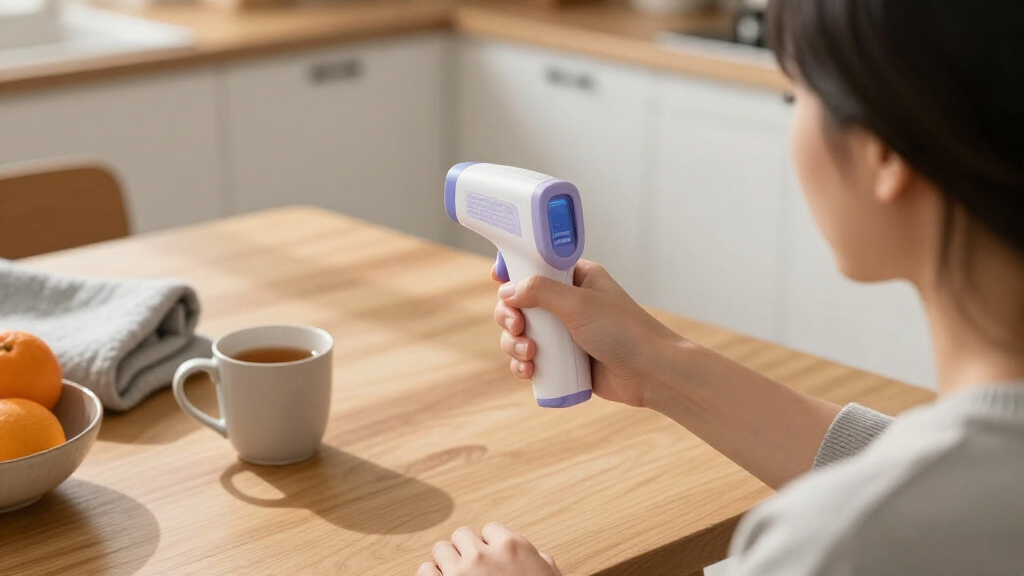
- Check the distance. Hold the sensor at the manufacturer’s stated distance — usually 1–3 cm from the center of the forehead. Too far away is the #1 cause of low readings.
- Clear the forehead. Wipe away sweat, push back hair, remove hats, and know that heavy makeup can skew the result.
- Aim at the center of the forehead. Not the temple, not the hairline — the middle, above the eyebrows.
- Take two or three readings. If they’re close together, believe them. If they scatter, average them or recheck conditions.
- Clean the sensor lens regularly with a soft cloth or cotton swab. A smudged lens is like a fingerprinted camera lens — everything comes out blurry.
One more timing tip: skip the reading entirely right after exercise, a hot shower, or coming in from the cold. Your skin temperature hasn’t caught up with your core yet, and neither has the math inside the device.
Why You Get Different Readings Every Time (and How to Fix It)
Fluctuating numbers almost always trace back to one of a handful of environmental culprits, and each one has a simple fix. Infrared thermometers measure what’s in front of them — so anything changing your skin temperature changes the answer. Understanding why each culprit distorts the reading helps you diagnose problems on the fly instead of guessing.
- Sweat or a damp forehead — moisture cools the skin. Pat dry, wait a minute, retake.
- A hat or headband just removed — trapped heat inflates the reading. Wait 10 minutes.
- Drafts, fans, or AC blowing on the face — step away from the airflow.
- Wrong distance or angle — drift an inch farther and watch the number drop.
- Cold room, warm forehead — ambient temperature drift is the enemy; acclimate the device first.
Why do these matter so much? Because the device’s algorithm assumes a normal relationship between skin temperature and core temperature — roughly a fixed offset. Sweat breaks that assumption by cooling the skin without changing your core, so the estimate drops. A hat breaks it in the opposite direction, warming the skin above what your core justifies. Drafts and ambient extremes confuse the sensor’s own calibration, because the lens itself sits at room temperature and its optics drift with it. In other words, every error source works by corrupting the same assumption — which is why fixing conditions, not recalibrating the device, is almost always the right move.
Here’s a real scenario: you check your temperature by the back door in January, get 97.8°F, and panic an hour later when the same device in your bedroom says 99.2°F. Nothing changed in your body — the first reading was taken in a cold entryway with a device still chilled from the car. Same person, two environments, two answers. That 1.4°F swing straddles the fever threshold, which is exactly why environment control isn’t optional pedantry — it’s the difference between “fine” and “call the doctor.”
If readings stay erratic after all of this, test the device on a healthy household member. Consistent normal readings there suggest your technique is fine — and the “fever” may be real. If the healthy person also reads erratically, the problem is conditions or the device, not the patient.
What to Look For When You Buy One
A good adult infrared thermometer costs roughly $25–$70, and the features that matter aren’t always the ones advertised loudest. Brands like Braun, iHealth, Kinsa, Withings, and Exergen consistently review well; the FDA-cleared designation on the packaging means the device met real performance standards. Why does that clearance matter? Because IR thermometers are algorithm-driven estimators — the manufacturer’s calibration is the product. FDA clearance means that algorithm was validated against clinical benchmarks, while an unverified import may simply be a generic sensor running untested math. That’s the real difference behind the price gap.
- Multiple modes — forehead, ear, object, and room temperature in one device adds flexibility. The tradeoff: switchable devices can default to the wrong mode at 3 a.m., so pick one with clearly labeled buttons.
- Backlit display with fever indicator — color-coded screens (green/yellow/red) make 3 a.m. checks readable without glasses. This matters more than it sounds: a groggy adult squinting at small digits is exactly how readings get transcribed wrong.
- Bluetooth and app tracking — models like Kinsa and Withings sync readings to your phone and log fever history, which doctors love seeing. A fever trend over 48 hours tells a clinician far more than any single number; the tradeoff is cost and battery dependence.
- Memory storage — the last 10–30 readings stored on-device beats scribbling numbers on a napkin, and it’s the cheaper way to get the same trend-tracking benefit if you don’t want an app.
- Specified measuring distance — a device that tells you exactly how far to hold it is a device you’ll use correctly. If the manual doesn’t state a distance, that’s a red flag about the engineering behind it.
Skip the forehead strips entirely, and be skeptical of ultra-cheap imports with no FDA clearance. According to FDA guidance issued during the pandemic, unapproved and counterfeit thermal devices were a genuine problem — buy from reputable retailers, not mystery third-party sellers. The cheapest device isn’t a bargain if a false “normal” reading keeps you home from care you needed.
When a Fever Reading Means You Should Call a Doctor
A home thermometer tells you whether you have a fever, not why — and the “why” is what a clinician evaluates. Generally, a fever is defined as a temperature of 100.4°F (38°C) or higher, though exact thresholds vary slightly by device and measurement site, so check your manual.
For adults, guidance from health authorities like the CDC and Mayo Clinic suggests seeking medical care if a fever reaches 103°F (39.4°C), lasts more than three days, or arrives with warning signs: severe headache, difficulty breathing, chest pain, confusion, persistent vomiting, or a stiff neck. A fever with a rash or one that keeps climbing despite fever reducers also warrants a call.
One group deserves special mention: older adults often run lower baseline temperatures, so a “normal” 99.2°F reading in a 82-year-old can represent a real fever for them. If you’re checking temperatures for an elderly parent, watch the trend more than the absolute number — a reading one degree above their usual baseline is more meaningful than any single threshold.
Your thermometer is a screening tool, not a diagnostician. It gives you a number; your doctor gives you an answer.
Frequently Asked Questions
Do infrared thermometers emit harmful radiation?
No. Infrared thermometers only detect thermal radiation emitted by your body — they passively read infrared energy the way a camera reads light. They emit nothing into your skin, so there is no exposure or health risk from normal use.
What temperature counts as a fever on a forehead thermometer?
For adults, a fever is generally 100.4°F (38°C) or higher. Check your device’s manual, because thresholds vary slightly by manufacturer and measurement site. If a reading is near the threshold, confirm with an oral thermometer.
Why does my infrared thermometer give different readings each time?
Usually technique or environment. Holding the device at the wrong distance, a sweaty or makeup-covered forehead, a hat just removed, drafts, or a thermometer that hasn’t adjusted to room temperature can all shift readings. Take multiple readings under consistent conditions — if they agree, trust them.
Are ear thermometers more accurate than forehead ones?
Ear (tympanic) thermometers are considered slightly more accurate when positioned correctly — pull the ear up and back to straighten the canal. If the probe angle is off or earwax blocks the canal, accuracy drops. Forehead models win on speed and hygiene for quick screening.
Do infrared thermometers work well for elderly adults?
Yes, with one caveat: older adults often have lower baseline body temperatures, so a seemingly mild reading like 99.2°F may represent a real fever for them. Track the trend against their usual baseline rather than relying on a fixed threshold, and consult a clinician about any unexplained change.
Conclusion
Treat your infrared thermometer like a smoke detector: excellent at telling you something’s wrong, not qualified to tell you what’s burning. Use it for fast, hygienic screening — then confirm anything surprising with an oral reading and a conversation with a clinician when symptoms warrant.
Master the technique and you’ll get numbers you can trust in under three seconds. Fumble the distance and hold a sweaty forehead under a ceiling fan, and you’ll chase phantom fevers all night. The device is smart. But you’re the one holding it.
Fall Picks
fall essentials
As an affiliate, we earn on qualifying purchases.