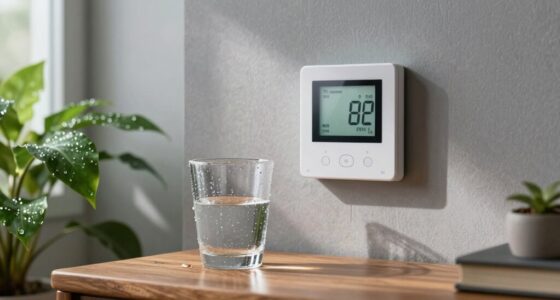
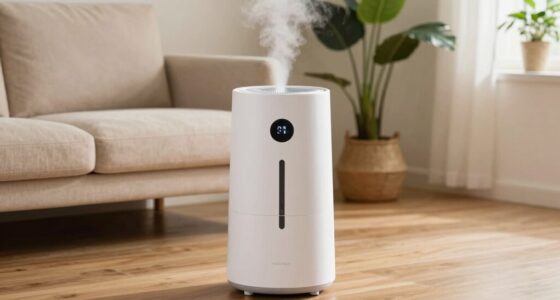
If you want a clear, consistent way to measure moisture in the air, absolute humidity is the better metric than relative humidity. Unlike relative humidity, which can change with temperature, absolute humidity focuses solely on the actual amount of water vapor per volume of air. This makes it more reliable for controlling environments, preventing issues like mold, and ensuring safety. Keep exploring to understand how this measurement can improve your indoor climate management.

Get health and wellness essentials delivered free with Prime
- Fast, free delivery on millions of items
- Prime Video, Amazon Music and more included
- Member-only deals all year
Key Takeaways
- Absolute humidity measures actual water vapor content in the air, unaffected by temperature, providing a more reliable moisture indicator than relative humidity.
- Unlike RH, absolute humidity offers consistent readings, enabling precise environmental control regardless of temperature fluctuations.
- It helps prevent issues like mold growth and condensation by accurately indicating moisture levels needed for safety and comfort.
- Absolute humidity facilitates better comparison across different environments or times, aiding in scientific, industrial, and environmental applications.
- Using absolute humidity improves decision-making for humidification or dehumidification, ensuring optimal indoor air quality and process efficiency.

Absolute humidity measures the amount of water vapor in the air, expressed as the mass of water per unit volume of air. Unlike relative humidity, which tells you how saturated the air is compared to its maximum capacity at a specific temperature, absolute humidity gives you a direct measure of the actual moisture content. This makes it a more straightforward way to understand the moisture level in your environment because it isn’t affected by temperature changes. When you know the absolute humidity, you can better assess whether the air is dry or humid, regardless of how warm or cold it is outside or inside.
Imagine you’re trying to control indoor air quality or optimize conditions for sensitive equipment or plants. Relying on relative humidity can sometimes lead to misconceptions because it fluctuates with temperature. For example, if the temperature drops, the relative humidity might spike even if the absolute moisture content stays the same. Conversely, in a warm room with the same absolute humidity, the air could feel dry. Absolute humidity strips away this ambiguity by focusing solely on the actual amount of water vapor present. It tells you, in grams per cubic meter, exactly how much moisture is in the air, allowing you to make precise adjustments.
Knowing the absolute humidity can help you make smarter decisions about heating, cooling, or humidifying spaces. If you want to prevent mold growth, for instance, keeping absolute humidity below certain levels is more reliable than just monitoring relative humidity. Similarly, if you’re involved in processes like drying or storage, where moisture content is critical, absolute humidity provides the clarity you need. It also allows for easier comparison across different environments or times because it’s unaffected by temperature shifts.
Getting a handle on absolute humidity involves measuring the water vapor’s mass and the air volume, which might require specific instruments like hygrometers or psychrometers. Once you have this data, interpreting moisture levels becomes more intuitive. You can set specific targets for comfort or safety and know exactly when to turn on humidifiers or dehumidifiers. Ultimately, absolute humidity offers a more consistent and actionable metric because it directly quantifies moisture content without the confounding influence of temperature. It’s especially valuable in scientific, industrial, and environmental contexts, where precise moisture control is essential. By focusing on the actual water vapor present, you gain a clearer, more reliable understanding of your environment’s humidity level.
Products Worth Considering

Levoit Core 400S-P Smart Air Purifier for Large Rooms

Levoit Eleva 300X HEPA Air Purifier for Home and Bedroom

OMRON VIVA 360+ Body Composition Monitor and Smart Scale
As an affiliate, we earn on qualifying purchases.
Frequently Asked Questions
How Does Absolute Humidity Impact Indoor Air Quality?
Absolute humidity directly affects your indoor air quality by controlling moisture levels. Higher absolute humidity can make the air feel damp, promoting mold growth and dust mites, which can trigger allergies or respiratory issues. Lower absolute humidity causes dry air, irritating your skin and respiratory passages. Maintaining ideal absolute humidity ensures a healthy, comfortable environment, reducing allergens and respiratory discomfort, and improving overall indoor air quality.
Can Absolute Humidity Be Used to Predict Mold Growth?
Yes, absolute humidity can predict mold growth because it shows the exact amount of water vapor in the air. When absolute humidity hits certain high levels, mold spores go into overdrive, like a volcano erupting with spores ready to settle and grow. You can use this data to prevent mold before it takes over, keeping your indoor environment safe, healthy, and mold-free.
How Does Temperature Affect Absolute Humidity Readings?
Temperature greatly influences absolute humidity readings because warmer air can hold more moisture. As temperature rises, the amount of water vapor in the air can increase even if the actual moisture content stays the same, resulting in higher absolute humidity. Conversely, cooling the air decreases its capacity to hold water vapor, leading to lower absolute humidity readings. So, when you measure absolute humidity, always account for temperature changes to interpret your results accurately.
Is Absolute Humidity Relevant for HVAC System Optimization?
Yes, absolute humidity is relevant for HVAC system optimization. It directly measures the amount of moisture in the air, helping you maintain ideal indoor conditions. By monitoring absolute humidity, you can adjust your system to prevent excessive dryness or humidity, improving comfort and energy efficiency. This precise control also reduces mold risks and preserves indoor air quality, making your HVAC system more effective and responsive to changing environmental conditions.
How Does Absolute Humidity Compare to Dew Point?
You’re asking how absolute humidity compares to dew point. Think of absolute humidity as the total amount of moisture in the air, whereas dew point indicates the temperature at which air becomes saturated. Absolute humidity is straightforward and consistent, making it easier for HVAC systems to manage moisture levels effectively. Dew point can fluctuate with temperature changes, so understanding both helps you keep indoor air comfortable and balanced.
Conclusion
So, next time you notice the air feels just right, remember it’s probably thanks to absolute humidity working quietly behind the scenes. It’s like a gentle dance, balancing moisture levels so you stay comfortable without even realizing it. Embracing this subtle metric helps you appreciate the little things—like perfect indoor air—that make your day a bit brighter. After all, sometimes the best comfort comes from those unseen, harmonious touches in your environment.