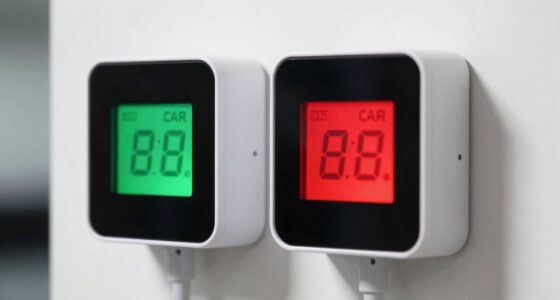

To effectively track air patterns over time, you should combine ground-based sensors and monitoring stations that measure air quality and wind data, with satellite imagery to observe large-scale movements. Incorporate weather forecast models to predict future changes and use visualization platforms to analyze trends visually. Leveraging advanced technologies like machine learning can improve accuracy. Continuing to explore these methods will help you gain an extensive understanding of atmospheric shifts and pollution dispersion.
Key Takeaways
- Utilize a network of ground-based sensors for continuous, real-time air quality and wind data collection across multiple locations.
- Integrate satellite imagery with ground sensors to observe large-scale wind flows and pollution dispersion over time.
- Employ weather forecast models and simulations to predict future air patterns and identify potential pollution episodes.
- Use interactive visualization platforms to analyze historical trends, seasonal variations, and real-time air movement.
- Apply advanced data analysis and machine learning techniques to interpret complex atmospheric data and improve tracking accuracy.

Using modern sensors and monitoring stations is one of the most reliable ways to track air patterns. These devices measure air quality parameters like particulate matter, ozone, nitrogen dioxide, and other pollutants. When you set up a network of sensors across different locations, you create an all-encompassing view of how air quality fluctuates over time and space. Data from these sensors can be visualized through wind visualization tools, which display wind speed and direction in real-time. This visualization helps you see how wind moves across areas, disperses pollutants, and influences air quality. It’s like having a live map of the atmosphere’s behavior right at your fingertips. Additionally, air quality monitoring networks can provide continuous data that helps identify long-term trends and seasonal variations in pollution levels. Satellite imagery also plays an essential role in tracking air patterns. By examining satellite data, you can observe large-scale wind flows, cloud movements, and pollution plumes over vast regions. These images provide a broad perspective that ground-based sensors may miss, especially in remote or inaccessible areas. When combined with wind visualization techniques, satellite data allows you to analyze how weather systems influence air quality and wind patterns over days or weeks. Incorporating weather patterns into your analysis helps you better understand the dynamics that affect air quality. Forecast models are another key component in tracking air patterns over time. These computer simulations integrate data from sensors, satellites, and weather observations to predict future wind flows and air quality conditions. When you utilize these models, you’re able to anticipate pollution episodes or weather changes before they happen. This proactive approach is invaluable for public health planning and environmental management. Incorporating real-time data from weather stations, sensors, and satellite sources into user-friendly visualization platforms makes tracking air patterns accessible and actionable. These platforms often feature interactive maps that display wind currents and air quality indices, helping you identify trends and anomalies quickly. By regularly analyzing this data, you can stay ahead of potential air quality issues and better understand how wind visualization influences pollution dispersion. Furthermore, data integration techniques enable a more comprehensive understanding of complex atmospheric interactions. Leveraging advanced modeling algorithms can significantly enhance prediction accuracy and provide deeper insights into atmospheric behaviors. Additionally, utilizing machine learning methods can improve the interpretation of large datasets, leading to more precise forecasts and better decision-making. Overall, combining technology, data analysis, and visualization tools forms the optimal way for you to track air patterns over time with clarity and precision.

8-in-1 Indoor Air Quality Monitor, Portable Tester for Temperature, Humidity, HCHO, TVOC, Smart Sensor for Grow Tents, Bedroom, Home
- 8-in-1 Air Quality Monitoring: Tracks CO2, AQI, temperature, humidity, HCHO, TVOC
- High-Precision Sensors: Provides fast, reliable, and sensitive readings
- Long-Lasting Rechargeable Battery: Up to 72 hours of use on a single charge
As an affiliate, we earn on qualifying purchases.
As an affiliate, we earn on qualifying purchases.
Frequently Asked Questions
What Equipment Is Essential for Tracking Air Patterns Effectively?
You need essential equipment like high-quality sensors that are regularly calibrated to guarantee accurate data collection. A reliable data logger helps you record air patterns consistently. For effective analysis, use data visualization tools to interpret the information clearly. This setup allows you to monitor changes over time, spot trends, and make informed decisions. Regular sensor calibration and good visualization techniques are key to tracking air patterns accurately and efficiently.
How Often Should Air Pattern Data Be Collected?
You should collect air pattern data as often as you breathe in air quality, which is to say, continuously. Ironically, the more consistent your data, the better you’ll understand fluctuations. Regular collection guarantees data consistency, revealing patterns or anomalies you might miss with sporadic checks. So, in truth, tracking air patterns should be an ongoing process—because air quality isn’t something you can afford to check once and forget.
Can Tracking Air Patterns Predict Weather Changes Accurately?
Tracking air patterns can help predict weather changes, but it’s not foolproof. By analyzing air quality and patterns over time, you can identify trends that influence local climate modeling. This data improves forecasting accuracy, especially when combined with other meteorological information. While it provides valuable insights, you should remember that weather prediction involves multiple factors, so air pattern tracking is a useful tool, not a definitive solution.
What Are Common Challenges in Monitoring Air Flow Over Time?
Ever wonder how reliably you can monitor air flow over time? Common challenges include maintaining accurate sensors and accounting for changing air quality and pollution sources. You might struggle with sensor calibration, data inconsistencies, or environmental factors like weather variability. These obstacles can hinder precise tracking, making it tough to identify pollution trends or assess air quality. Overcoming these issues requires robust equipment and consistent data analysis to guarantee accurate, meaningful insights.
How Does Urban Development Impact Air Pattern Tracking?
Urban development impacts air pattern tracking by increasing urban heat, which alters local air circulation, and complicates pollution dispersion modeling. As cities expand, structures can block or redirect airflow, making it harder for you to accurately monitor and predict air movement. Elevated temperatures and dense buildings create complex, dynamic patterns, requiring advanced sensors and models to effectively track changes in air flow over time.

Ultrasonic Wind Speed and Direction Sensor Module Detection Weather Station Transmitter Output RS485 0-5V 0-10V 4-20mA 0-40m/s(Special Base Bracket)
- Sensor Type: Ultrasonic Wind Speed & Direction
- Output Options: RS485, 0-5V, 0-10V, 4-20mA
- Measurement Range: 0-40 m/s
As an affiliate, we earn on qualifying purchases.
As an affiliate, we earn on qualifying purchases.
Conclusion
By mastering the art of tracking air patterns over time, you’ll unlock the secrets of the skies like a weather wizard. Imagine predicting storms before they even form or catching elusive breezes that others miss—almost like having a superpower. With the right tools and techniques, you’ll become a true air detective, unraveling mysteries that span centuries in just moments. So, gear up and take control of the wind—your adventure in air tracking is about to reach legendary heights!

Satellite Remote Sensing for Archaeology
As an affiliate, we earn on qualifying purchases.
As an affiliate, we earn on qualifying purchases.

Temtop Air Quality Monitor PM2.5 PM10 Particle Counter, Formaldehyde, Temperature, Humidity, TVOC AQI Tester for Indoor/Outdoor Air Pollution Detection w/Data Export
- All-in-One Air Quality Monitoring: Measures PM2.5, PM10, formaldehyde, VOCs, humidity, temperature, AQI
- Data Export & Historical Data: Exports data to Excel, displays 12-hour PM2.5 histogram, supports 3 months recording
- Durable & Accurate Sensors: Laser sensor lasts 20,000 hours, optimized for high precision
As an affiliate, we earn on qualifying purchases.
As an affiliate, we earn on qualifying purchases.