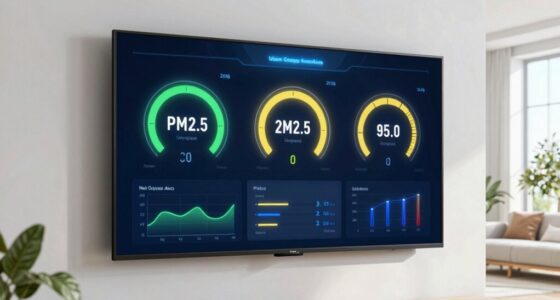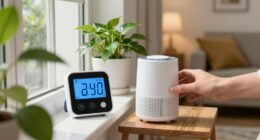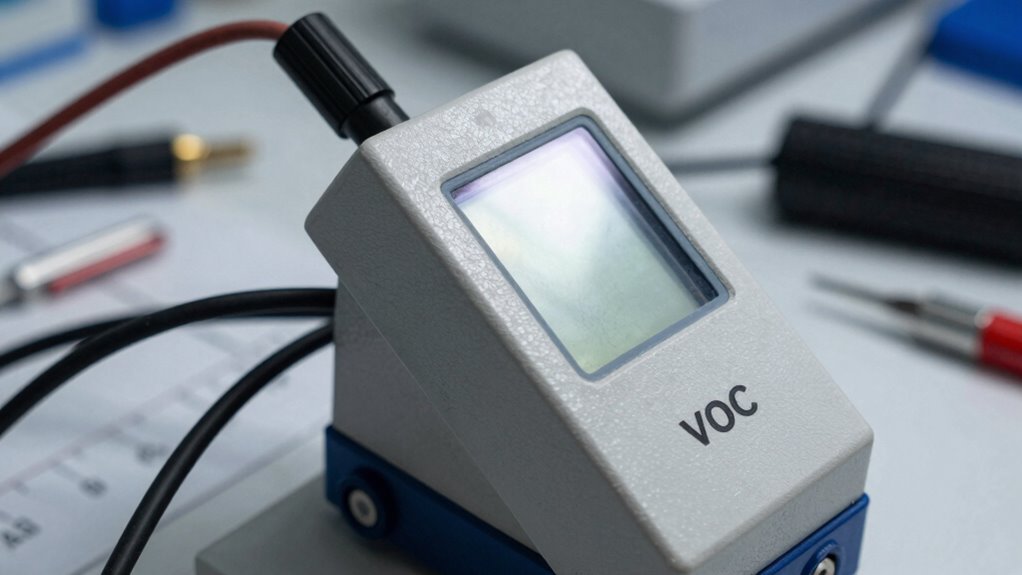

To get accurate VOC measurements, avoid placing sensors near emission sources like cleaning supplies or vents that blow hot or cold air. Don’t stash them in corners, behind furniture, or in stagnant airflow spots—these can cause false or inconsistent data. Also, steer clear of direct sunlight or humid areas that can affect performance. Follow manufacturer instructions closely and regularly calibrate your sensors. Keep reading if you want more tips on proper placement and ensuring reliable air quality monitoring.
Key Takeaways
- Place sensors too close to emission sources like paints or exhausts, causing artificially high readings.
- Avoid corners, behind furniture, or near vents to prevent stagnant air and inaccurate VOC measurements.
- Don’t expose sensors to direct sunlight, heat, or high humidity, which can lead to sensor drift or false readings.
- Follow manufacturer guidelines and calibrate sensors regularly to ensure placement accuracy and data reliability.
- Position sensors at breathing height (3-6 feet) in open, stable environments for representative air quality data.
Proper placement of VOC sensors is essential for obtaining accurate readings, yet many common mistakes can compromise your data. When you position a sensor in the wrong spot, it can produce skewed results that don’t reflect the true air quality of your environment. One of the most frequent errors is placing sensors too close to sources of VOC emissions, such as cleaning supplies, paints, or vehicle exhaust. These localized sources can cause artificially high readings, misleading you into thinking the entire space is more polluted than it actually is. To avoid this, you should position sensors at a reasonable distance from such sources, ideally where people spend most of their time, and where the air mixes well.
Another mistake is placing sensors in areas with poor airflow or stagnant air. If your sensor is tucked into a corner, behind furniture, or near a closed window, it might not capture the true VOC levels circulating in the room. Poor airflow can cause the sensor to underestimate or overestimate VOC concentrations. You need to ensure the sensor is placed in an open, accessible area where air moves freely. This might mean avoiding tight corners or spaces behind large objects. It’s also important to position the sensor at a height that reflects typical breathing zones—generally around 3 to 6 feet above the floor—so that the readings are representative of what occupants inhale.
Lighting and temperature conditions can also influence sensor accuracy. Placing sensors in direct sunlight or near heat sources can cause readings to fluctuate or drift over time. Heat can affect the sensor’s internal components, leading to unreliable data. Similarly, areas with high humidity or condensation can damage the sensor or produce inaccurate results. You should choose locations that are shaded and have stable temperature and humidity levels, away from vents that blow hot or cold air directly onto the device. Additionally, understanding the importance of sensor calibration is vital, as it ensures the accuracy of your readings over time.
Furthermore, neglecting to calibrate sensors regularly or ignoring manufacturer guidelines on placement can lead to erroneous data. Sensors drift over time, so consistent calibration ensures your readings remain reliable. Always follow the manufacturer’s instructions regarding placement and maintenance, and consider periodic validation with known VOC sources for added confidence. By avoiding these placement mistakes—proximity to emission sources, poor airflow zones, extreme environmental conditions, and neglecting calibration—you’ll substantially improve the accuracy of your VOC measurements. Proper sensor placement is a simple yet crucial step that ensures your data truly reflects the air quality in your environment, enabling better decision-making and healthier spaces.

HiLetgo 37 Sensor Assortment Kit for Arduino & Raspberry Pi – 37 in 1 Robot Project Starter Kit
37 Sensors Assortment Kit in One Starter Kit
As an affiliate, we earn on qualifying purchases.
As an affiliate, we earn on qualifying purchases.
Frequently Asked Questions
How Often Should VOC Sensors Be Recalibrated for Accuracy?
You should recalibrate VOC sensors at least once every three to six months to maintain accuracy. However, if you notice erratic readings or environmental changes, recalibrate sooner. Regular calibration ensures your sensors provide reliable data and helps prevent false alarms or missed detections. Keep track of calibration dates and follow manufacturer guidelines for specific sensor models. Consistent maintenance keeps your VOC monitoring system performing at its best.
What Environmental Factors Most Impact VOC Sensor Reliability?
Environmental factors like temperature fluctuations, humidity, and airborne particulates most impact your VOC sensor’s reliability. Rapid temperature changes can cause sensor drift, while high humidity can lead to false readings or damage. Dust, smoke, or chemical fumes can clog or interfere with sensor detection. To maintain accuracy, you should monitor these conditions closely, keep sensors properly calibrated, and protect them from extreme environmental influences.
Can Placement Mistakes Cause False VOC Readings?
Yes, placement mistakes can cause false VOC readings, and it’s ironically the simplest errors that mess up your data most. You might think putting sensors anywhere is fine, but proximity to vents, windows, or sources of pollution skews results. It’s like inviting inaccuracies into your system—so don’t overlook careful placement. Proper positioning guarantees your readings reflect reality, saving you from costly misjudgments and ensuring reliable, trustworthy data.
Are Certain VOCS More Affected by Sensor Placement Errors?
Yes, certain VOCs are more affected by sensor placement errors. For example, compounds like benzene and formaldehyde, which are often emitted from specific sources such as exhaust or building materials, can show significant concentration fluctuations depending on sensor location. If you place sensors too close to these sources or in areas with poor airflow, you might get skewed readings, making it harder to accurately assess overall air quality.
How Do Temperature and Humidity Influence VOC Sensor Performance?
Temperature and humidity considerably influence VOC sensor performance. When temperatures rise, sensors may become less accurate due to increased chemical activity or sensor drift. High humidity can cause false readings or sensor saturation, as moisture interferes with detection processes. You should regularly calibrate sensors for different environmental conditions and consider using sensors designed to withstand temperature and humidity variations to guarantee reliable VOC measurements.
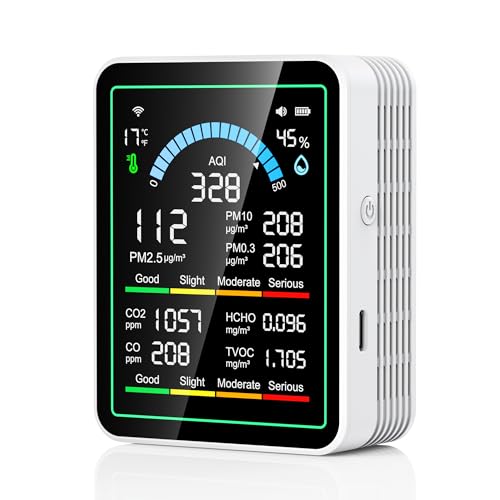
Air Quality Monitor Indoor, 10 in 1 Portable Smartair Quality Tester for CO2 | CO | TVOC | HCHO | Temp | AQI | PM0.3-1 Detection Suitable for Home, Cars, Plants, Pets and Hotels
【10-in-1 Smart Air Quality Monitor: Your All-Round Environmental Guardian】 This portable intelligent air quality tester delivers ultra-precise multi-gas…
As an affiliate, we earn on qualifying purchases.
As an affiliate, we earn on qualifying purchases.
Conclusion
Don’t let careless placement create chaos in your VOC readings. By avoiding these common mistakes, you’ll guarantee accurate assessments and improve your overall outcomes. Focus on fixing flaws, fine-tuning techniques, and staying attentive to details. With mindful methods and meticulous measures, you’ll master the art of precise placement, preventing pitfalls and promoting perfect results. Keep practicing, stay vigilant, and let your keen eye conquer challenges, turning errors into excellence every time.

Airthings Battery-Operated Lightweight Digital Home Radon Detector with LCD Display for Continuous and Long-Term Monitoring
As an affiliate, we earn on qualifying purchases.
As an affiliate, we earn on qualifying purchases.

GoveeLife Smart Air Quality Monitor with PM2.5, WiFi, Temperature & Humidity Sensors, LED Display, 2s Refresh, 2-Year Data Storage, for Home & Office Wired
High Accuracy & Fast Refresh Data: With this smart sensor, the PM2.5 accuracy is ±15 µg/m³ while temperature…
As an affiliate, we earn on qualifying purchases.
As an affiliate, we earn on qualifying purchases.