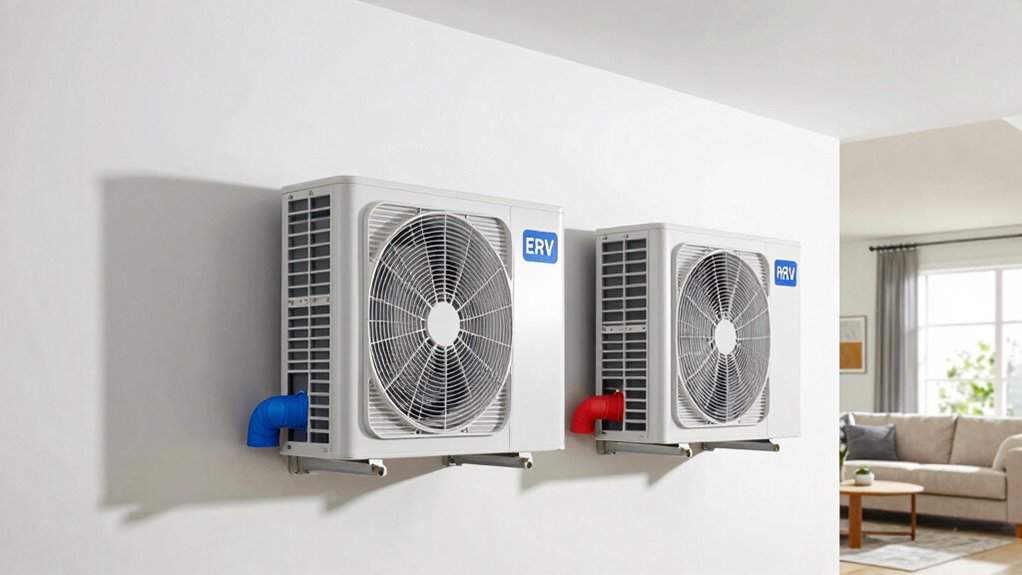

If you’re choosing between an ERV and HRV, understanding their functions helps. An HRV exchanges stale indoor air with fresh outdoor air and recovers heat to save energy, making it ideal for colder climates. An ERV not only recovers heat but also transfers moisture, helping balance humidity levels and prevent mold. Your choice depends on your climate and indoor air quality needs. Keep exploring to see which system best fits your home and lifestyle.

Get health and wellness essentials delivered free — and shop member deals
- Fast, free delivery on millions of items
- Access to Prime Big Deal Days deals on October 6–7
- Prime Video, Amazon Music and more included
Key Takeaways
- HRVs prioritize heat recovery to reduce heating costs, ideal for colder climates, while ERVs also transfer moisture to manage humidity.
- HRVs do not transfer moisture, making them suitable for dry environments; ERVs balance indoor humidity by transferring moisture.
- ERVs are better for humid or seasonal climates to prevent mold and maintain comfortable indoor moisture levels.
- HRVs improve air quality and energy efficiency mainly through heat exchange; ERVs additionally control indoor humidity.
- Maintenance for ERVs may be more frequent due to moisture transfer components compared to the simpler HRV system.

Are you unsure about whether an ERV or HRV is the right ventilation system for your home? Choosing between these two options depends on your priorities, especially when it comes to indoor air quality and energy efficiency. Both systems are designed to improve the air inside your house, but they do so in slightly different ways. Understanding these differences can help you make an informed decision that best suits your needs.
An HRV, or Heat Recovery Ventilator, focuses primarily on maintaining indoor air quality by exchanging stale indoor air with fresh outdoor air. It recovers heat from the outgoing air to warm the incoming air during colder months, which helps you save on heating costs. If your main concern is reducing indoor pollutants and maintaining a consistent temperature, an HRV is a solid choice. It’s especially effective in colder climates, where minimizing heat loss is crucial. However, HRVs aren’t designed to transfer moisture, so in humid environments, they might not be the best option, as they could lead to overly dry indoor air or struggle with excess humidity.
On the other hand, an ERV, or Energy Recovery Ventilator, also exchanges indoor and outdoor air but adds the ability to transfer moisture between the two air streams. This feature helps balance humidity levels inside your home, making ERVs ideal for climates with high humidity or significant seasonal changes. By controlling moisture, ERVs can improve indoor air quality by reducing mold growth and preventing the air from becoming too dry or too damp. Additionally, understanding the air exchange process is essential for optimizing system performance. From an energy efficiency perspective, ERVs are comparable to HRVs—they recover heat during the exchange process, reducing heating and cooling costs. However, because they manage both heat and moisture, ERVs can sometimes require more maintenance to keep the system functioning optimally. Proper maintenance of ventilation systems is crucial to ensure their longevity and efficiency.
Furthermore, climate considerations play a vital role in choosing between the systems, as they impact how effectively each system manages indoor conditions. Ultimately, your choice hinges on your local climate and indoor air quality needs. If you’re in a cold climate and want to maximize energy efficiency while improving air quality, an HRV might be the better fit. But if your environment experiences humidity challenges or you want more control over indoor moisture levels, an ERV offers a more balanced approach. In either case, both systems can significantly enhance indoor air quality and reduce energy consumption when properly installed. Your decision should be based on understanding your home’s specific climate, your comfort priorities, and how much maintenance you’re willing to handle.
As an affiliate, we earn on qualifying purchases.
Frequently Asked Questions
How Long Do ERV and HRV Units Typically Last?
ERV and HRV units typically last around 10 to 15 years, depending on maintenance and usage. Their lifespan is influenced by energy efficiency and how well you care for them. Regular filter changes and professional inspections can extend their life. Keep in mind, installation costs impact your initial investment, but proper upkeep guarantees you get the most out of your system for years to come.
Are ERV and HRV Systems Suitable for All Climate Zones?
While ERV and HRV systems offer great benefits, they aren’t suited for all climate zones. In extremely humid or dry environments, climate adaptability becomes a concern, and installation challenges may arise. For instance, in very humid areas, ERVs help manage moisture, but in colder climates, HRVs are more effective. You should assess your home’s specific needs and local climate to determine the best system, ensuring proper installation for maximum performance.
What Is the Maintenance Required for ERV and HRV Systems?
You need to regularly maintain your ERV and HRV systems by replacing filters every 6 to 12 months and cleaning the system components annually. Check filters for dirt and debris, and replace them as needed to guarantee efficient airflow. Additionally, clean the core and fans to prevent dust buildup, which can reduce system performance. Proper maintenance keeps your ventilation system working effectively and prolongs its lifespan.
Can ERV and HRV Units Be Integrated With Smart Home Systems?
Sure, ERV and HRV units can be integrated with smart home systems, but don’t expect a smooth ride. While some models boast smart home compatibility, integration challenges still exist, making it a bit of a project. You might need additional controllers or custom setups. Still, it’s worth the effort if you want to automate your ventilation and optimize energy efficiency effortlessly.
Do ERV and HRV Systems Improve Indoor Air Quality Significantly?
Yes, ERV and HRV systems can greatly improve your indoor air quality by enhancing air filtration and reducing pollutants. They also boost energy efficiency by recycling indoor air and maintaining fresh ventilation without wasting energy. These systems help remove allergens, dust, and moisture, creating a healthier living environment. Regular maintenance guarantees peak performance, so you get the best air quality and energy savings over time.
ERV energy recovery ventilator with moisture transfer
As an affiliate, we earn on qualifying purchases.
As an affiliate, we earn on qualifying purchases.
Conclusion
Think of ERVs and HRVs as the lungs of your home, quietly breathing in fresh air and exhaling stale air. Choosing the right system is like selecting the perfect pair of lungs—one that filters out pollutants and balances humidity seamlessly. When you make the right choice, your home becomes a sanctuary where every breath feels crisp and clean, turning your living space into a invigorating oasis amid the chaos outside.
home indoor air quality ventilation system
As an affiliate, we earn on qualifying purchases.
As an affiliate, we earn on qualifying purchases.
humid climate ERV ventilation system
As an affiliate, we earn on qualifying purchases.
As an affiliate, we earn on qualifying purchases.
Evergreen bestsellers Picks
bestsellers
As an affiliate, we earn on qualifying purchases.