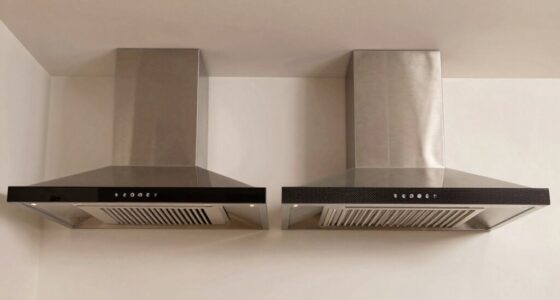
High CFM in home kitchens means your range hood can quickly and effectively remove smoke, fumes, grease, and odors while you cook. It guarantees proper airflow, preventing airborne pollutants from lingering and settling on surfaces. This helps keep your kitchen air clean and fresh, creating a healthier environment. Choosing a unit with enough CFM for your space is key to efficient ventilation. Stick around to discover how to select the right one for your kitchen needs.

Get health and wellness essentials delivered free with Prime
- Fast, free delivery on millions of items
- Prime Video, Amazon Music and more included
- Member-only deals all year
Key Takeaways
- High CFM indicates a range hood’s ability to move large amounts of air quickly, improving ventilation.
- It effectively removes smoke, fumes, and odors at the source, enhancing air quality.
- Proper CFM selection depends on kitchen size and cooking style for optimal performance.
- Higher CFM units expel heat and moisture more efficiently, preventing buildup.
- Modern high CFM hoods often include smart features for real-time airflow adjustments.

When you have a high CFM unit, it’s better equipped to remove airborne particles, grease, and odors quickly. This doesn’t just improve air quality; it also prevents these contaminants from settling on your kitchen surfaces or lingering in the air. A powerful fan with high CFM can capture smoke and fumes at the source, reducing the spread of airborne pollutants and maintaining a healthier kitchen environment. Additionally, understanding airflow capacity can help you select a unit that matches your specific cooking needs. Optimizing air exchange rate is essential for maintaining a fresh kitchen atmosphere, especially in busy cooking spaces. Proper ventilation efficiency ensures that heat and moisture are expelled effectively, and selecting the right CFM can improve overall kitchen air quality. Increasingly, modern range hoods incorporate smart technology features to monitor and adjust airflow for optimal performance.
Products Worth Considering

LEVOIT Vital 200S-P Smart Air Purifier for Large Rooms

Withings Body Smart Wi-Fi and Bluetooth Smart Scale

Levoit Core 400S-P Smart Air Purifier for Large Rooms
As an affiliate, we earn on qualifying purchases.
Frequently Asked Questions
How Do I Calculate the Ideal CFM for My Kitchen?
To calculate your ideal CFM, measure your kitchen’s size in square feet and multiply by 15, which accounts for ventilation efficiency. This guarantees proper air exchange and helps reduce noise levels. For example, a 200 sq ft kitchen needs around 3,000 CFM. Keep in mind, higher CFM isn’t always better; balancing ventilation efficiency with noise levels ensures your range hood works effectively without excessive noise.
Does Higher CFM Mean Quieter Operation?
Think of a high CFM range hood as a powerful river rushing through your kitchen. While it moves air efficiently, it often creates more noise, making noise levels higher. So, higher CFM doesn’t mean quieter operation—in fact, it can be louder. However, it can improve energy efficiency by quickly removing smoke and odors. If quiet is your priority, look for models with noise-reducing features even with higher CFM.
Can a High CFM Range Hood Fit in Small Kitchens?
A high CFM range hood can fit in small kitchens if you consider appliance compatibility and ventilation design. Measure your space carefully to guarantee the hood isn’t too bulky, and check if it’s compatible with your existing ductwork. Compact models with high CFM ratings are available, so you can get powerful ventilation without sacrificing space. Proper installation and creative placement help maximize efficiency in tight kitchen areas.
How Often Should I Clean a High CFM Vent?
You should clean your high CFM vent at least once every three to six months to maintain ideal air quality and ventilation efficiency. Regular cleaning prevents grease buildup and dust accumulation, which can hinder airflow. If you cook frequently or use your range often, consider cleaning it more often. Proper maintenance ensures your kitchen stays fresh, safe, and free from airborne contaminants, keeping your cooking environment healthy and efficient.
Is There a CFM Limit for Residential Kitchens?
Yes, there’s a CFM limit for residential kitchens, typically around 300 CFM, to meet ventilation standards and maintain good air quality. Exceeding this limit can cause noise issues or inefficient ventilation. To guarantee superior air quality and comply with standards, choose a range hood with a CFM appropriate for your kitchen size. Always consider your local building codes and manufacturer recommendations when selecting a vent fan.
Conclusion
With high CFM in your kitchen, you’re fundamentally bringing in a powerful gust of fresh air, clearing out smoke and odors like a breeze on a summer day. It’s like opening all the windows and letting the outside world flood in, making your space feel brighter and more inviting. So, when you choose a high CFM system, you’re not just venting—it’s like welcoming a gust of fresh air into your home, transforming your cooking space into a clean, vibrant haven.