For an energy-efficient portable AC with an inverter, my best overall pick is the Hisense HAP0825TWD, whose dual-hose design and 8,000 BTU capacity suit smaller spaces without jumping to a larger unit. The Gasbye 14,000 BTU stands out for its stated 13.6 CEER and full DC inverter compressor, while the Midea 12,000 BTU offers a middle-capacity alternative. The main tradeoffs are room size versus energy use, single- versus dual-hose airflow, and smart features versus straightforward operation. BTU figures are not always directly comparable, so check the rating method and your room conditions before choosing. Read on for the full comparison, selection criteria, and advice for matching an inverter model to your space.

Get health and wellness essentials delivered free with Prime
- Fast, free delivery on millions of items
- Prime Video, Amazon Music and more included
- Member-only deals all year
Key Takeaways
- Room size changes the shortlist: the Hisense is the smaller-capacity choice at 8,000 BTU, while many entries cluster around 14,000 BTU and two models list 16,000 BTU.
- Dual hoses recur among the higher-capacity options: models from Hisense, Gasbye, DREO, and ZAFRO use dual-hose designs, which can limit the negative pressure associated with single-hose exhaust setups.
- The Gasbye has the clearest stated efficiency figure: its listed 13.6 CEER gives shoppers a specific number to compare, though performance still depends on rating conditions and installation.
- Capacity labels need context: the ZAFRO listing gives both 14,000 BTU and 10,000 BTU SACC, showing why buyers should compare matching rating methods rather than relying on the largest headline number.
- Extra modes do not automatically mean better efficiency: heating, Wi-Fi, dehumidifying, sleep modes, and timers can help with convenience, but the right capacity and a well-sealed window setup matter more to cooling performance.
| Hisense HAP0825TWD 8,000 BTU Dual-Hose Inverter Portable Air Conditioner |  | Best for Quiet, Smaller Rooms | Cooling capacity: 8,000 BTU DOE/SACC; 10,000 BTU ASHRAE | Room coverage: Up to 350 sq. ft. | Hose configuration: Dual hose | VIEW ON AMAZON | See Our Full Breakdown |
| Midea 12,000 BTU Inverter Portable Air Conditioner |  | Best for Smart Controls | Cooling capacity: 12,000 BTU ASHRAE; 8,000 BTU SACC | Coverage area: Up to 350 sq. ft. | Modes: Cooling, dehumidification, fan | VIEW ON AMAZON | See Our Full Breakdown |
| ZAFRO Smart Inverter Portable Air Conditioner, 14,000 BTU |  | Best for Low-Drain Operation | Cooling capacity: 14,000 BTU; 10,000 BTU SACC | Airflow: 480 m³/h | Energy efficiency: CEER 12.8 | VIEW ON AMAZON | See Our Full Breakdown |
| SereneLife 14,000 BTU Dual Hose Portable Inverter Air Conditioner | 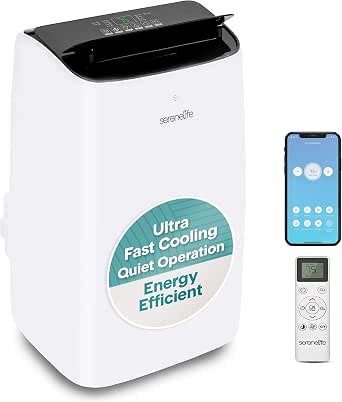 | Best for Heating and Cooling | Cooling capacity: 14,000 BTU | Claimed coverage: Up to 650 sq. ft. | Modes: Cooling, heating, dehumidifying, fan | VIEW ON AMAZON | See Our Full Breakdown |
| Gasbye Dual Hose Portable Air Conditioner, 14,000 BTU, Full DC Inverter Compressor |  | Best for Published Efficiency Data | Cooling capacity: 14,000 BTU ASHRAE; 10,500 BTU SACC | Coverage area: Up to 500 sq. ft. | Energy efficiency: 13.6 CEER | VIEW ON AMAZON | See Our Full Breakdown |
| 16,000 BTU Inverter Dual Hose Portable Air Conditioner for Rooms |  | Best for Large Rooms and Feature-Rich Control | Cooling capacity: 16,000 BTU | Stated room coverage: Up to 750 sq. ft. | Noise: As low as 40 dB in Silent Mode | VIEW ON AMAZON | See Our Full Breakdown |
| DREO Inverter Portable Air Conditioners, High Efficiency, 14000 BTU Dual-Hose |  | Best for Bedrooms and Drainage-Free Convenience | Cooling capacity: 14,000 BTU ASHRAE / 10,000 BTU DOE | Stated room coverage: 200–300 sq. ft. | Noise: 42 dB | VIEW ON AMAZON | See Our Full Breakdown |
| ZAFRO Smart Inverter Portable Air Conditioner, 14000 BTU (10000 BTU SACC), Dual Hose |  | Best Efficiency Figure in This Group | Cooling capacity: 14,000 BTU / 10,000 BTU SACC | Noise: 42 dB | Wattage: 1,250 W | VIEW ON AMAZON | See Our Full Breakdown |
| 16,000 BTU Inverter Dual-Hose Portable Air Conditioner |  | Best for Broad Window Compatibility | Cooling capacity: 16,000 BTU ASHRAE / 12,000 BTU SACC | Stated room coverage: Up to 850 sq. ft. | Temperature range: 61°F–86°F | VIEW ON AMAZON | See Our Full Breakdown |
| 14,000 BTU Inverter Portable Air Conditioner, 4-in-1 AC for Rooms up to 750 Sq. Ft. |  | Best for Simple, Remote-Controlled Operation | Cooling capacity: 14,000 BTU ASHRAE / 10,000 BTU SACC | Stated room coverage: Up to 750 sq. ft. | Temperature range: 64°F–90°F | VIEW ON AMAZON | See Our Full Breakdown |
| 14,000 BTU Inverter Dual-Hose Portable Air Conditioner |  | Best for Large, Humid Rooms | Cooling capacity: 14,000 BTU ASHRAE / 10,000 BTU SACC DOE | Coverage area: Up to 700 sq. ft. | Modes: Cooling, dehumidifier, and fan | VIEW ON AMAZON | See Our Full Breakdown |
| TURBRO Greenland 14,000 BTU Inverter Portable Air Conditioner |  | Best for Smart-Home Control | Cooling power: 14,000 BTU | Coverage: Up to 600 sq. ft. | Noise level: 43 dB | VIEW ON AMAZON | See Our Full Breakdown |
| 14,000 BTU Portable Air Conditioner, 3-in-1 Cooling, Dehumidifying, and Fan Unit with Remote Control and Installation Kit |  | Best for Lower-Drainage Upkeep | Cooling capacity: 14,000 BTU ASHRAE / 10,000 BTU SACC | Coverage area: Up to 700 sq. ft. | Modes: Cooling, dehumidifying, and fan | VIEW ON AMAZON | See Our Full Breakdown |
| energy efficient portable ac inverter | Cooling capacity | Modes | Noise level |
|---|---|---|---|
| Hisense HAP0825TWD 8,000 BTU D | 8,000 BTU DOE/SACC; 10,000 BTU ASHRAE | — | — |
| Midea 12,000 BTU Inverter Port | 12,000 BTU ASHRAE; 8,000 BTU SACC | Cooling, dehumidification, fan | 48 dB |
| ZAFRO Smart Inverter Portable | 14,000 BTU; 10,000 BTU SACC | Cool, Dry, Fan, Sleep, Extra, Eco | As low as 42 dB |
| SereneLife 14,000 BTU Dual Hos | 14,000 BTU | Cooling, heating, dehumidifying, fan | 53 dB |
| Gasbye Dual Hose Portable Air | 14,000 BTU ASHRAE; 10,500 BTU SACC | — | 45 dB |
| 16,000 BTU Inverter Dual Hose | 16,000 BTU | Cool, heat, dehumidify, fan, sleep, silent, turbo, and Eco | — |
| DREO Inverter Portable Air Con | 14,000 BTU ASHRAE / 10,000 BTU DOE | — | — |
| ZAFRO Smart Inverter Portable | 14,000 BTU / 10,000 BTU SACC | — | — |
| 16,000 BTU Inverter Dual-Hose | 16,000 BTU ASHRAE / 12,000 BTU SACC | — | — |
| 14,000 BTU Inverter Portable A | 14,000 BTU ASHRAE / 10,000 BTU SACC | Cooling, dehumidify, fan, and sleep | — |
| 14,000 BTU Inverter Dual-Hose | 14,000 BTU ASHRAE / 10,000 BTU SACC DOE | Cooling, dehumidifier, and fan | As low as 42 dB |
| TURBRO Greenland 14,000 BTU In | — | — | 43 dB |
| 14,000 BTU Portable Air Condit | 14,000 BTU ASHRAE / 10,000 BTU SACC | Cooling, dehumidifying, and fan | 52 dB; sleep mode below 48 dB |
More Details on Our Top Picks
Hisense HAP0825TWD 8,000 BTU Dual-Hose Inverter Portable Air Conditioner
The Hisense pairs an 8,000 BTU SACC rating with a dual-hose setup and inverter compressor, a sensible match for rooms up to 350 sq. ft. Its stated 42 dB(A) quiet mode is a useful distinction for bedrooms, while the Midea offers more ASHRAE capacity and app-and-voice control at a similar stated coverage area. The Hisense adds app control, dehumidifying, and fan modes, but its 700-watt draw and smaller SACC rating point to a more modest cooling role than the higher-capacity ZAFRO or Gasbye. The tradeoff is portability: 65 pounds makes it harder to move between rooms, and the listed warranty is only 90 days. I’d choose it for quiet, steady cooling in a moderate-size space, not for large or frequently rearranged rooms.
Pros:- Dual-hose design supports more consistent cooling than a typical single-hose setup.
- Inverter compressor is designed to adjust output rather than run at a fixed rate.
- Quiet mode is rated at 42 dB(A).
- App, remote, and touch controls accompany cooling, fan, and dehumidifying modes.
Cons:- At 65 lb, it is heavier than the Midea and the listed ZAFRO.
- Its 8,000 BTU SACC rating is less suited to larger rooms than the 10,000 BTU SACC ZAFRO.
- The stated 90-day limited warranty is short.
Best for: Bedroom occupants or remote workers cooling a room up to 350 sq. ft. who prioritize quiet operation and dual-hose inverter design.
Not ideal for: Buyers who need to cool a larger space, move the unit often, or want a longer stated warranty.
- Cooling capacity:8,000 BTU DOE/SACC; 10,000 BTU ASHRAE
- Room coverage:Up to 350 sq. ft.
- Hose configuration:Dual hose
- Inverter:Yes
- Quiet-mode noise:42 dB(A)
- Power:115 V; 700 W
- Dimensions and weight:12.9 × 17.48 × 28.26 in; 65 lb
- Warranty:90-day limited warranty
Our verdict“Choose the Hisense for quieter inverter cooling in a moderate-size room, but skip it if you need higher capacity or easy room-to-room portability.”
Midea 12,000 BTU Inverter Portable Air Conditioner
The Midea’s strongest case is its flexible app and voice control: SmartHome app, Alexa, Google Assistant, and a remote make it easier to adjust cooling without going to the unit. It also covers up to 350 sq. ft. and provides cooling, fan, and dehumidification modes, much like the smaller Hisense. The Midea’s listed 8,000 BTU SACC rating matches the Hisense’s SACC figure, despite its higher 12,000 BTU ASHRAE label, so I would not choose it on the larger headline number alone. Its claimed energy use—over 66% less than the U.S. federal standard—is a notable efficiency claim, though no CEER figure is supplied here. At 48 dB, it is louder on paper than the Hisense in quiet mode; the 24-hour timer and included reusable filter add practical value.
Pros:- Supports SmartHome app, Alexa, Google Assistant, and remote control.
- Includes a 24-hour timer and reusable air filter.
- Provides cooling, fan, and dehumidification modes.
- The listed inverter efficiency claim targets lower energy use than the federal standard.
Cons:- Its 8,000 BTU SACC rating is the same as the lower-capacity-labeled Hisense, so the higher ASHRAE figure needs context.
- The stated 48 dB noise level is higher than the Hisense and ZAFRO quiet-mode figures.
- Installation requires a window opening at least 30 inches high.
Best for: Smart-home users cooling a room up to 350 sq. ft. who want app, voice, and remote controls with scheduled operation.
Not ideal for: Light sleepers prioritizing the lowest stated noise level, or buyers whose window opening is shorter than 30 inches.
- Cooling capacity:12,000 BTU ASHRAE; 8,000 BTU SACC
- Coverage area:Up to 350 sq. ft.
- Modes:Cooling, dehumidification, fan
- Noise level:48 dB
- Controls:SmartHome app, remote, Alexa, Google Assistant
- Temperature range:62°F–90°F
- Dimensions and weight:13.74 × 17.44 × 28.66 in; 52.9 lb
- Window opening:Minimum height of 30 in
Our verdict“Pick the Midea if smart-home control and scheduling matter more than the quietest stated operation or a compact window opening.”
ZAFRO Smart Inverter Portable Air Conditioner, 14,000 BTU
The ZAFRO combines a dual-hose inverter system with a 10,000 BTU SACC rating, making it a more capable cooling pick than the Hisense or Midea on the listed SACC figures. Its standout convenience is the self-evaporating system, which can run for up to 72 hours without drainage when humidity stays below 90%. That can cut down on emptying interruptions, though very humid conditions still call for a drain hose. Six modes, app and remote control, a timer, and noise as low as 42 dB broaden its use beyond basic cooling. The Gasbye offers a higher stated 10,500 BTU SACC rating and a 13.6 CEER figure, so it gives efficiency-minded buyers more published performance data; the ZAFRO instead emphasizes mode flexibility and reduced drain chores. Its 1,250-watt draw is also worth noting.
Pros:- Dual-hose inverter design and 10,000 BTU SACC capacity suit more demanding cooling than the Hisense or Midea.
- Self-evaporating operation is listed for up to 72 hours below 90% humidity.
- Six modes, app control, remote control, and a 24-hour timer offer operating flexibility.
- Noise is listed as low as 42 dB.
Cons:- A drain hose is needed in humidity above 90%.
- The 14,000 BTU headline capacity is higher than its 10,000 BTU SACC rating.
- Its listed 1,250-watt draw is higher than the Hisense’s 700 W.
Best for: People cooling a medium-to-large room who want multiple operating modes and fewer drainage interruptions in moderate humidity.
Not ideal for: Buyers in persistently very humid spaces who cannot connect a drain hose, or shoppers seeking a stated CEER figure for comparison.
- Cooling capacity:14,000 BTU; 10,000 BTU SACC
- Airflow:480 m³/h
- Energy efficiency:CEER 12.8
- Hose configuration:Dual hose
- Noise level:As low as 42 dB
- Power:115 V; 1,250 W
- Modes:Cool, Dry, Fan, Sleep, Extra, Eco
- Drainage-free operation:Up to 72 hours below 90% humidity
Our verdict“Choose the ZAFRO for versatile, higher-capacity cooling with extended drainage-free operation in moderate humidity.”
SereneLife 14,000 BTU Dual Hose Portable Inverter Air Conditioner
Unlike the Hisense, Midea, and ZAFRO, the SereneLife adds heating mode alongside cooling, dehumidifying, and fan operation, giving it a broader year-round role. It is listed for spaces up to 650 sq. ft., though the supplied details do not include a SACC figure or CEER rating, so its capacity and efficiency are harder to compare directly with the Gasbye and ZAFRO. The manufacturer claims up to 40% better energy efficiency than standard portable AC motors and 50% faster cooling; I’d treat those as product claims rather than directly comparable test results. The published 53 dB noise level is notably higher than the 42 dB ZAFRO and Hisense quiet-mode figures. Wi-Fi control, a washable filter, and a one-year warranty round it out, but buyers focused narrowly on quiet cooling have stronger matches in this group.
Pros:- Heating mode adds a year-round function not listed for the other products here.
- Advertised coverage reaches up to 650 sq. ft.
- Dual-hose design and inverter compressor are intended to support efficient cooling.
- Wi-Fi control, remote, washable filter, and one-year warranty are included or listed.
Cons:- At 53 dB, it has a higher stated noise level than the Hisense and ZAFRO quiet-mode figures.
- No SACC or CEER rating is provided in the supplied product data.
- The 650 sq. ft. coverage and efficiency figures are manufacturer claims without comparable test details here.
Best for: Households wanting one portable unit for seasonal cooling and supplemental heating in a larger living area.
Not ideal for: Noise-sensitive bedroom users or efficiency-focused shoppers who require a listed SACC or CEER figure to compare models.
- Cooling capacity:14,000 BTU
- Claimed coverage:Up to 650 sq. ft.
- Modes:Cooling, heating, dehumidifying, fan
- Noise level:53 dB
- Power:115 V; 1,030 W
- Refrigerant:R-32
- Dimensions and weight:14.06 × 16.5 × 27.09 in; 52.8 lb
- Warranty:1 year
Our verdict“Choose the SereneLife if heating plus cooling and broad claimed coverage matter more than low noise or directly comparable efficiency ratings.”
Gasbye Dual Hose Portable Air Conditioner, 14,000 BTU, Full DC Inverter Compressor
The Gasbye is the clearest fit for shoppers comparing efficiency figures: it lists a 13.6 CEER rating, a full DC inverter compressor, and a 10,500 BTU SACC capacity. That gives it a stronger documented efficiency-and-capacity case than the Midea, whose supplied data lacks a CEER figure, and a slightly higher SACC rating than the ZAFRO. The dual-hose configuration supports cooling without the negative-pressure drawback of common single-hose units, while its 45 dB noise claim and display-off mode suit overnight use. It is not the smallest option here: at 15.5 inches deep and 29.3 inches high, it takes more room than the ZAFRO. The high-positioned drain outlet helps with manual draining, but humid, unsealed rooms may still require it; extension hoses are not recommended.
Pros:- The 13.6 CEER rating gives buyers a published efficiency figure for comparison.
- Full DC inverter compressor and dual hoses support steady, efficient cooling.
- 10,500 BTU SACC capacity is higher than the listed ZAFRO and the Hisense or Midea.
- 45 dB noise level, display-off mode, and a three-year quality coverage period are listed.
Cons:- Its 15.5-inch depth and 29.3-inch height make it larger than the ZAFRO.
- Manual drainage may be needed above 85% relative humidity in unsealed rooms.
- Extension hoses are not recommended, limiting flexibility for distant windows.
Best for: Efficiency-minded buyers cooling a room up to 500 sq. ft. who want a stated CEER rating, dual hoses, and a longer listed warranty.
Not ideal for: People with limited floor space, unusually humid unsealed rooms, or installations that require an extended exhaust hose.
- Cooling capacity:14,000 BTU ASHRAE; 10,500 BTU SACC
- Coverage area:Up to 500 sq. ft.
- Energy efficiency:13.6 CEER
- Compressor:Full DC inverter
- Hose configuration:Dual hose; 5.9-in diameter, 59-in length
- Noise level:45 dB
- Dimensions:15.5 × 17.7 × 29.3 in
- Warranty:3-year quality coverage
Our verdict“Choose the Gasbye if you want the strongest supplied efficiency documentation and higher SACC capacity, provided its size and hose limits fit your room.”
16,000 BTU Inverter Dual Hose Portable Air Conditioner for Rooms
With a stated reach of up to 750 sq. ft., this Temprium is the strongest fit here for buyers prioritizing broad coverage alongside inverter operation. Its dual-hose design supports cooling without relying on the single-hose approach used by many portable units, while the variable-speed compressor is designed to maintain temperatures with fewer start-stop swings. Compared with the DREO 14,000 BTU model, this unit offers more listed cooling capacity and more operating modes, including heat and Eco, but the DREO provides a specific 200–300 sq. ft. recommendation and a clearer window-size range. Temprium’s 40 dB Silent Mode and app and voice controls add flexibility for nighttime use. The tradeoffs are its 1,550-watt draw, one-year warranty, and the need for a drain hose in persistently humid conditions despite its self-evaporating system.
Pros:- 16,000 BTU capacity and stated coverage up to 750 sq. ft.
- Inverter compressor and dual-hose design support steadier cooling.
- Silent Mode is listed as low as 40 dB.
- App, remote, touch, Alexa, and Google Assistant controls, with eight modes.
Cons:- Listed wattage is 1,550 W, higher than the ZAFRO 14,000 BTU model’s 1,250 W.
- Continuous drainage may be needed in high-humidity conditions.
- The stated manufacturer warranty is one year.
Best for: People cooling a large, open room who want inverter temperature control, app or voice operation, and multiple modes including heat.
Not ideal for: Buyers of compact bedrooms or rooms without space for a larger portable unit, and anyone seeking a low-wattage model or a long stated warranty.
- Cooling capacity:16,000 BTU
- Stated room coverage:Up to 750 sq. ft.
- Noise:As low as 40 dB in Silent Mode
- Wattage:1,550 W
- Voltage:115 V
- Refrigerant:R-32
- Modes:Cool, heat, dehumidify, fan, sleep, silent, turbo, and Eco
- Controls:App, remote, touch, Alexa, and Google Assistant
Our verdict“Choose the Temprium if you need broad stated coverage and extensive controls, but skip it if lower power draw matters more than capacity.”
DREO Inverter Portable Air Conditioners, High Efficiency, 14000 BTU Dual-Hose
The DREO pairs an inverter compressor with a dual-hose setup and a self-evaporating system designed to avoid drainage below 90% humidity. That combination suits buyers who want steadier cooling and less routine water handling in a bedroom or modest living space. Its stated coverage is 200–300 sq. ft., making the capacity guidance more restrained than the Temprium’s claim of up to 750 sq. ft.; I would favor DREO when room fit is the priority rather than chasing the largest number. The manufacturer claims 32% greater energy efficiency than traditional models, but the supplied data does not give a CEER figure for direct comparison with ZAFRO’s 12.8. DREO lists 42 dB operation, app, remote, and Alexa control, though it offers fewer documented modes and no listed heat function.
Pros:- Dual-hose design helps limit hot-air backflow.
- Inverter operation is intended to adjust output to cooling demand.
- Self-evaporating drainage is designed for use below 90% humidity.
- App, remote, and Alexa controls with listed 42 dB operation.
Cons:- Stated room coverage is only 200–300 sq. ft., below the Temprium’s stated reach.
- No CEER value is provided in the supplied product information.
- The listed feature set does not include a heat mode.
Best for: Bedroom users with rooms around 200–300 sq. ft. who value dual-hose cooling, smart controls, and minimal routine drainage.
Not ideal for: People cooling large open-plan areas or those who need a published CEER rating, heat mode, or a verified fit for windows outside the stated range.
- Cooling capacity:14,000 BTU ASHRAE / 10,000 BTU DOE
- Stated room coverage:200–300 sq. ft.
- Noise:42 dB
- Wattage:1,540 W
- Voltage:115 V
- Refrigerant:R-32
- Window fit:20–53 in. window openings
- Dimensions:14.37 × 17.32 × 28.13 in. (D × W × H)
- Weight:55.4 lb
Our verdict“Pick DREO for a bedroom-sized space where drainage convenience and smart control matter more than maximum coverage or a published efficiency rating.”
ZAFRO Smart Inverter Portable Air Conditioner, 14000 BTU (10000 BTU SACC), Dual Hose
ZAFRO earns this role through its listed CEER of 12.8, the clearest efficiency benchmark among these five models. Its 14,000 BTU ASHRAE capacity and dual-hose design make it a practical middle ground for buyers who want inverter cooling without moving up to the larger Temprium or the 16,000 BTU model reviewed below. The 1,250-watt rating is also lower than the listed draw of those higher-capacity options, though wattage alone does not establish real-world operating cost. At 42 dB, ZAFRO matches DREO’s listed noise level and adds app control, a remote, six modes, and a 24-hour timer. Its self-evaporating design can reduce drainage chores for up to 72 hours, but the unit still calls for a drain hose above 90% humidity. Its 54-pound weight also makes frequent room-to-room moves less appealing.
Pros:- CEER 12.8 is a useful published efficiency comparison point.
- Listed 1,250 W draw is lower than the 1,540 W DREO and 1,550 W Temprium figures.
- Self-evaporating system is listed for up to 72 hours of drainage-free operation.
- Wi-Fi app control, remote, six modes, and a 24-hour timer.
Cons:- At 54 lb, carrying it between rooms or floors may be cumbersome.
- A drain hose may be required above 90% humidity.
- Its 14,000 BTU capacity is below the 16,000 BTU Temprium and other larger-capacity pick.
Best for: Efficiency-minded buyers cooling a medium-sized space who want a published CEER, app control, and reduced routine drainage.
Not ideal for: People who need the highest listed capacity, frequently move an AC between floors, or live in very humid conditions without a convenient drain.
- Cooling capacity:14,000 BTU / 10,000 BTU SACC
- Noise:42 dB
- Wattage:1,250 W
- Voltage:115 V
- Refrigerant:R-32
- Dimensions:14.25 × 16.54 × 27.2 in. (D × W × H)
- Weight:54 lb
- Modes and drainage:Six modes; self-evaporating system listed for up to 72 hours
Our verdict“Choose ZAFRO if a published efficiency rating and lower listed wattage are your priorities, provided its capacity suits your room.”
16,000 BTU Inverter Dual-Hose Portable Air Conditioner
This 16,000 BTU model combines a dual-hose layout with an inverter compressor and a stated reach of up to 850 sq. ft., giving it the broadest coverage claim in this group. I would treat that figure as a starting point rather than a guarantee; the supplied data does not specify the room conditions behind it. Compared with the Temprium, it lists a slightly larger coverage area but fewer smart features and operating modes. Its practical advantage is installation flexibility: the kit is described for vertical or horizontal sliding windows up to 60 inches wide. A 42 dB sleep-mode figure, washable filter, four fan speeds, and 24-hour timer round out the everyday controls. The tradeoffs are no supplied CEER or wattage figure for efficiency comparison and automatic condensate discharge that works in only about 85% of environments.
Pros:- 16,000 BTU capacity with a stated coverage claim up to 850 sq. ft.
- Dual-hose design and inverter technology support cooling with reduced hot-air backflow.
- Window kit is stated to fit vertical and horizontal sliding windows up to 60 in. wide.
- Washable filter, four fan speeds, sleep mode, and 24-hour timer.
Cons:- No CEER or wattage figure is supplied for comparison with the ZAFRO or Temprium.
- Automatic condensate discharge is described as working in about 85% of environments.
- Controls are limited to a remote in the supplied information, with no listed app or voice support.
Best for: Households with a large room and a sliding window that needs a wider fit range, who prefer straightforward remote controls over app features.
Not ideal for: Efficiency shoppers who require a published CEER or wattage, or users in humid spaces who need dependable drainage without monitoring.
- Cooling capacity:16,000 BTU ASHRAE / 12,000 BTU SACC
- Stated room coverage:Up to 850 sq. ft.
- Temperature range:61°F–86°F
- Sleep-mode noise:As low as 42 dB(A)
- Airflow:Up to 470 m³/h
- Modes and fan speeds:Cool, dry, fan, and auto; four fan speeds
- Window compatibility:Vertical or horizontal sliding windows up to 60 in. wide
- Dimensions:14 × 27 × 16.5 in. (W × H × D)
- Certification:DOE and ETL certified
Our verdict“Choose this unit for its large stated coverage and broad sliding-window fit, but look elsewhere if you need a published efficiency figure or more dependable condensate handling.”
14,000 BTU Inverter Portable Air Conditioner, 4-in-1 AC for Rooms up to 750 Sq. Ft.
This model keeps the feature set uncomplicated: inverter cooling, four operating functions, a remote, and a 24-hour timer. That makes it a more approachable pick than the app- and voice-heavy Temprium, though the Temprium offers dual-hose construction, more modes, and a lower listed minimum noise level. Here, the product description gives 14,000 BTU ASHRAE and 10,000 BTU SACC, while its stated coverage reaches 750 sq. ft.; buyers should match capacity to their actual room rather than rely on that maximum claim alone. The unit also lists a dehumidifying capacity of up to 100 pints per day and caster wheels for repositioning. Its meaningful drawbacks are a 52 dB minimum noise claim, a 1,430-watt draw, and bulky listed dimensions that may complicate storage or tight installations.
Pros:- Inverter compressor adjusts output to match cooling demand.
- Cooling, dehumidify, fan, and sleep functions cover common household needs.
- Self-evaporative system reduces routine drainage under normal conditions.
- Caster wheels, side handles, remote, and 1–24 hour timer support everyday use.
Cons:- Listed noise is as low as 52 dB, louder than the 40–42 dB claims of the other picks.
- The supplied information does not identify a dual-hose design or CEER rating.
- At 68.3 lb and 35.24 in. wide as listed, it may be difficult to move or fit in tight spaces.
Best for: People seeking inverter cooling with a remote and basic modes for a living room or home office, without needing Wi-Fi or voice commands.
Not ideal for: Light sleepers who prioritize the quietest listed operation, or buyers who need a compact unit, dual-hose airflow, or smart-home controls.
- Cooling capacity:14,000 BTU ASHRAE / 10,000 BTU SACC
- Stated room coverage:Up to 750 sq. ft.
- Temperature range:64°F–90°F
- Noise:As low as 52 dB
- Wattage:1,430 W
- Voltage:110 V
- Dehumidifying capacity:Up to 100 pints per day
- Modes:Cooling, dehumidify, fan, and sleep
- Weight:68.3 lb
Our verdict“Pick this model for straightforward remote-operated inverter cooling and dehumidifying, but choose a quieter dual-hose option for bedrooms or energy comparisons based on CEER.”
14,000 BTU Inverter Dual-Hose Portable Air Conditioner
For buyers prioritizing inverter efficiency in a larger room, this model pairs a dual-hose layout with 14,000 BTU ASHRAE capacity and coverage listed up to 700 square feet. The dual-hose design helps limit the replacement of cooled indoor air with warm outside air, a useful advantage over single-hose options such as the TURBRO Greenland. Its 42 dB low-noise figure, sleep mode, and three operating modes add flexibility for overnight use and damp weather. The tradeoff is that its self-evaporating system is not hands-off in every climate: the listing says manual draining may be needed about every eight hours when humidity exceeds 80%. At 65 pounds, it is also a substantial appliance to relocate, even with wheels. I’d choose it for cooling reach and dual-hose airflow, not for maintenance-free operation in persistently humid rooms.
Pros:- Dual-hose inverter design is intended to cool faster while reducing energy waste from replacement air.
- Listed coverage reaches up to 700 sq. ft., more than the TURBRO Greenland’s stated 600 sq. ft.
- Sleep operation is listed as low as 42 dB.
- Cooling, dehumidifying, and fan modes provide options beyond temperature control.
Cons:- Manual draining may be needed about every eight hours above 80% humidity.
- At 65 lbs, it is heavy to move despite its wheels.
- Remote control requires two AAA batteries, which are not included.
Best for: People cooling a large, humid living area who want a dual-hose inverter setup and cooling, fan, and dehumidifier modes.
Not ideal for: Buyers in persistently very humid spaces who cannot manage periodic draining, or anyone needing a lightweight unit to carry between floors.
- Cooling capacity:14,000 BTU ASHRAE / 10,000 BTU SACC DOE
- Coverage area:Up to 700 sq. ft.
- Modes:Cooling, dehumidifier, and fan
- Dehumidification:Up to 96 pints/day
- Noise level:As low as 42 dB
- Power:115 V, 1200 W
- Dimensions and weight:13 × 16 × 27 in.; 65 lbs
- Refrigerant:R32
Our verdict“Choose this dual-hose model for broad room coverage and quiet sleep operation if occasional draining in very humid conditions is acceptable.”
TURBRO Greenland 14,000 BTU Inverter Portable Air Conditioner
The TURBRO Greenland is the smart-control pick in this group: app and Wi-Fi access, plus Alexa and Google Assistant support, make it easier to adjust cooling without reaching for the remote. Its inverter compressor can vary output with demand, which is more aligned with energy-conscious use than simply running at full power, though the supplied details do not give a direct efficiency rating for comparison. The stated 43 dB noise level is close to the 42 dB figure on the dual-hose 14,000 BTU model, but this unit lists coverage up to 600 square feet rather than 700. It also draws 1300 watts and weighs 71.2 pounds, making it both more power-hungry on paper and heavier than that alternative. I’d favor it for connected controls, not maximum stated room coverage or easy portability.
Pros:- App and Wi-Fi controls work with Alexa and Google Assistant.
- Inverter technology adjusts compressor speed to cooling demand.
- Combines air conditioning, dehumidifying, and three-speed fan functions.
- Stated 43 dB noise level is close to the quieter figures of other models in this batch.
Cons:- At 71.2 lbs, it is heavier than the dual-hose 14,000 BTU model.
- Coverage is listed at up to 600 sq. ft., below that model’s 700 sq. ft. claim.
- Listed power draw is 1300 W, compared with 1200 W for the dual-hose alternative.
Best for: Smart-home users who want app or voice-assistant control while cooling a room listed up to 600 sq. ft.
Not ideal for: Buyers seeking the broadest stated coverage, a lighter unit, or an option that does not depend on a corded power source.
- Cooling power:14,000 BTU
- Coverage:Up to 600 sq. ft.
- Noise level:43 dB
- Dehumidification:Up to 85 pints/day
- Functions:Air conditioner, dehumidifier, and fan
- Smart controls:App, Wi-Fi, Alexa, and Google Assistant
- Power:115 V, 1300 W
- Dimensions and weight:17.52 × 19.57 × 34.84 in.; 71.2 lbs
Our verdict“Pick the TURBRO Greenland if voice and app controls matter more to you than maximum listed coverage or easier relocation.”
14,000 BTU Portable Air Conditioner, 3-in-1 Cooling, Dehumidifying, and Fan Unit with Remote Control and Installation Kit
This 14,000 BTU unit is the maintenance-minded choice for buyers who want large-room coverage without routine daily draining: its description says the self-evaporating system eliminates daily drainage. That is a practical contrast with the dual-hose model in this group, which may need manual draining about every eight hours in humidity above 80%. It also includes a washable filter, sleep mode, timer, and child lock, giving it useful everyday controls without the app and voice features found on the TURBRO Greenland. Its main energy-efficiency caveat is the listed SEER rating of 12, described as moderate compared with higher-efficiency models; the supplied details also do not specify inverter technology. At 52 dB in standard operation, it is louder on paper than the other two picks, though sleep mode is listed below 48 dB. I’d choose it for simpler drainage, not for a proven inverter advantage.
Pros:- Self-evaporating system is described as eliminating daily manual drainage.
- Coverage is listed up to 700 sq. ft.
- Sleep mode is listed below 48 dB, quieter than its 52 dB standard noise figure.
- Includes a washable filter, child lock, auto swing, and 24-hour timer.
Cons:- The supplied product details do not specify inverter technology, making it a less certain match for an inverter-focused roundup.
- Its SEER rating of 12 is described as moderate compared with higher-efficiency models.
- Standard noise is listed at 52 dB, louder than the other two products in this batch.
Best for: Buyers wanting a 700-sq.-ft.-rated portable AC with a self-evaporating system and straightforward remote-based controls.
Not ideal for: Shoppers specifically seeking documented inverter-compressor efficiency or the quietest stated normal-operation noise level.
- Cooling capacity:14,000 BTU ASHRAE / 10,000 BTU SACC
- Coverage area:Up to 700 sq. ft.
- Modes:Cooling, dehumidifying, and fan
- Noise level:52 dB; sleep mode below 48 dB
- Power:115 V / 60 Hz, 1300 W
- Refrigerant:R-32
- Filter:Removable and washable
- Controls and features:Remote, child lock, auto swing, sleep mode, and 24-hour timer
Our verdict“Choose this model for stated 700-sq.-ft. coverage and reduced routine drainage, but look elsewhere if verified inverter efficiency is your priority.”

How We Picked
I ranked these models around what matters when energy use is part of the buying decision: inverter compressor claims, stated efficiency data, hose configuration, cooling capacity, and how clearly each listing describes its intended room size. I gave more weight to concrete, comparable details than to broad claims such as “high efficiency” or “quiet.” A dual-hose setup can be a practical advantage for a portable unit, but it does not by itself prove that one model uses less electricity than another.
The order also reflects fit and usability. Models with clearer capacity or efficiency information rank ahead of listings that provide little detail, while smaller and mid-capacity options remain relevant for buyers who do not need a large unit. I treated features such as Wi-Fi, heating, timers, and dehumidifying as useful extras rather than efficiency evidence. Since the supplied product information does not establish comparable independent energy tests, I do not present the ranking as a measured energy-use contest.
Factors to Consider When Choosing Energy Efficient Portable Ac Inverter
Portable inverter ACs can reduce cycling and help maintain steadier cooling, but the product name alone does not tell me whether a unit will be efficient in your room. I start with the space, compare like-for-like ratings, and then check how the exhaust setup and installation affect the real workload.
Match Cooling Capacity to the Room
Start with the room you need to cool, not the biggest BTU number on the listing. An oversized unit can cool the air quickly without addressing humidity as effectively, while an undersized one may run hard on hot days. Ceiling height, sunlight, insulation, occupancy, and heat-producing appliances all change the load. Treat coverage claims as estimates rather than guarantees, especially if your room is open to a hallway or adjoining space. Compare ratings that use the same test method; this roundup’s ZAFRO listing, for example, states both 14,000 BTU and 10,000 BTU SACC. If you are between sizes, check the manufacturer’s room guidance and local climate rather than automatically choosing the larger unit.
Compare Efficiency Ratings on the Same Basis
An inverter label describes how a compressor can vary its output; it does not tell you the unit’s exact electricity use in every room. Look for a published efficiency measure, such as CEER, and check which cooling capacity and test standard accompany it. The Gasbye listing’s stated 13.6 CEER is more useful for comparison than a general “high efficiency” claim, but it should still be compared with figures calculated under the same standard. Do not compare headline BTU values with SACC values as though they were interchangeable. If a listing omits an efficiency figure, treat that as missing information rather than proof of poor performance. Your bill also depends on runtime, thermostat setting, outdoor temperature, and how well the room holds cool air.
Choose the Hose Setup for Your Window and Room
Single-hose units exhaust indoor air, which can draw warm outdoor air into the room through gaps and other openings. Dual-hose designs use a separate intake and exhaust path, helping reduce that pressure imbalance; several higher-capacity options in this roundup use this layout. That advantage is most relevant during long cooling periods or in rooms that are hard to seal. A dual-hose kit can take more space near the window and may be less convenient to arrange. Before buying, measure the window opening and check the kit’s fit range, hose length, and whether the window type is supported. A poor seal can undermine cooling regardless of the compressor design.
Plan for Noise, Drainage, and Daily Use
Portable ACs keep a compressor and airflow system inside the room, so “quiet” is relative and noise specifications may be measured under conditions that differ from your home. If the unit will run in a bedroom, look for a clearly stated sound level and a sleep setting, then consider where the exhaust hose and appliance will sit. Dehumidifying and self-evaporative features can reduce routine water handling, but humid weather may still require drainage depending on the model and operating conditions. Check whether the unit needs a drain hose, how accessible the filter is, and how often the manufacturer recommends cleaning it. These practical details affect whether the unit remains comfortable to run through a long cooling season.
Pay for Features You Will Actually Use
Wi-Fi, remote controls, timers, and sleep settings can make it easier to manage cooling, but extra modes do not automatically lower energy consumption. Heating adds useful seasonal flexibility only if you need it and the product’s heating performance suits your climate. A 4-in-1 label may combine cooling, fan, dehumidifying, and sleep functions, yet the core cooling capacity and efficiency data should remain your priority. For a small room with simple needs, a basic model with a suitable capacity may be easier to live with than a feature-heavy unit. For a shared living area, app controls or a timer can help coordinate use, but compare those conveniences against the space, noise, and installation requirements.
Frequently Asked Questions
Does an inverter portable AC always use less electricity than a non-inverter model?
No. An inverter compressor can vary its speed instead of repeatedly switching fully on and off, which may help during sustained operation, but the design alone does not prove lower energy use. Capacity, efficiency rating, room heat load, thermostat setting, and installation all affect consumption. Compare published efficiency figures using the same test standard, and be cautious when a listing provides only a broad efficiency claim. A well-sized, properly vented unit can matter more than the inverter label by itself.
Should I choose a dual-hose model if energy efficiency is my main concern?
A dual-hose setup can reduce the negative pressure created when a portable AC exhausts room air, which may help limit warm air entering from outside. That makes it a useful design feature, especially for longer cooling sessions, but it is not a direct energy rating. Window fit, hose placement, and room sealing still have a large effect on performance. Dual hoses can also take more room and require a suitable window arrangement. Compare the complete installation and published efficiency data rather than choosing on hose count alone.
How should I compare a 14,000 BTU listing with a SACC rating?
Check whether the figures use the same rating method before comparing them. A listing may show a larger headline BTU number alongside a lower SACC figure, as the ZAFRO entry in this roundup does. SACC accounts for factors that can affect portable AC performance in real-world conditions, so it is not interchangeable with a different BTU rating. Use the rating that matches the manufacturer’s room guidance and compare that same measure across shortlisted models. If a listing does not explain its figures, ask the seller or manufacturer before treating the headline capacity as decisive.
Can a portable inverter AC cool an open-plan area as efficiently as a closed room?
Usually, an open-plan area is harder to cool because conditioned air spreads beyond the space the unit can handle. A stated coverage area is best treated as a guide, not a promise, since ceiling height, sunlight, insulation, and connected rooms change the load. Cooling one enclosed room with a properly fitted window kit will generally give the unit a more manageable job than trying to cool several connected spaces. If you need comfort across a broad layout, consider whether a portable unit is the right format before selecting a larger capacity. Avoid relying on a coverage number alone when the room has open doorways or high heat gain.
What should I check before buying if the window kit may not fit?
Measure the window opening and compare it with the kit’s supported width and installation method before ordering. Check whether the window slides vertically or horizontally, and confirm that the kit can seal that style without leaving large gaps. Also note the hose length and where the AC can sit; a long or sharply bent exhaust path can complicate setup. If your window is unusually shaped or opens outward, confirm compatibility with the manufacturer rather than assuming a standard kit will work. A secure seal matters for cooling performance, so an improvised fit can erase some of the benefit of an efficient compressor.
Conclusion
For most shoppers who want a straightforward smaller-room choice, I’d start with the Hisense HAP0825TWD as my best overall pick, pairing its 8,000 BTU capacity with a dual-hose design. The Gasbye 14,000 BTU is my best value-style efficiency pick for buyers who want a stated 13.6 CEER and higher capacity, while the 16,000 BTU dual-hose models suit buyers prioritizing cooling reach over compactness. For a premium feature set, compare the SereneLife with heating and Wi-Fi against the smart ZAFRO; choose only the extras you expect to use. Beginners may find the Midea 12,000 BTU a sensible middle-capacity starting point, but should verify its efficiency rating and room guidance before purchase. For bedrooms or noise-sensitive spaces, give greater weight to a clearly stated sound level, and for broader areas, prioritize capacity, dual-hose installation, and a well-sealed window over smart features.