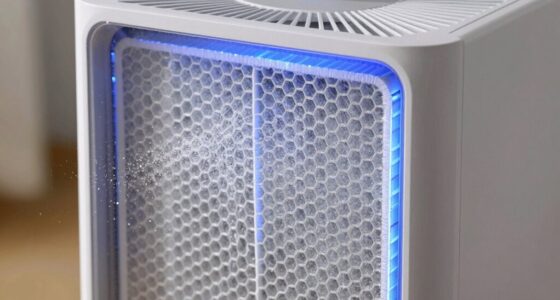
To estimate air changes per hour (ACH) with a portable air cleaner, determine its CADR (clean air delivery rate in CFM) and your room’s volume (length x width x height). Use the formula ACH = (CADR x 60) / room volume. This gives you a simple way to see how quickly your cleaner filters the air. If you want to improve your air quality and meet recommended ACH levels, keep exploring for more detailed guidance.

Get health and wellness essentials delivered free with Prime
- Fast, free delivery on millions of items
- Prime Video, Amazon Music and more included
- Member-only deals all year
Key Takeaways
- Calculate ACH by dividing the cleaner’s CADR (CFM) by the room volume in cubic feet.
- Multiply the result by 60 to convert from air changes per minute to per hour.
- Use the formula: ACH = (CADR × 60) / room volume for a quick estimation.
- Ensure room dimensions are accurate for a reliable ACH estimate.
- Higher ACH values (above 4) indicate more effective air exchange with a portable cleaner.

Have you ever wondered how effective portable air cleaners are at invigorating indoor air? Understanding this can help you make smarter decisions about the air quality in your home or office. One straightforward way to gauge their effectiveness is by estimating air changes per hour (ACH). ACH tells you how many times the cleaner can filter the entire volume of a room within an hour. It’s a simple yet powerful metric that helps you compare different units and determine if your space is receiving adequate filtration.
To start, you’ll need two key pieces of information: the Clean Air Delivery Rate (CADR) of your air cleaner and the volume of your room. The CADR, usually listed on the device’s packaging or manual, indicates how much cleaned air the unit can produce per minute, measured in cubic feet per minute (CFM). The room volume is calculated by multiplying its length, width, and height, giving you the total cubic footage. Once you have these figures, calculating the air changes per hour becomes straightforward.
Calculate ACH by dividing your cleaner’s CADR by room volume and multiplying by 60.
The formula is simple: divide the CADR by the room volume, then multiply by 60. This converts the flow rate from per minute to per hour. Mathematically, it looks like this: ACH = (CADR * 60) / room volume. For example, if your air cleaner has a CADR of 200 CFM and your room measures 20 feet by 15 feet with an 8-foot ceiling, the volume is 2,400 cubic feet. Plugging these numbers into the formula gives ACH = (200 * 60) / 2,400, which simplifies to 12.5. This means your air cleaner can theoretically refresh the air in your room 12.5 times every hour.
Keep in mind, though, that real-world conditions affect these estimates. Factors like furniture, curtains, and even how often the door opens influence actual air exchange rates. Additionally, understanding air exchange rates and how they relate to your needs can help you optimize your setup. Nonetheless, this calculation offers a useful baseline. If you’re aiming for higher air change rates—such as 4 to 6 ACH for allergy relief or better air quality—you can compare your calculated ACH to these targets and decide whether your current cleaner is sufficient or if you need a more powerful model.
portable air purifier with high CADR
As an affiliate, we earn on qualifying purchases.
As an affiliate, we earn on qualifying purchases.
Frequently Asked Questions
How Does Room Size Affect Air Change Calculations?
Room size directly impacts air change calculations because larger rooms require more clean air to achieve the same air exchange rate. When you measure the room’s volume (length x width x height), you see how much air needs to be circulated. A portable cleaner’s effectiveness depends on this volume. As the room gets bigger, you’ll need a more powerful unit or run it longer to maintain good air quality.
Can Portable Cleaners Replace HVAC Systems Entirely?
Portable cleaners can’t replace HVAC systems entirely because they only filter the air in a limited space and don’t provide temperature control or ventilation. While they improve air quality, they lack the capacity to circulate air throughout an entire building or handle large volumes of air efficiently. For thorough climate management and ventilation, you still need a properly designed HVAC system alongside portable air cleaners for ideal indoor air quality.
What Maintenance Is Required for Optimal Performance?
You should regularly clean or replace the portable cleaner’s filters according to the manufacturer’s instructions to maintain efficiency. Keep the unit free of dust and debris, and inspect the fans and vents for obstructions. Make certain the device is plugged in properly and avoid overusing it beyond recommended durations. Periodic checks and proper upkeep will ensure your cleaner performs at its best and continues to improve air quality effectively.
How Long Does It Take to Improve Air Quality?
It typically takes about 30 minutes to a few hours for your air quality to noticeably improve after turning on a portable cleaner. The exact time depends on the room size, the cleaner’s capacity, and the initial air quality. You should see a significant difference within the first hour, especially if you run the cleaner continuously. Keep it running consistently for the best results and to maintain improved air quality.
Are There Safety Concerns With Portable Air Cleaners?
Sure, safety concerns with portable air cleaners? No worries—unless you’re allergic to clean air or forget to change filters. Sometimes, folks worry about ozone emissions or noise, but most modern units are safe if you follow manufacturer instructions. Just keep them away from water and don’t run them 24/7 without breaks. Basically, as long as you use them responsibly, your air stays safe and fresh—no villainous side effects included.
air quality monitor for indoor air
As an affiliate, we earn on qualifying purchases.
As an affiliate, we earn on qualifying purchases.
Conclusion
Now that you know how to estimate air changes with a portable cleaner, you can confidently improve your indoor air quality. Isn’t it worth taking simple steps to create a healthier environment for yourself and those around you? By understanding these calculations, you empower yourself to make smarter choices about ventilation. Remember, clean air isn’t just a luxury—it’s a necessity. So, why not start today and breathe easier knowing you’re taking control of your space?
room size calculator for air purifier
As an affiliate, we earn on qualifying purchases.
As an affiliate, we earn on qualifying purchases.
As an affiliate, we earn on qualifying purchases.
Fall Picks
fall essentials
As an affiliate, we earn on qualifying purchases.